- Seeking Solutions for the Successful and Leading Implementation of the Digital New Deal
The Korea Evaluation Institute of Industrial Technology (KEIT) and the Institute for Information & Communications Technology Planning & Evaluation (IITP), leading national industrial technology and information and communication technology (ICT) research and development (R&D), jointly held a print roundtable on the 17th presenting the vision of future industries transformed through the government’s Korean New Deal policy’s core axis, the ‘Digital New Deal.’
Under the theme ‘Korea’s Future Strategy, Conditions for the Digital New Deal,’ the roundtable explored solutions for the successful and leading implementation of the Digital New Deal based on three presentations: ▶ Digital New Deal and R&D ▶ Digital New Deal Strategy and Effects ▶ Vision of the Digital New Deal.
KEIT and IITP initially planned an in-person roundtable with experts from industry, academia, and research institutes, but due to the persistent spread of the third wave of COVID-19, they switched to a print roundtable format to comply with government quarantine guidelines.
The roundtable included participants such as Jeong Yang-ho, President of KEIT; Seok Je-bum, President of IITP; Kim Young-sam, President of the Korea Electronics Technology Institute (KETI); Oh Sang-rok, Head of the Quarantine Robot Business Group at the Korea Institute of Science and Technology (KIST); Hong Sung-soo, Professor of Electrical and Information Engineering at Seoul National University College of Engineering; Choi Yang-oh, Advisor at Hyundai Research Institute; and Wang Seon-taek, Policy Committee Member at Yeo Si-jae.
The roundtable proceeded with written responses from each institution and experts to questions on the three presentations: ▶ Digital New Deal and R&D ▶ Digital New Deal Strategy and Effects ▶ Vision of the Digital New Deal.
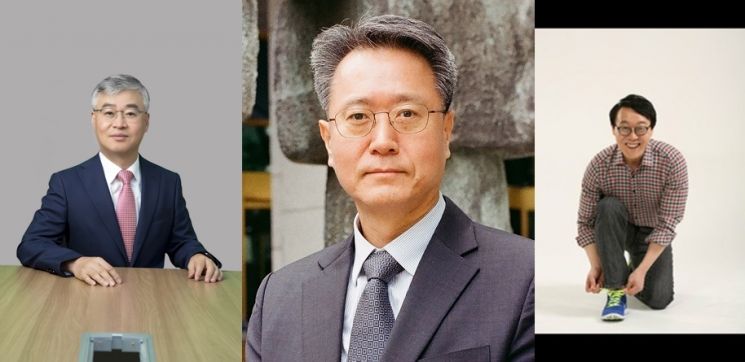 (From left) Hong Seong-su, Professor, Department of Electrical and Computer Engineering, College of Engineering, Seoul National University; Wang Seon-taek, Policy Committee Member, Yeosijae; Choi Yang-o, Advisor, Hyundai Research Institute
Digital New Deal and R&D... Role and Necessity of R&D
The first presentation, ‘Digital New Deal and R&D,’ focused on the role and necessity of R&D.
Jeong Yang-ho, President of KEIT, stated, “The core of the Digital New Deal is D.N.A, that is, Data, Network, and AI technologies integrated into all industrial sectors to upgrade our technological level by one step.” He added, “By applying DNA technologies to key industries, we aim to revitalize industries such as wearables and care robots, and by integrating them into new industrial fields, we seek to create future growth industries like autonomous driving and electric hydrogen vehicles.”
Seok Je-bum, President of IITP, explained, “The Digital New Deal, a pillar of the Korean New Deal, is based on the ICT industry and actively responds to the transition to a data economy by strengthening the D.N.A. ecosystem, digitally transforming educational infrastructure, and fostering non-face-to-face industries to create jobs and lead the digital transformation.”
He further added, “Together with the Ministry of Science and ICT, we secured a budget of 510 billion KRW for ICT R&D projects in the Digital New Deal sector in 2021, a 38% increase compared to this year, to strengthen our role as the agency responsible for the Digital New Deal.”
Wang Seon-taek, Policy Committee Member at Yeo Si-jae, noted, “Korea’s R&D scale is among the world’s highest, with a success rate of about 98% in research and development projects, which is very high.” However, he pointed out, “There are still many shortcomings. Research productivity is relatively low; Korea’s average is about 3.05%, which is significantly lower than 10% at U.S. public research institutes. Therefore, a control tower organization responsible for national R&D oversight and planning functions is necessary.”
 (From left) Jeong Yang-ho, President of Korea Evaluation Institute of Industrial Technology (KEIT); Seok Je-bum, President of Institute for Information & Communications Technology Planning & Evaluation (IITP); Kim Young-sam, President of Korea Electronics Technology Institute (KETI); Oh Sang-rok, Head of Quarantine Robot Project Group at Korea Institute of Science and Technology (KIST)
Digital New Deal Strategy and Effects... Institutional Strategies and Economic & Job Effects
The second presentation, ‘Digital New Deal Strategy and Effects,’ covered the main strategies of each institution related to the New Deal and the economic and job effects.
Regarding the main strategies of each institution, explanations were given by Jeong Yang-ho, Seok Je-bum, and Kim Young-sam, President of KETI.
Jeong Yang-ho said, “KEIT is promoting the Digital New Deal policy from two perspectives. First, we are building a Data Dam during the work process to digitally transform the planning and evaluation management of R&D projects. We are developing the R&D Planning Support System (ROME) and the evaluation system (STELLA) incorporating big data and AI technologies.” He added, “ROME operates as an open platform to enhance the public nature of R&D information and act as a catalyst for activating exchange and cooperation among researchers. STELLA will change the evaluation method, which currently relies on the experience and knowledge of existing evaluators, into a data-based evaluation environment, overcoming constraints of time (synchronous/asynchronous) and space (face-to-face/non-face-to-face).”
He continued, “Second, we are discovering and strengthening support for industrial technology R&D projects that integrate DNA technologies into existing industries. To this end, we selected three major strategies and eight projects, and plan to expand the New Deal-related budget from 263 billion KRW in 2020 to about 390 billion KRW in 2021.”
Jeong also cited KEIT’s Digital New Deal R&D achievements, saying, “We are already leading international standards in the K-quarantine R&D field. The Ministry of Trade, Industry and Energy, the National Institute of Technology and Standards, and KEIT jointly established a roadmap for 18 types of the 3T K-quarantine model consisting of Test, Trace, and Treat. Among them, standard operating procedures for Walk-Thru and Drive-Thru screening clinics have already been adopted as international standards.”
Seok Je-bum said, “IITP is promoting the non-face-to-face business digital innovation technology development project (17.51 billion KRW) to support R&D and commercialization of core non-face-to-face technologies.” He added, “We are also running two projects (totaling 44.247 billion KRW), including the Innovation Academy (26.737 billion KRW), to nurture software talent driving the digital economy.”
Kim Young-sam said, “KETI is helping the digital transformation of industrial sites using D.N.A. The demo factory at the Ansan Smart Manufacturing Innovation Center operated by KETI is the world’s first 5G-based smart manufacturing testbed, where last year’s manufacturing renaissance vision declaration ceremony was held.” He added, “So far, seven companies including S Corporation have benchmarked the demo factory to establish smart factories, and with KETI’s support, productivity improvement, defect rate reduction, and process intelligence have been achieved.”
Professor Hong Sung-soo of Seoul National University presented prospects on the job effects of the government’s Digital New Deal investment strategy.
Professor Hong said, “Looking at the economic and job effects of the Digital New Deal: ▶ In 2020, the initial phase of the digital transformation, a total project cost of 63 trillion KRW was invested for crisis recovery and immediately implementable projects; ▶ In 2021-2022, the stepping stone phase, cumulative total project costs of 677 trillion KRW will be invested to create new growth paths, estimated to create 887,000 jobs; ▶ In 2023-2025, the consolidation phase, cumulative total project costs of 160 trillion KRW will be invested to complement and stabilize new growth paths, creating 1.9 million jobs.”
Oh Sang-rok, Head of the Quarantine Robot Business Group at KIST, emphasized fostering the robot industry closely linked to the Digital New Deal and forecasted its economic effects.
Oh said, “According to the government’s goal to become one of the world’s top four robot powers by 2023, the domestic robot market size is expected to expand, estimated to increase from 5.8 trillion KRW in 2018 to 20 trillion KRW in 2025 based on sales.”
Vision of the Digital New Deal... Suggestions for Successful Implementation and Future Outlook
The final third presentation, ‘Vision of the Digital New Deal,’ presented suggestions for the successful implementation of the New Deal policy and the future of the Digital New Deal.
First, Jeong Yang-ho emphasized the importance of communication and collaboration for the successful implementation of the Digital New Deal.
Jeong said, “The core of the Digital New Deal is the Data Dam. During the construction and operation of the Data Dam, the spirit of openness, communication, collaboration, and sharing must be upheld. Through collaboration among related public institutions, relevant information should flow smoothly and be utilized by opening it to the private sector, operating in a way that creates new jobs.” He added, “Just as the value of a dam increases when its water flows to be used as drinking water, agricultural water, public water, and power sources, the openness and communication of related information through the Data Dam are most important. Also, warm policy consideration for sectors where digital transformation is difficult or slow is necessary.”
Following this, suggestions were made by Seok Je-bum, Kim Young-sam, Oh Sang-rok, and Choi Yang-oh.
Seok said, “The role of core technologies that can enhance the ripple effect of digital innovation is crucial. To respond to changes caused by COVID-19, we are actively promoting the development of core non-face-to-face technologies needed for remote education, work, and medical services, while focusing on future core technologies such as 6G, next-generation AI, intelligent semiconductors, and quantum information communication.”
Kim said, “Along with D.N.A., it is necessary to focus on developing materials and components technologies. If data corresponds to information entering through the five senses, network to nerves, and AI to the brain’s ‘function’ that integrates them, then materials and components technologies correspond to the ‘organs’ that enable the ‘function’ to be well implemented. I hope that through organic joint development between D.N.A. technologies and related materials and components technologies, the successful implementation of the Digital New Deal can be expected.”
Oh said, “The Digital New Deal is undoubtedly a strategy to leap forward as a leading country, but to successfully implement it, there are clearly issues that the government and private sector must jointly consider and solve. Institutional reforms such as regulatory innovation and improvement are necessary, and conflicts may arise between emerging industries through non-face-to-face methods and existing industries. Establishing procedures to reasonably mediate and execute conflicts between new and old industries is urgent.”
Advisor Choi said, “Recently, the government has firmly recognized that data accumulation and recreation determine national future competitiveness and is fostering the foundation for data industry development through the enactment of the Basic Data Act, which is highly welcomed.” He proposed additional policy tasks such as reorganizing digital governance (establishing a Data Agency, appointing a Digital Czar), pursuing a Free Data Trade Agreement (FDTA), and establishing data finance companies and data exchanges.
Professor Hong Sung-soo forecasted the future of the Digital New Deal.
Hong said, “The Digital New Deal policy means building national industrial infrastructure in various fields through digital technology to create a cyclical value chain and generate numerous humanistic jobs within that value chain.” He diagnosed, “Ultimately, it is a very innovative and effective future strategy that pursues two goals: creating new markets and creating jobs.”
He added, “In this process, alongside the government’s role, active participation and roles of companies are essential. Companies must continue service development competition with ethics and responsibility. If a well-planned Digital New Deal policy is steadily implemented on this foundation, the future created will be very bright.”
This print roundtable explored the importance of the Digital New Deal and the directions of each institution’s initiatives. The success or failure will depend on how much cooperation is achieved among companies, government, private sectors, and domestic and international partners. Jeong Yang-ho, President of KEIT, and Seok Je-bum, President of IITP, who arranged today’s meeting, found it meaningful to discuss the direction of the Digital New Deal and expressed their intention to strive for the successful promotion of the Digital New Deal through cooperation between the two institutions in the future.
© The Asia Business Daily(www.asiae.co.kr). All rights reserved.
![User Who Sold Erroneously Deposited Bitcoins to Repay Debt and Fund Entertainment... What Did the Supreme Court Decide in 2021? [Legal Issue Check]](https://cwcontent.asiae.co.kr/asiaresize/183/2026020910431234020_1770601391.png)

















