UNIST Professor Jongwon Lee's Team Converts Long-Wavelength Mid-Infrared to Mid-Wavelength Mid-Infrared
Selective Light Wavelength Change According to Original Polarization Rotation Direction of Light Reflected on Surface

[Asia Economy Yeongnam Reporting Headquarters, Reporter Kim Yong-woo] A technology has been developed that utilizes light by changing its wavelength after encountering a small and thin flat structure called a ‘metasurface.’
A new technology has been developed that converts long-wavelength mid-infrared laser beams into mid-wavelength mid-infrared beams.
Mid-infrared is a type of infrared light invisible to the human eye and is used to analyze the components of harmful substances.
The research team led by Professor Lee Jong-won of the Department of Electrical and Electronic Engineering at Ulsan National Institute of Science and Technology (UNIST, President Lee Yong-hoon) developed a new metasurface that selectively changes the wavelength of incident light depending on the rotation direction of the circular polarization.
A metasurface is a planar structure densely arranged on the surface with artificial structures called ‘meta-atoms,’ which are much smaller than the wavelength of light.
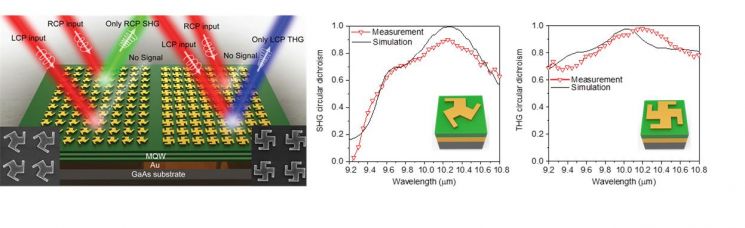
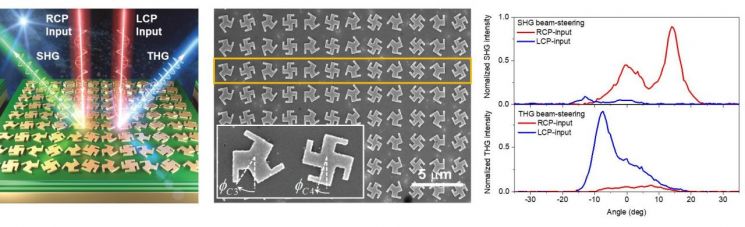
Light incident on the developed metasurface is converted into new wavelengths of light whose wavelengths are reduced to 1/2 (right circular polarization) or 1/3 (left circular polarization) depending on the rotation direction of the circular polarization.
By utilizing this characteristic, commercially available long-wavelength mid-infrared laser light can be directed onto the metasurface to easily obtain light in the shorter wavelength mid-wavelength mid-infrared region.
Absorption spectroscopy using mid-infrared has the highest accuracy and identification capability among material analysis methods. Absorption spectroscopy analyzes components by absorbing light into the material.
However, existing laser light sources that emit light in the mid-infrared region are made by stacking semiconductor layers thousands of nanometers thick, making the manufacturing process complicated.
Additionally, the light sources are expensive, and a single light source can only produce a portion of the entire mid-infrared spectrum.
Using the metasurface developed by the research team, it is possible to generate light covering most of the mid-infrared range (3~12μm) with a single mid-infrared laser.
The right circularly polarized component of commercially available 9-12μm (micrometer, 10^-6 m) tunable wavelength mid-infrared laser light can produce light in the 4.5~6μm wavelength band, and the left circularly polarized component can produce light in the 3~4μm wavelength band.
Professor Lee Jong-won explained, “Through this research, we confirmed that using a commercially available mid-infrared laser and a single metasurface can achieve the effect of having multiple mid-infrared lasers.”
Metasurfaces that selectively change the frequency or wavelength of light according to the circular polarization direction (nonlinear chiral metasurfaces) have had problems with low nonlinear circular dichroism, which distinguishes circular polarization directions to induce wavelength conversion, and low optical conversion efficiency.
The metasurface developed this time has nonlinear circular dichroism close to the maximum value of 1 simultaneously for two types of wavelength conversion (1/2 and 1/3 wavelength conversion), and its efficiency has improved more than 100 times compared to existing ones.
Daek Ik Kim, a doctoral researcher in the Department of Electrical and Electronic Engineering at UNIST and the first author, explained, “This is the first study to simultaneously solve the problems of low nonlinear circular dichroism and efficiency of existing nonlinear chiral metasurfaces.”
The metasurface developed by the research team consists of meta-atoms with two types of unique geometric structures (broken mirror inversion symmetry structures) arranged on a very thin semiconductor (multiple quantum wells) composed of several layers.
An advantage is that the phase of light can also be changed as desired by rotating these meta-atoms. Because of this, light can be focused or dispersed without thick lenses. It also enables the implementation of ultra-thin planar optical devices like cameras.
Professor Lee said, “The developed metasurface can be applied not only to broadband mid-infrared light sources but also to various optical devices such as high-efficiency nonlinear holograms, ultra-sensitive chiral sensors, and nonlinear optical information processing devices.”
This research was published in the world-renowned journal Nano Letters on November 11. The research was supported by the Korea Research Foundation’s Mid-career Researcher Support Program and the Nano-Materials Technology Development Project.
© The Asia Business Daily(www.asiae.co.kr). All rights reserved.



















