Everyday Life of Koreans in the COVID Era Through App Usage
#Kim Young-sik (alias) starts his day by checking the items delivered to his door early in the morning. The box is filled with daily necessities he ordered yesterday. Working from home, he habitually opens a delivery app as lunchtime approaches. Recently, the number of restaurants listed on delivery apps has increased significantly, offering a wider variety of menu options. After finishing work, he begins tidying up his home. Unused items around the house keep catching his eye. He decided to list these items on a secondhand trading app for someone else to use.
This is the everyday life of an ordinary Korean in the year marked by the novel coronavirus infection (COVID-19). Buying necessary goods through e-commerce and solving meals via delivery apps have become common parts of daily life. As people spend more time at home, secondhand trading has also emerged as a new trend. Users of representative services such as Coupang, Baemin (Baedal Minjok), and Danggeun Market have shown remarkable growth this year.
According to WiseApp, an app analytics service, the smartphone apps most used by Koreans in November this year with the highest year-on-year user growth were Danggeun Market, Coupang, and Baemin. This is based on a sample survey of Korean smartphone users aged 10 and above conducted by Ideaware, a big data company that operates WiseApp.
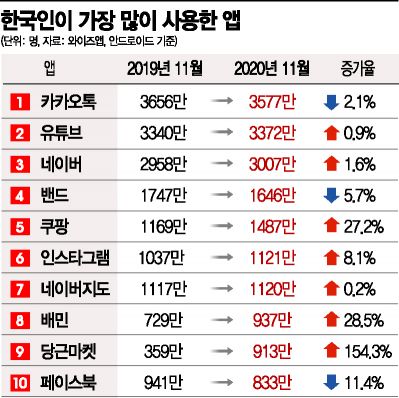
◆Bought from Coupang, Ate with Baemin=The survey results show that, based on Android smartphones, the app with the most users in November was KakaoTalk, used by 35.77 million people. It was followed by YouTube (33.72 million) and Naver (30.07 million). However, these apps also ranked 1st to 3rd last year, and their user growth this year was not significant. KakaoTalk, ranked first, had 36.56 million users in November last year, showing a slight decrease this year. YouTube and Naver’s growth rates were only 0.9% and 1.6%, respectively.
In contrast, Coupang and Baemin showed remarkable user growth this year. Coupang’s monthly users increased from 11.69 million in November last year to 14.87 million this year, a 27% growth rate. Baemin also grew from 7.29 million to 9.37 million users, a 28% increase. Among the top 10 most used apps by Koreans, only Coupang, Baemin, and Danggeun Market showed growth rates above 20%. This indicates that many people have entered the contactless consumption market this year, buying goods from Coupang and ordering food through Baemin due to COVID-19. Professor Yoo Byung-jun of Seoul National University’s Business School explained, “Consumers are quickly adapting to changes in the contactless era. With social distancing and longer time spent at home, a new lifestyle is emerging. The share of online e-commerce is rapidly increasing.”
◆Awakening to Secondhand Trading=The rise of the secondhand trading platform Danggeun Market is also notable. Danggeun Market’s users increased from 3.59 million in November last year to 9.13 million this year, a 154% growth in just one year. The increase of 5.54 million users is the largest among the top 10 most used apps by Koreans this year. This survey is based on Android smartphones, and including iPhones (iOS), Danggeun Market’s users exceed 10 million. Kim Yong-hyun, co-CEO of Danggeun Market, said, “The connections among local residents that started with secondhand trading have grown into a regional lifestyle exchange platform where 10 million users communicate. We will continue to enhance services focused on ‘connection’ and create new value and vision as a local community.”
The leap of Danggeun Market is evidence that secondhand trading has emerged as a new consumer trend this year. Another secondhand trading platform, Bungaejangter, recorded 11 million transactions by November this year, an approximately 11% increase compared to the same period last year, with transaction amounts rising 19% to 1.1 trillion won. An industry insider analyzed, “Due to the economic downturn caused by COVID-19, many people are paying attention to reasonable consumption through secondhand trading. The increase in ‘stay-at-home’ time has also led to more people tidying their homes, which contributed to the rise in secondhand items and market activation.”
© The Asia Business Daily(www.asiae.co.kr). All rights reserved.

















