Urgent Review by Economic Experts
KDI Economic Outlook Suggests "Need to Control Debt Growth Rate"
Josaeyeon Highlights "Burden of Continuous Welfare Spending Increase"
Merkel States "National Debt Must Be Repaid"... Also Points Out "We Need to Be Honest Too"
[Asia Economy Reporter Jang Sehee] As government spending to mitigate the shock of the novel coronavirus infection (COVID-19) has significantly increased, discussions on tax hikes are becoming inevitable in many places. With the start of vaccination and the approach of the 'post-COVID' era, tax increases have been raised as one of the arguments for proactive measures. Although the government maintains that it is premature since the COVID-19 crisis is still ongoing, there are also voices suggesting that specific guidelines should be presented, as missing the timing could lead to a heavier burden.
Recently, the Korea Development Institute (KDI) has drawn attention regarding tax hikes. In its economic outlook recommendations for the second half of 2020 released last month, KDI stated, "As the economy recovers in the future, it is necessary to prepare measures in advance to strongly control the pace of national debt increase," and "It is necessary to discuss securing fiscal revenue through tax increases in the long term." The necessity of tax hikes was not mentioned in last year's recommendations but was newly reflected this year, expressing concern over the rapidly increasing national debt.
Jung Kyu-cheol, head of the Economic Outlook Office at KDI, recently said in an interview, "As the aging population causes growth rates to decline, revenues will naturally decrease," and "Since there are limits to reducing expenditures, tax increase measures to secure revenue must be discussed." He explained, "Since it takes several years until actual tax hikes, after overcoming COVID-19, tax hike discussions should be intensified in earnest."
Another government-funded research institute, the Korea Institute of Public Finance, also agrees with this stance. Kim Yoo-chan, president of the Korea Institute of Public Finance, stated, "As welfare expenditures continue to increase due to aging and other factors, the government's total expenditures are also rising," and "An appropriate level of tax increase should be implemented to create a structure where incoming revenue matches outgoing expenditures."
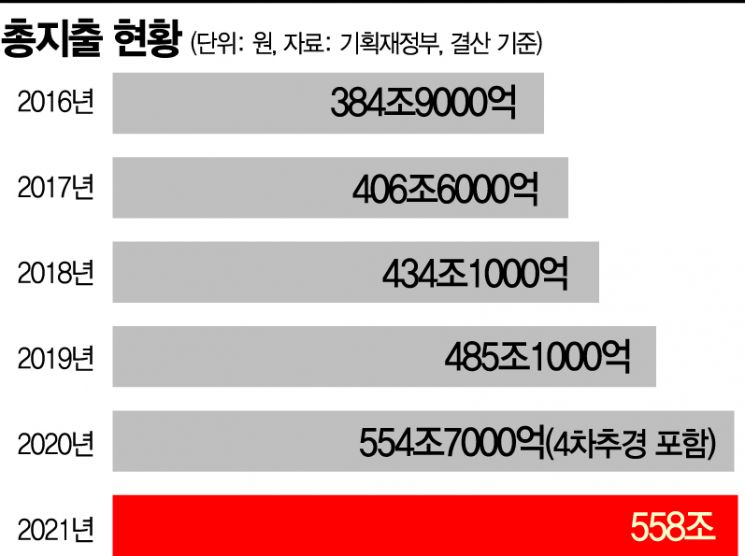
According to the Ministry of Economy and Finance, next year's total expenditure is expected to be 558 trillion won, an increase of 45.7 trillion won compared to the previous year. Especially this year, with four supplementary budgets, 554.7 trillion won has already been spent. Next year's national debt will reach 956 trillion won, pushing the debt-to-GDP ratio up to 47.3%.
As total expenditures balloon like a snowball, there are voices within the government suggesting the need to consider measures to secure tax revenue. A Ministry of Economy and Finance official said, "We agree on the necessity," adding, "To move toward moderate burden and moderate welfare, we need to carefully consider how much funding is required."
While everyone agrees on the necessity of 'tax increases,' the government and political circles, who should lead the initiative, are reluctant to publicly mention it. They find it burdensome to be at the center of all criticism and instead emphasize building public consensus. Hong Nam-ki, Deputy Prime Minister and Minister of Economy and Finance, said, "The most important thing regarding tax increases is forming public consensus," and added, "I think tax increases can only be realized if there is public consensus."
Experts are paying attention to German Chancellor Angela Merkel's candid confession. Earlier this month, while promoting expanded fiscal support, Chancellor Merkel sought public understanding by stating, "From 2023, we must start repaying national debt." She dispelled concerns about deteriorating fiscal soundness due to fiscal expansion by presenting a concrete exit strategy.
Professor Yoo Jae-won of Konkuk University's Department of Economics said, "Considering the presidential election the year after next, there will be a desire to spend more money," and added, "Therefore, tax increases are even more necessary. The government needs to openly state that it is necessary."
© The Asia Business Daily(www.asiae.co.kr). All rights reserved.
![User Who Sold Erroneously Deposited Bitcoins to Repay Debt and Fund Entertainment... What Did the Supreme Court Decide in 2021? [Legal Issue Check]](https://cwcontent.asiae.co.kr/asiaresize/183/2026020910431234020_1770601391.png)
















