Store Closed Due to False Broadcast by YouTuber... Owner "It's Unfair"
"Please Create Laws to Prevent False Broadcast Damage" Cheong Petition
Some YouTubers Continue Manipulated Broadcasts for Profit
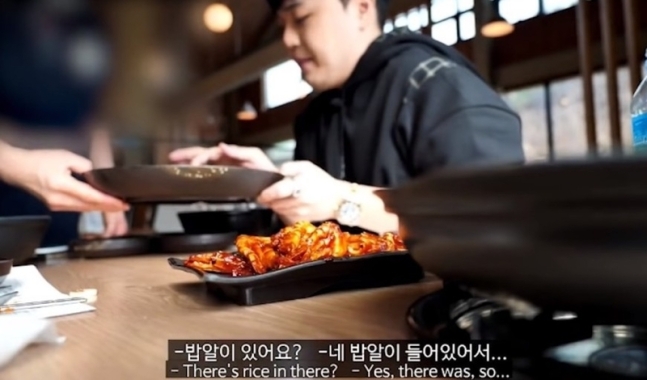 A broadcast video by YouTuber Hayan Tree raising suspicions of food reuse at a soy sauce marinated crab restaurant. Photo by YouTube channel 'Hayan Tree' screenshot
[Asia Economy Reporter Heo Midam] "We had to stop business because of a YouTuber spreading false information," "Please stop the tyranny of YouTubers."
Recently, some YouTubers have been creating content based on false information or 'fake news' for the purpose of sponsorships or advertising revenue, causing social problems.
In one case, a restaurant was driven to the point of closing its doors entirely due to such YouTubers. Experts pointed out that the competition in the one-person media market has overheated, leading YouTubers to seek sensational content.
Recently, a restaurant owner appealed through a Blue House national petition, claiming unfairness after having to suspend business due to a YouTuber's false broadcast.
On the 15th, the petitioner posted a message titled "Please create laws and systems so that self-employed people do not suffer damage from YouTubers' false broadcasts," stating that they run a soy sauce marinated crab restaurant and were forced to close due to the spread of false information by a YouTuber.
The owner said, "One day, a popular food YouTuber suddenly visited and posted a video of our store titled 'All-you-can-eat restaurant reusing food,' which quickly reached 1 million views," adding, "Our restaurant was stigmatized as a place that reuses food."
He continued, "Our store was flooded with countless abusive calls, complaints, and ridicule, with obscene content that cannot be spoken aloud. Indiscriminate malicious comments also spread on major portal sites and various communities. Eventually, due to mental distress, we had to suspend business," he lamented.
The owner further stated, "We overcame COVID-19 and operated the store diligently, but now we have to close it because of one false video by a YouTuber. This is extremely unfair," urging, "Please establish laws and systems so that self-employed people can focus on their business with peace of mind." As of 9:30 a.m. on the 17th, the petition had gained about 27,309 supporters.
Previously, YouTuber 'Hayan Tree,' who has 690,000 subscribers, raised suspicions of food reuse by showing rice grains in refilled marinated crab at an all-you-can-eat soy sauce marinated crab restaurant in Daegu. The video he released also showed the restaurant's name on the menu board.
However, it was later confirmed that the rice grains were from his own meal. Hayan Tree went to the restaurant to film an apology video, but the restaurant had already closed.
In a recent video, Hayan Tree apologized, saying, "I should have presented the video with accurate facts and stories, but I sincerely apologize for my ignorance in not considering my influence," but it was reported that the restaurant suffered severe damage.
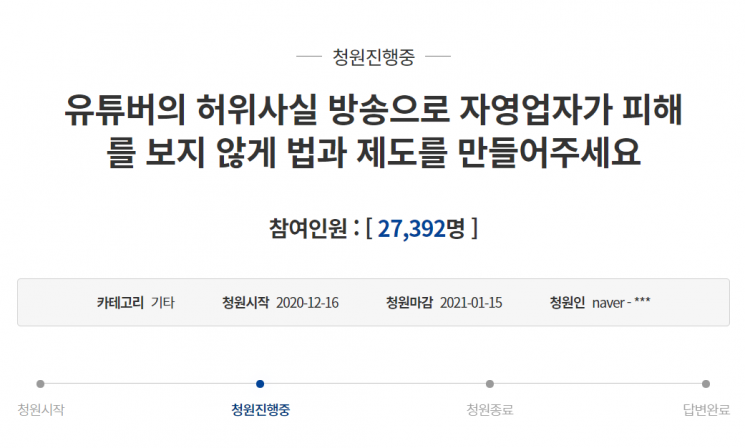 Recently, a restaurant owner posted a plea on the Blue House National Petition Board expressing frustration over false broadcasts by a YouTuber. Photo by Blue House National Petition Board capture.
This is not the only case where self-employed people have suffered damage due to YouTubers' reckless accusations.
YouTuber 'Song Daeik' caused controversy in June by claiming that a delivery person secretly ate the food he ordered. In the video, he showed a piece of chicken with what looked like bite marks and claimed that the pizza delivered was two slices short of the ordered amount. However, this was revealed to be a staged broadcast.
He was even sued by the company involved and, amid the controversy, posted a video titled "I'm Sorry," stating, "The previous video was entirely staged. It happened because of my greed without any excuse," and apologized.
◆ Spreading false information and staged broadcasts... ultimately illegal acts for profit
YouTubers produce sensational content because it is linked to advertising revenue. To monetize a YouTube channel, certain conditions must be met, such as having over 1,000 subscribers and more than 4,000 hours of annual watch time.
Once these conditions are met, ads are attached to video content, and YouTubers earn revenue. Although the revenue rate varies depending on video length and audience, it is known that about $1 (approximately 1,090 KRW) is earned per 1,000 views.
The problem is that some YouTubers indiscriminately spread false information or even stage broadcasts to earn such revenue. Especially for YouTubers with many subscribers, their influence is enormous, causing unavoidable social confusion.
It is practically difficult for self-employed restaurant owners who decide to close their businesses or whose reputations are damaged overnight to recover. This is why strong punishment is needed for YouTubers who produce fake broadcasts for money.
 YouTuber Song Dae-ik is apologizing for the manipulation controversy. Photo by YouTube channel 'Song Dae-ik' screenshot.
◆ Guidelines exist to regulate 'fake broadcasts,' but more detailed systems are needed
Animal care YouTuber 'Gapsu Farm,' who once attracted attention with over 500,000 subscribers, also caused a major scandal when manipulation was exposed. This YouTuber was loved for adopting and raising abandoned cats, but in May, it was revealed through a friend's exposure that the pets were actually purchased from a pet shop.
Additionally, YouTuber 'I'm Tourette,' who gained popularity by sharing daily life while claiming to suffer from tic disorder (Tourette syndrome) last December and gained nearly 400,000 subscribers in a month, apologized after it was revealed that the behavior in the videos was exaggerated acting.
Some argue that the continued occurrence of staged broadcasts despite ongoing controversies is because YouTubers are not properly punished. According to YouTube's own 'Community Guidelines,' YouTube removes content related to spam and deceptive practices, sensitive content (excessive exposure and sexual content), violent or dangerous content, and regulated goods (such as firearms). However, it is difficult to regulate staged broadcasts because their harmfulness is not intuitively judged.
Experts diagnose that such incidents have occurred due to overheated competition in the YouTube market to attract subscribers. They also suggest that more proactive institutional improvements are needed to prevent such situations.
Professor Kwak Geumju of Seoul National University's Department of Psychology pointed out, "Because the YouTube market is competitive, YouTubers tend to look for increasingly unique or bizarre topics." She added, "In the process, excessive competitiveness can lead to a lack of morality," analyzing, "Also, YouTubers tend to feel satisfaction and pleasure the more views they get, which can lead to the illusion that they are extraordinary people." She emphasized, "Individuals like YouTubers need to have ethical maturity, and institutional measures to manage this are also necessary."
© The Asia Business Daily(www.asiae.co.kr). All rights reserved.
![User Who Sold Erroneously Deposited Bitcoins to Repay Debt and Fund Entertainment... What Did the Supreme Court Decide in 2021? [Legal Issue Check]](https://cwcontent.asiae.co.kr/asiaresize/183/2026020910431234020_1770601391.png)

















