Government: "Strengthening auditor independence reduces speculative capital interference"
Does not clarify on business sector's request for '1-year suspension of 3% rule'
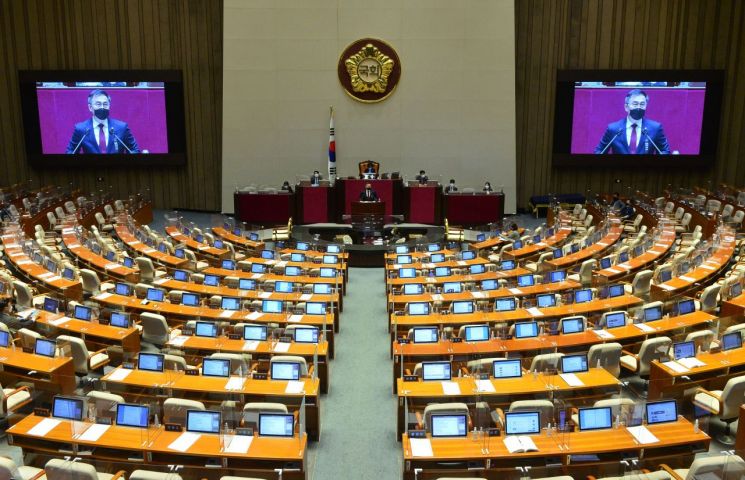
[Asia Economy Reporter Moon Chaeseok] The government once again emphasized that the 'Fair Economy 3 Acts (Amendments to the Commercial Act and the Fair Trade Act, and the enactment of the Financial Complex Corporate Group Supervision Act)' forcibly passed by the National Assembly will contribute to enhancing management transparency and reducing the scope for interference by foreign speculative capital. Despite the fact that an American activist fund announced a large-scale offensive against Korean companies just six days after the law was passed, the government reiterated its existing stance that "if management becomes transparent, speculative capital will not be able to attack."
On the 16th at 11 a.m., the government held a 'Joint Briefing on the Fair Economy 3 Acts' at the Seoul Government Complex and stated this. It reiterated the legislative justification of "preventing major shareholder tyranny and protecting minority shareholder rights." The outlook that it will boost corporate trust and revitalize the economy remained unchanged.
No mention of business community's request for "1-year grace period on the '3% rule'"

Regarding the 'separate election of audit committee members,' which attracted the most attention among the amendments to the Commercial Act, the government said, "It will secure the independence of audit committee members, thereby enhancing the soundness and transparency of management, as well as operational efficiency in appointing audit committee members and auditors."
The amended law requires listed companies to elect at least one audit committee member separately from directors, and limits the voting rights of major shareholders to 3% in this election. However, when appointing an outside director as an auditor, the voting rights of major shareholders and their special related parties are not aggregated, and individual 3% voting rights are recognized.
The business community has argued that once the amended law is passed, foreign funds and hostile companies will not be able to properly block management rights. They claim that because of a structure where major shareholders and hostile forces can unite to secure more than 20% of voting rights, corporate defense rights may weaken.
The day before, the American activist fund Whitebox Advisors claimed, "LG Group's spin-off decision negatively affects corporate governance," and "Despite clearly better alternatives, the board unanimously approved a plan that sacrifices minority shareholders to resolve family succession issues." This was just six days after the law was passed in the regular National Assembly session on the 9th.
The government said, "If management transparency increases through the separate election of audit committee members, the so-called 'foreign speculative capital' will have no room to interfere."
A government official explained, "The content related to the 3% rule will be promulgated next month, and since it has not yet been promulgated, it is questionable whether speculative capital launched an attack immediately after the law changed," adding, "It is difficult to assert now whether speculative capital attacks will actually decrease as corporate management transparency increases after the amendment, and it is cautious to link the incident yesterday (Whitebox Advisors' warning to LG) with today's briefing."
The government did not provide a clear response to the business community's request for a one-year grace period on the '3% rule.' Earlier, on the 14th, four economic organizations?the Korea Employers Federation, Korea Federation of SMEs, Korea Federation of Medium-sized Enterprises, and Korea Listed Companies Association?issued a joint statement requesting at least a one-year delay in the enforcement of the Commercial Act amendments including the 3% rule.
The 'multiple derivative suit system' in the Commercial Act amendment will also proceed as planned. This system allows shareholders of a parent company to file derivative suits against directors of subsidiaries if the subsidiary suffers damage due to neglect of duty, etc.
The business community opposed this, citing concerns that ▲ speculative forces could buy shares cheaply and file lawsuits, and ▲ the burden on holding companies could increase.
The government said, "Since the compensation amount in multiple derivative suits belongs to the subsidiary as a public interest lawsuit, the possibility of frivolous lawsuits is not high," and "Compensating for damages caused by illegal acts of subsidiary directors is not necessarily advantageous only to foreign funds."
Expanding regulations on private interest diversion while repeatedly stating "normal internal transactions are allowed"
Regarding the major theme of the Fair Trade Act amendment, 'regulation of conglomerate private interest diversion,' the government repeatedly stated, "We will effectively monitor acts that unfairly allocate wealth to the controlling family by eliminating regulatory blind spots."
The amended law expands the criteria for regulating private interest diversion by controlling families. It strengthens regulations on preferential transactions. The current threshold of controlling family shareholding is unified to 20% for both listed and unlisted companies, down from 30% for listed and 20% for unlisted companies, and subsidiaries where these companies hold more than 50% of shares are also included.
The number of companies subject to private interest diversion regulation will increase from 210 to 598. Among the top 10 groups, the number will rise from 29 to 104. From the end of next year when the law is enforced, 24 companies including Samsung Life Insurance, Hyundai Glovis, SK, and Hanwha will be subject to internal transaction regulations.
Because of this, the business community has appealed that if share sales continue after the law amendment, it could be difficult to maintain corporate competitiveness and management rights.
The government responded, "Private interest diversion regulation governs unfair internal transactions and does not prohibit normal internal transactions, nor does it require the controlling family to sell shares." This is a continuation of explanations consistently emphasized by the Fair Trade Commission.
Regarding the limited allowance for general holding companies to own corporate venture capital (CVC), the government conveyed a fundamental message that "it will attract abundant retained earnings within companies to productive sectors such as ventures, thereby promoting a vibrant venture ecosystem."
Under current law, venture capital (VC) is classified as a financial company, so holding companies cannot own CVCs because general holding companies under the Fair Trade Act cannot have financial or insurance companies as subsidiaries.
Although the government presented CVC as a kind of incentive, the business community argued that ▲ large companies are prohibited from investing in companies of the controlling family or affiliates, and ▲ overseas investment is limited to 20% of total CVC assets, which will diminish the effect.
The government did not provide a specific message regarding the limited effect of CVCs. However, it only stated, "We have meticulously prepared safeguards at each stage such as CVC establishment, fundraising, investment, and recovery to prevent excessive control expansion by general holding companies or misuse for private interest diversion by controlling families."
'Complaints about 'overlapping regulations' but 'No'... Only urging 'strengthened risk management'
Regarding complaints that the Financial Group Supervision Act constitutes 'overlapping regulations' in addition to sector-specific regulations, the government said, "The risks regulated and supervised by individual sector laws are different." It conveyed a message that financial markets will stabilize through strengthened risk management.
The core of the law is to integrate supervision of blind spots in regulating non-holding type financial complex corporate groups. It applies to corporate groups ▲ whose affiliated financial companies engage in two or more financial businesses and ▲ whose total assets of affiliated financial companies exceed 5 trillion won. Six groups including Samsung, Hyundai Motor, Hanwha, Mirae Asset, Kyobo, and DB fall under this.
The group's representative financial company must oversee and submit all tasks such as internal control, risk management, soundness management, reporting, and disclosure, and establish and prepare group internal control and risk management policies. It must organize a consultative body with affiliated financial companies to manage internal control.
The financial sector complains, "Soundness regulations are already applied by sector such as insurance, banking, and cards, so group-level regulations are additional."
The government explained, "The bill does not manage the soundness and capital adequacy of individual financial companies like sector-specific supervision, but supervises the group's capital adequacy due to mutual and circular investments among affiliated financial companies and whether risks of specific affiliates are transmitted to the group."
It added, "This law does not include any provisions imposing obligations on non-financial affiliates or supervising non-financial affiliates by financial authorities."
The government said, "The amendment to the Commercial Act will enable reasonable decision-making by individual companies, the amendment to the Fair Trade Act will block abuse of economic power and expansion of indirect control by corporate groups, and the enactment of the Financial Group Supervision Act will enhance transparency, accountability in corporate management, and soundness of our economy."
© The Asia Business Daily(www.asiae.co.kr). All rights reserved.
![User Who Sold Erroneously Deposited Bitcoins to Repay Debt and Fund Entertainment... What Did the Supreme Court Decide in 2021? [Legal Issue Check]](https://cwcontent.asiae.co.kr/asiaresize/183/2026020910431234020_1770601391.png)

















