Seoul City Conducts 'Public Conflict Awareness Survey' Among 1,000 People Aged 19 and Over
6 Out of 10 Respondents Say 'Very Serious'... Adequate Measures Needed for Construction of Undesirable Facilities
[Asia Economy Reporter Jo In-kyung] Eight to nine out of ten Seoul citizens diagnosed that conflicts in our society are at a serious level. This is due to a general lack of trust, including distrust of the government, and it was found that public conflicts are intensifying especially in the housing and economic sectors.
Seoul City disclosed on the 16th the results of the 'Seoul Citizens' Perception Survey on Public Conflicts,' conducted from the 25th to the 27th of last month on 1,000 adult men and women aged 19 and over residing in Seoul.
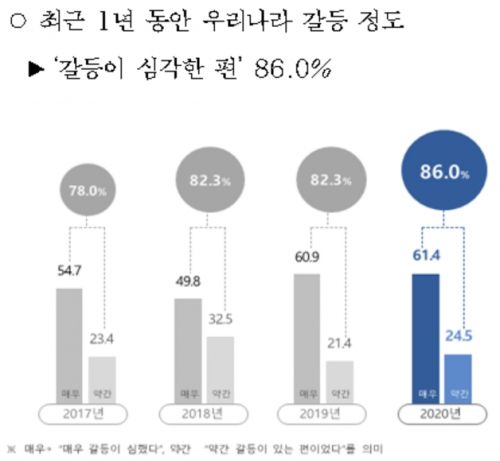
As a result, when asked about the conflict situation in Korea over the past year, 86.0% of Seoul citizens responded that "there is conflict." The proportion of citizens who responded that there was conflict in the past increased from 78.0% in 2017 to 82.3% in both 2018 and 2019. In particular, following last year (60.9%), 6 out of 10 Seoul citizens (61.4%) this year also responded that "conflicts are very severe," showing a continuing extreme conflict situation.
On the other hand, the degree of conflict experience with family, workplace, or people around in the past year showed a decreasing trend: 30.9% in 2017, 30.6% in 2018, 29.1% in 2019, and 28.9% in 2020. Also, 13.6% of Seoul citizens responded that they had experienced conflicts with public institutions such as city hall or district offices.
Citizens cited the main causes of such public conflicts in our society as ▲general lack of trust including distrust of the government (42.3%) ▲lack of mature democratic civic consciousness that considers others (35.1%) ▲unilateral public policy implementation by the central government and local governments (33.1%). Regarding claims related to social conflicts, the responses were ▲individual diversity should be respected even if it causes social conflicts (71.6%) ▲conflict is inevitable and society develops through conflict (55.6%) ▲social conflicts in our society are more due to individual consciousness and tendencies than structural social problems (37.7%) in that order.
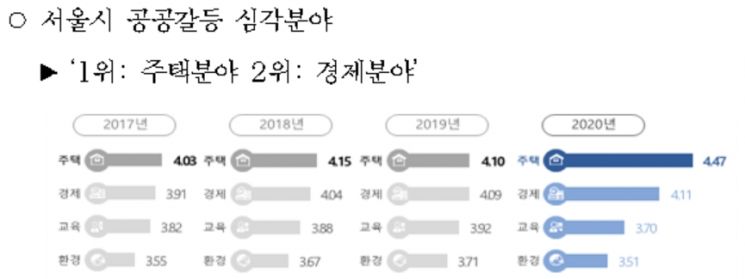
The fields where public conflicts are serious were ranked as housing (4.47 points), economy (4.11 points), education (3.70 points), environment (3.51 points), welfare (3.24 points), safety (3.09 points), transportation (3.00 points), and culture (2.74 points). In particular, the severity in the housing and economic sectors has continued to increase compared to four years ago, and currently, it is more severe than the overall public conflict level in Seoul (average 3.77 points).
When conflicts occurred between Seoul City and residents of adjacent areas due to the construction and expansion of resident-averse facilities, ▲73.2% responded that if there is damage to local residents, the plan should be reconsidered and sufficient measures should be prepared before proceeding, which was more than twice the 26.8% who responded that it should be promoted for the majority of citizens despite some damage and opposition.
The most desirable solutions when public conflicts occur were preferred in the order of ▲attempting mediation and reconciliation through third parties such as conflict experts or institutions (59.3%) ▲resolving through dialogue until the end (21.6%) ▲resolving legally through lawsuits, etc. (11.3%). Regarding Seoul City's key directions for promoting projects to prevent and resolve conflicts, the order was ▲collecting opinions from stakeholders (47.8%) ▲focusing on conflict prevention (39.3%) ▲customized conflict mediation (32.6%).
This survey was conducted through a professional institution to understand the overall perception of citizens about public conflicts, to review Seoul City's conflict management direction, and to use it as basic data for establishing response measures. The sampling error is ±3.1 percentage points at a 95% confidence interval.
Hong Soo-jung, Seoul City's Conflict Mediation Officer, explained, "The main causes of public conflicts felt by Seoul citizens are not legal or institutional problems but conscious issues such as trust and communication," adding, "To resolve this, it is effective to go through a process of sufficiently collecting the opinions of stakeholders, and in that process, mediation and arbitration by a third party can bring effective results."
© The Asia Business Daily(www.asiae.co.kr). All rights reserved.
![User Who Sold Erroneously Deposited Bitcoins to Repay Debt and Fund Entertainment... What Did the Supreme Court Decide in 2021? [Legal Issue Check]](https://cwcontent.asiae.co.kr/asiaresize/183/2026020910431234020_1770601391.png)
















