Support for Small Business Owners Alone Is Insufficient... Payment Targeted for January Next Year
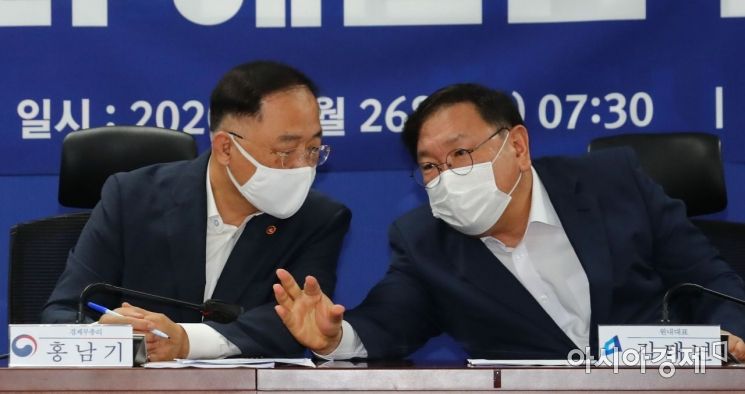 Deputy Prime Minister for Economy Hong Nam-ki and Kim Tae-nyeon, floor leader of the Democratic Party of Korea, are attending the 2021 budget formulation party-government consultation held at the National Assembly on the 26th, talking during the meeting. Photo by Yoon Dong-joo doso7@
[Asia Economy reporters Kim Hyun-jung and Jang Se-hee] The ruling party and government have settled on including low-income groups and employment-vulnerable groups as recipients of the third disaster relief fund to respond to the damage caused by the novel coronavirus infection (COVID-19). This decision comes from the judgment that support for small business owners alone is insufficient, as the COVID-19 damage is deeper and more prolonged than initially expected.
According to the Democratic Party of Korea and the government on the 15th, the recipients of the third disaster relief fund to respond to COVID-19 damage are summarized as ▲small business owners ▲low-income groups ▲employment-vulnerable groups. The ruling party and government reached this consensus as the damage expanded due to the recent social distancing measures?level 2.5 in the metropolitan area and level 2 in non-metropolitan areas?following the COVID-19 situation. The Ministry of Economy and Finance, the main ministry in charge, is currently calculating detailed specifics such as the exact recipients and amounts. The actual target payment period is planned for January next year, with efforts to provide support as quickly as possible.
The ruling party and government’s initial mention of the payment scale as '3 trillion KRW + α' is also interpreted as an intention to flexibly select the recipients. A senior government official stated, "We are considering providing support broadly not only to small business owners and self-employed but also to low-income groups and employment-vulnerable groups," adding, "Since the spread of COVID-19 continues, we are currently assessing the extent of damage and the budget size that can be executed."
President Moon Jae-in also presided over a senior secretaries meeting at the Blue House the day before and emphasized, "Please prepare thoroughly in advance so that support for youth and low-income vulnerable groups can be executed swiftly as planned," and "In addition to existing support measures, please quickly prepare an execution plan so that the 3 trillion KRW third disaster relief fund budget passed by the National Assembly can be executed promptly in a damage-tailored manner."
However, if the disaster relief fund recipients are expanded to include employment-vulnerable and low-income groups, there is a possibility of difficulties in the 'rapid execution' ordered by President Moon, considering the scale and public opinion. For this reason, during the previous second disaster relief fund payment, selective payments based on income levels were excluded, and emergency livelihood support (400 billion KRW for 890,000 households) was provided only to households facing livelihood crises.
The funding is expected to be covered by the related budget of 3 trillion KRW passed by the National Assembly and the rollover amount of about 500 billion KRW from the previous second disaster relief fund. Based on the second support fund, more than 400 billion KRW was spent on total unemployment response, including 200 billion KRW for job-seeker benefits (28,000 people), 100 billion KRW for special youth job-seeking support (200,000 people), and 100 billion KRW for COVID-19 overcoming job provision (24,000 people), in addition to support related to wage workers. However, the employment situation has worsened compared to September when the second disaster relief fund payment plan was announced (1 million people), with 1,028,000 unemployed occurring in October alone, so it is uncertain whether the support scale will be sufficient.
© The Asia Business Daily(www.asiae.co.kr). All rights reserved.
![User Who Sold Erroneously Deposited Bitcoins to Repay Debt and Fund Entertainment... What Did the Supreme Court Decide in 2021? [Legal Issue Check]](https://cwcontent.asiae.co.kr/asiaresize/183/2026020910431234020_1770601391.png)















