Defect Control by Light Enables 2D Semiconductor Doping
Visible Light Induces p-Type, UV Light Induces n-Type
Realization of 2D 'Chameleon Semiconductor'
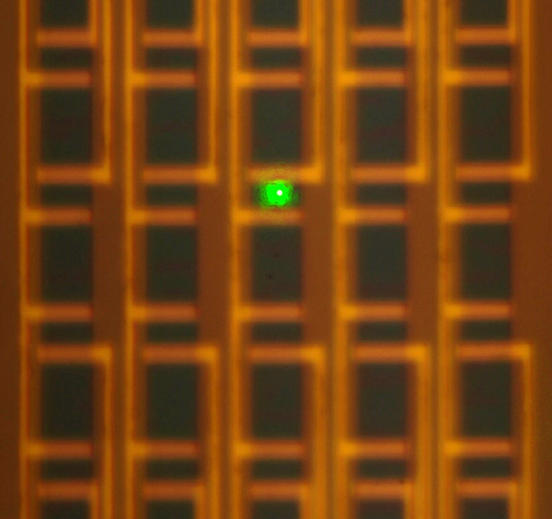
[Asia Economy Reporter Junho Hwang] A technology to create two-dimensional semiconductors using light has been developed. It is expected to become a core technology contributing to the commercialization of flexible electronic devices and ultra-small computers.
The research team led by Deputy Director Moonho Jo of the Atomic Control Low-Dimensional Electron Systems Research Group at the Institute for Basic Science discovered that two-dimensional semiconductor materials can be doped using light of different wavelengths, and implemented atomic-layer integrated circuit devices that can change semiconductor functions in real time and at will. The related paper was published on the 15th in the international journal Nature Electronics.
Doping Two-Dimensional Semiconductors with Light
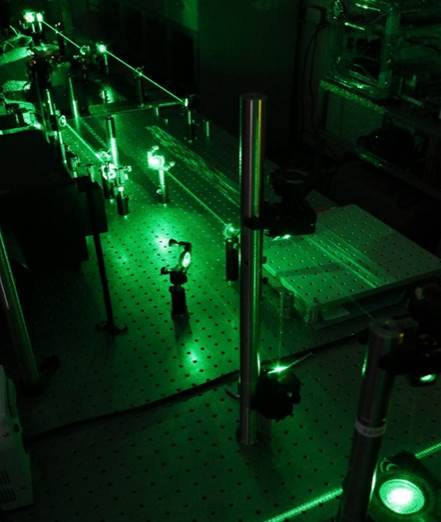
The research team developed a method to dope two-dimensional semiconductors using light, which has been pointed out as a cause of semiconductor damage. They focused on the fact that various chemical changes can be induced depending on the intensity and wavelength of light. The team observed various changes caused by light on two-dimensional semiconductor molybdenum ditelluride (MoTe2) using transmission electron microscopy and scanning tunneling microscopy with atomic-level resolution.
Through this, the team confirmed that ultraviolet light dopes the two-dimensional semiconductor as n-type, while visible light dopes it as p-type. Ultraviolet light, which has a short wavelength and strong energy, breaks the atomic bonds between tellurium and molybdenum in the semiconductor. This causes some molybdenum atoms on the surface to be removed, increasing the number of electrons and turning it into an n-type semiconductor. On the other hand, visible light replaces the tellurium atoms with oxygen, increasing the number of holes throughout the material. In particular, the team confirmed that doping with light is possible not only for molybdenum ditelluride but also for other two-dimensional semiconductors such as tungsten diselenide (WSe2).
Integrated Circuits Changing Functions with Light
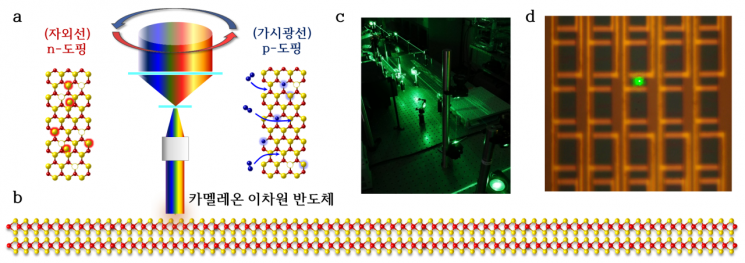
Using this, the research team implemented integrated circuit devices whose functions can be changed. By irradiating two-dimensional semiconductors with lasers, they created inverters, a representative component of logic circuits, by making n-type and p-type semiconductors. They then demonstrated that by applying light again to the fabricated inverter, it can be transformed into a switch, a component with the exact opposite function.
Deputy Director Moonho Jo stated, "We confirmed that the doping process essential for implementing two-dimensional semiconductor integrated circuits can be simply understood through photochemical reactions between light and materials," adding, "This integrated research combining basic science and applied technology is an ideal example of new semiconductor technology."
Meanwhile, two-dimensional semiconductors are next-generation semiconductors that will realize thin and flexible electronic devices and ultra-small computers. To achieve this, it is necessary to freely control the types and concentrations of internal impurities like silicon semiconductors. In particular, these semiconductors are divided into n-type with many electrons and p-type with many holes depending on impurities, and by junctioning n-type and p-type, transistors can be formed, enabling the realization of single integrated circuits.
© The Asia Business Daily(www.asiae.co.kr). All rights reserved.
![User Who Sold Erroneously Deposited Bitcoins to Repay Debt and Fund Entertainment... What Did the Supreme Court Decide in 2021? [Legal Issue Check]](https://cwcontent.asiae.co.kr/asiaresize/183/2026020910431234020_1770601391.png)


















