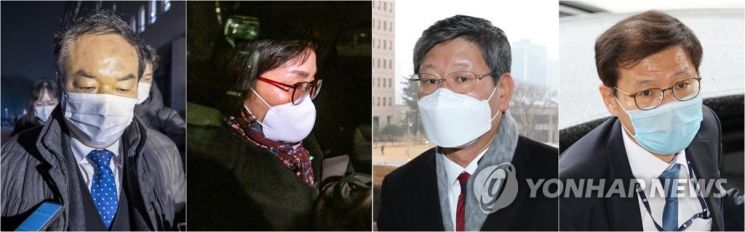
 From the left in the photo, Jeong Han-jung, professor at Hankuk University of Foreign Studies Law School and acting chairman of the disciplinary committee for Prosecutor General Yoon Seok-yeol; Ahn Jin, professor at Chonnam National University Law School; Lee Yong-gu, Vice Minister of Justice; and Shin Sung-sik, head of the Anti-Corruption and Serious Crime Division at the Supreme Prosecutors' Office.
[Asia Economy Reporter Choi Seok-jin] The Ministry of Justice Disciplinary Committee (Disciplinary Committee) and Prosecutor General Yoon’s side, which have been at odds over procedural issues in the operation of the disciplinary committee?such as the ‘recusal request’ against disciplinary committee members and the designation of Minister of Justice Choo Mi-ae, who is subject to disqualification as the person who filed the disciplinary charge against Prosecutor General Yoon, as the disciplinary committee chair?have now engaged in a legal battle over witness examination.
With the disciplinary committee’s deliberation scheduled to resume on the 15th, Prosecutor General Yoon’s side is raising as many procedural defects as possible in preparation for future court litigation, while the Ministry of Justice and the disciplinary committee appear to be careful to ensure that any procedural issues do not adversely affect future trials.
On the 12th, Channel A reported in an exclusive article titled “[Exclusive] Disciplinary Committee Limits Direct Witness Examination by Yoon Seok-yeol’s Side” that “the Ministry of Justice disciplinary committee stated at the hearing held on the 10th that only disciplinary committee members can question the adopted witnesses, thereby restricting direct witness examination by Prosecutor General Yoon’s side, which led to their opposition.”
Disciplinary Committee: “Cross-examination rights are not guaranteed during examination procedures”… “Only committee members can ask questions” stance
In response, the disciplinary committee stated in a notification message sent to reporters, “According to the Prosecutor Disciplinary Act, the committee may adopt and examine witnesses upon the request or ex officio of the accused, and at this time, ‘examination’ of witnesses is a procedure where the committee questions the witnesses and receives answers, which is clearly stipulated and interpreted by law, differing from ‘interrogation’ of witnesses in criminal procedure. This can be understood by comparing it to the pre-arrest warrant ‘examination’ procedure.”
They cited Article 13 of the Prosecutor Disciplinary Act (Examination or Witness Examination, etc.), which states, “The committee may order an appraisal and examine witnesses ex officio or upon the request of the accused or special defense counsel, and may request administrative agencies or other institutions to investigate facts or submit documents.”
Just as a judge conducting a pre-arrest warrant hearing questions the suspect and then decides whether to issue the warrant, the witness examination procedure conducted by the disciplinary committee is interpreted as a process for committee members to confirm factual matters necessary for disciplinary resolution.
However, the disciplinary committee added, “If necessary, the committee plans to proceed with the examination procedure in a way that guarantees the accused’s right to defense by accepting requests from defense counsel for supplementary questions to the committee as much as possible.”
While emphasizing that Prosecutor General Yoon’s side’s right to direct witness examination is not naturally guaranteed by legal interpretation and maintaining a restrictive stance, it appears they intend to avoid procedural defect claims from Yoon’s side through ‘supplementary questions to the committee.’
Yoon’s side: “Right to request witnesses is part of the right to submit evidence… exercising the right to question is natural”
Yoon’s side immediately rebutted the Ministry of Justice’s explanation.
Lawyer Lee Wan-gyu, representing Prosecutor General Yoon, stated in a position paper sent to reporters, “One of the core principles of due process is the right to ‘assert and prove,’ which is part of the natural justice principle ‘audi alteram partem’ (hear the other side). The right to assert and prove includes first, the right to rebut unfavorable evidence, and second, the right to submit favorable evidence.”
He continued, “The right to rebut unfavorable evidence includes the right to cross-examine opposing witnesses, especially including the right to cross-examine witnesses adopted ex officio.”
Lawyer Lee emphasized, “Articles 11 and 12 of the Prosecutor Disciplinary Act stipulate the accused’s or special defense counsel’s right to submit evidence, and Article 13 states, ‘The committee may order an appraisal and examine witnesses ex officio or upon the request of the accused or special defense counsel.’ In other words, the right to request witness examination is recognized as part of the right to submit evidence, and the person who requests witness examination naturally has the right to question the witness.”
He added, “The right to request witnesses is part of the right to submit evidence, and since the witness requester intends to submit evidence through the witness’s testimony, it is natural for the requester to exercise the right to question the requested witness.”
Denial of cross-examination “ignores the basics of due process”… “Should compare with the Judicial Disciplinary Act”
Lawyer Lee also rebutted the Ministry of Justice’s comparison of the denial of Yoon’s side’s cross-examination rights to the ‘pre-arrest suspect examination.’
He argued, “The disciplinary committee focuses on the term ‘witness examination’ and claims it is different from ‘interrogation,’ so only the committee can question, but this is unfair. Examination (審問) as a procedure granting the parties an opportunity to testify is different from examination (尋問) as a method of evidence investigation.”
He added, “Examination (審問) has two meanings: ‘to question thoroughly’ and ‘a procedure granting the parties an opportunity to testify.’ The pre-arrest examination is a procedure where the court questions the suspect and grants the parties an opportunity to testify.”
He explained, “On the other hand, examination (尋問) or interrogation (訊問) means questioning as a method of evidence investigation in litigation procedures. Japan abolished the term ‘interrogation (訊問)’ after the war, but Korea maintained it when enacting the Criminal Procedure Act after the war. Currently, several laws use the term ‘examination (尋問)’ instead of ‘interrogation (訊問)’ for procedures involving questioning and answering, with the same meaning.”
He continued, “There is a generational difference between interrogation and examination as methods of evidence investigation, but the term ‘examination’ does not deny the parties’ right to question. Granting the parties the right to submit evidence and request witnesses without granting the right to question those witnesses ignores the basic principle of due process.”
Finally, Lawyer Lee said, “The Judicial Disciplinary Act uses the term ‘examination (審問)’ in Article 12 for procedures questioning the disciplinary subject about the facts and necessary matters, and uses the term ‘interrogation (訊問)’ in Article 16 for witnesses. According to the disciplinary committee’s argument, the Judicial Disciplinary Act recognizes the parties’ right to question because it uses ‘interrogation,’ but the Prosecutor Disciplinary Act does not recognize the parties’ right to question because it uses ‘examination.’ Considering the similarities between the Judicial Disciplinary Act and the Prosecutor Disciplinary Act, this is an inappropriate argument.”
Among the remaining 4 members, 3 majority support Minister Choo… Without cross-examination, ‘witness examination’ is meaningless
Previously, the disciplinary committee adopted eight witnesses in total, including seven witnesses requested by Prosecutor General Yoon’s side and Shim Jae-cheol, the head of the Ministry of Justice’s Prosecutor’s Office, who voluntarily resigned from the disciplinary committee, adopted ex officio.
Among them, four?Lee Sung-yoon, head of the Seoul Central District Prosecutors’ Office; Shim Jae-cheol, head of the Ministry of Justice’s Prosecutor’s Office; Han Dong-soo, head of the Supreme Prosecutors’ Office Inspection Department; and Jung Jin-woong, deputy chief prosecutor of the Gwangju District Prosecutors’ Office?are classified as the so-called ‘Choo line’ within the prosecution or are figures who actively assisted Minister Choo Mi-ae’s disciplinary charge against Prosecutor General Yoon, and are expected to give testimony favorable to Minister Choo. However, it is still uncertain whether Lee, Han, and Jung will attend the disciplinary committee on the 15th.
On the other hand, four witnesses likely to testify favorably for Prosecutor General Yoon include Ryu Hyuk, the Ministry of Justice’s Inspector General who pointed out procedural problems in Yoon’s disciplinary process; Prosecutor Lee Jeong-hwa, who revealed that her report stating that the ‘judicial information collection document’ ordered by Park Eun-jung, the Ministry of Justice’s Inspection Officer, was unlikely to constitute abuse of authority was deleted from Yoon’s inspection records; Son Joon-sung, head of the Supreme Prosecutors’ Office Investigation Information Department who authored the document; and Park Young-jin, chief prosecutor of the Ulsan District Prosecutors’ Office involved in the ‘Channel A case’ investigation.
Professor Jung Han-joong of Hankuk University of Foreign Studies Law School, who Minister Choo entrusted as the disciplinary committee chair in her stead, Deputy Minister of Justice Lee Yong-gu, an ex officio member, and external member Professor Ahn Jin of the Law School are three members likely to vote in favor of a severe disciplinary resolution against Prosecutor General Yoon according to Minister Choo’s intentions. Prosecutor General Yoon’s recusal requests against Shim and these three members were based on this assessment.
Currently, the disciplinary committee has only four members left after Minister Choo was disqualified, two external members resigned, only one was replaced by Professor Jung, and Shim avoided the last hearing. Even if Shin Sung-sik, head of the Supreme Prosecutors’ Office Anti-Corruption and Serious Crime Division, who did not file a recusal request, holds a passive opinion on Yoon’s disciplinary action, the remaining three members still constitute a quorum of the majority of attending members, allowing them to pass a severe disciplinary resolution such as dismissal against Prosecutor General Yoon.
Therefore, it seems unlikely that the members siding with Minister Choo will pose sharp questions to the adopted witnesses about the procedural controversies or substantive disciplinary reasons during the witness examination. Even if Lee or Shim appear as witnesses, they are likely to avoid answering by citing reasons such as ‘the matter is under investigation.’
Prosecutor General Yoon’s side’s insistence on the necessity of direct cross-examination of witnesses appears to be aimed less at persuading the disciplinary committee members for a favorable outcome and more at securing testimony necessary to prove in future court cases?such as disciplinary cancellation lawsuits or injunction applications?that the disciplinary charge was unjust and the disciplinary procedures were flawed.
© The Asia Business Daily(www.asiae.co.kr). All rights reserved.

















