Steven Noper, Columbia University Professor, Outlook
[Asia Economy New York=Correspondent Baek Jong-min] There is a forecast that the next U.S. administration under Joe Biden will reach an early agreement on the South Korea-U.S. defense cost-sharing negotiations.
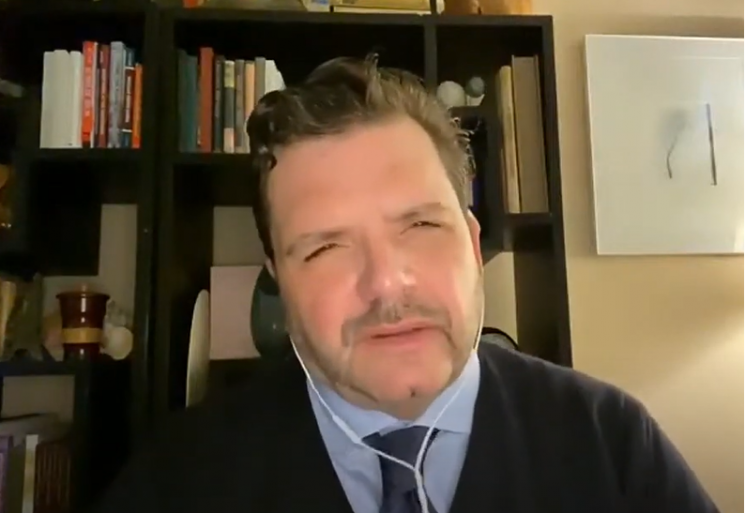
Steven Noper, a professor at Columbia University in the U.S., said at an online seminar titled "Prospects for the New Administration and South Korea-U.S. Relations," hosted by the Consulate General in New York on the 11th (local time), "The Biden administration will return to the diplomatic normalization we knew after World War II," using the term 'Alliance-first.'
This is a term opposite to the current Donald Trump administration's 'America First.'
Professor Noper referred to Biden's statement in a Korean media contribution shortly before the presidential election, in which he declared that he would not extort South Korea by threatening to withdraw U.S. troops stationed in Korea, and predicted that the South Korea-U.S. defense cost-sharing negotiations would be concluded promptly.
He said, "Regarding the Special Measures Agreement (SMA) on defense cost-sharing, we will see a quick agreement within the first month or two," adding, "A fairly rapid resolution is expected."
He also forecast that in North Korea-U.S. relations, instead of President Trump's impulsive 'top-down' diplomacy, sufficient working-level negotiations and trust-building will precede.
In particular, he anticipated that Biden might appoint a special envoy for the Korean Peninsula issue, considering that the 'strategic patience' of the former Barack Obama administration did not yield results.
Professor Noper advised that the Biden administration needs to "rebuild the New York channel more strongly" for North Korea-U.S. communication.
He mentioned that although there is a possibility of provocations such as missile launches by North Korea during the U.S. administration transition, it might rather refrain from doing so.
Professor Noper predicted, "They might not conduct test launches because it could eliminate the rationale for easing sanctions."
Professor Noper warned that the Korean Peninsula issue could be influenced by internal U.S. issues such as the novel coronavirus infection (COVID-19) crisis, the resulting economic recession, racial conflicts, and U.S.-China relations.
He explained, "As U.S.-China relations deteriorate to the worst on multiple fronts, it could be a very difficult path for South Korea to cross, but I do not think the Biden administration will force South Korea to make a choice."
© The Asia Business Daily(www.asiae.co.kr). All rights reserved.
![User Who Sold Erroneously Deposited Bitcoins to Repay Debt and Fund Entertainment... What Did the Supreme Court Decide in 2021? [Legal Issue Check]](https://cwcontent.asiae.co.kr/asiaresize/183/2026020910431234020_1770601391.png)















