More than 3 out of 4 Office Workers Satisfied with Remote Work
Experts Say "Use of Remote Work Will Increase Even After COVID-19 Pandemic"
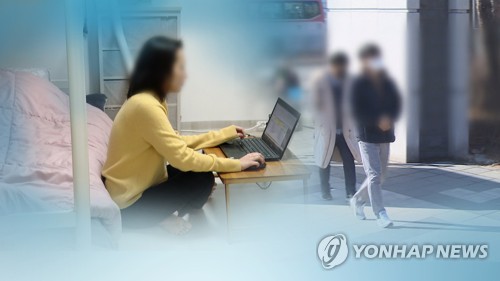 The spread of the novel coronavirus infection (COVID-19) has led to half of domestic companies adopting a telecommuting system. Satisfaction with the use of telecommuting was generally high among both companies and employees. Photo by Yonhap News Agency
[Asia Economy Reporter Kim Suwan] "Thanks to telecommuting, my quality of life has improved."
As the number of companies implementing telecommuting has increased due to the COVID-19 pandemic, office workers have shown satisfaction with working from home. Although telecommuting was suddenly implemented because of COVID-19, opinions indicate that work productivity is not significantly different from normal office work. However, there are also concerns that the boundary between work and rest has become loose, requiring improvement.
Mr. Lee (30), an office worker who started telecommuting from the early stages of the COVID-19 crisis, stated that reducing unnecessary meetings and being able to focus on work actually helped improve productivity.
Mr. Lee said, "There doesn't seem to be a big difference between going to the office and working from home," adding, "Rather, I save commuting time and the frequent company dinners naturally disappeared, so I have more personal time." He continued, "The biggest advantage is being able to work without worrying about others' opinions," and added, "I hope telecommuting will continue to be promoted even after the COVID-19 situation ends."
According to a survey, more than three out of four office workers cited saving commuting time and reduced company dinners as the main reasons for their satisfaction with telecommuting.
Employment portal Incruit and non-face-to-face part-time job recruitment platform AlbaCall conducted a telecommuting satisfaction survey targeting 748 office workers from the 18th to the 20th of last month. As a result, 77.5% of respondents answered that they were "satisfied."
The most frequently cited reason was saving commuting time (29.5%). This was followed by △minimizing infection concerns (23.5%) △elimination of unnecessary company dinners and events (15.0%) △ability to manage household chores and childcare (10.4%) △perception that non-face-to-face work methods improve work efficiency (12.5%) △saving travel time related to meetings (8.3%), among others. Thus, telecommuting appears to have brought significant changes to the way office life is conducted.
The number of companies utilizing telecommuting is also increasing. According to the Ministry of Employment and Labor's "Telecommuting Utilization Survey" conducted on August 5 targeting 400 HR managers and 878 workers from workplaces with five or more employees, 48.8% of the surveyed companies operated telecommuting.
By company size, the rates were △100?299 employees (54.0%) △300 or more employees (51.5%) △10?29 employees (43.9%) △30?99 employees (42.7%), showing no significant variation by size.
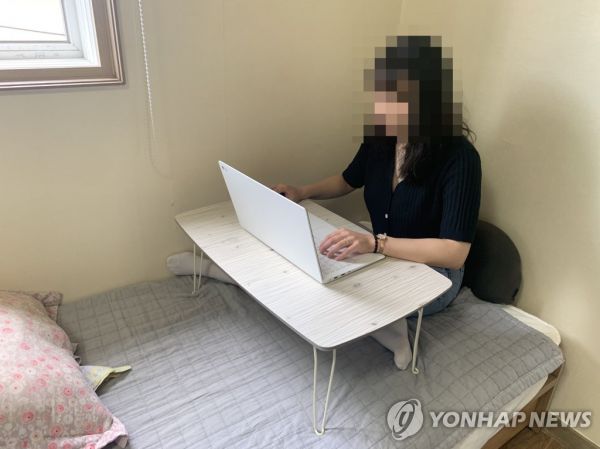 As the number of companies utilizing remote work to prevent infection from the novel coronavirus disease (COVID-19) increases, the government has announced a remote work manual. Photo by Yonhap News
On the other hand, some voices complain that work efficiency has declined due to telecommuting. They argue that communication among employees is not properly conducted because work is done remotely. In particular, some say that the boundary between rest and work is unclear, causing significant stress.
According to the earlier survey, the most difficult issue experienced while telecommuting was communication difficulties (62.6%). Other challenges included fairness issues with jobs unsuitable for telecommuting (44.1%) and difficulties in performance management and evaluation (40.0%).
To address these problems, the government recently announced a telecommuting manual. In September, the Ministry of Employment and Labor released the first-ever "Comprehensive Telecommuting Manual," covering everything from telecommuting introduction procedures to operational regulations and legal disputes.
The Ministry provided checklists and operational regulations for each stage so that companies introducing telecommuting for the first time can easily utilize them.
Legal issues are organized by topic, including △introduction and implementation △working hours, overtime, and rest periods △work management and performance evaluation △wages, telecommuting costs, and equipment △personal information protection and security measures △occupational safety and health and industrial accident compensation.
Regarding this, Minister of Labor Lee Jae-gap emphasized, "Successfully establishing telecommuting is not only a way to overcome the COVID-19 infectious disease crisis but also an opportunity to innovate work methods. Therefore, it is crucial for companies and workers to smoothly establish telecommuting based on trust and cooperation," stressing the need to establish a proper telecommuting culture.
Experts predict that the use of telecommuting will increase even after the COVID-19 crisis is resolved. Ha Sang-woo, head of the Economic Research Division at the Korea Employers Federation, announced the results of a survey on telecommuting status targeting the top 100 domestic companies by sales last year, stating, "For flexible work systems such as telecommuting to be successfully established in the era of the 4th Industrial Revolution, building a performance-centered personnel management system and improving communication methods within companies will be key tasks."
© The Asia Business Daily(www.asiae.co.kr). All rights reserved.
![User Who Sold Erroneously Deposited Bitcoins to Repay Debt and Fund Entertainment... What Did the Supreme Court Decide in 2021? [Legal Issue Check]](https://cwcontent.asiae.co.kr/asiaresize/183/2026020910431234020_1770601391.png)