85% of Newly Listed Stocks Since November Rise Above IPO Price
[Asia Economy Reporter Eunmo Koo] Newly listed stocks that entered the market after last month's rally are showing signs of a smooth landing.
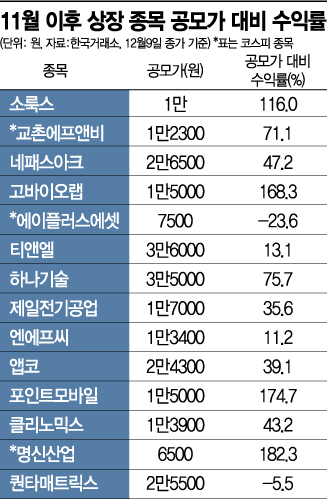
According to the Korea Exchange on the 10th, more than 85% of the stocks newly listed in the domestic stock market from last month until the day before were recorded to have risen compared to their initial public offering (IPO) price. Since November, a total of 14 stocks (3 on KOSPI, 11 on KOSDAQ, excluding SPACs) have entered the market, of which only two stocks?Aplus Asset and QuantaMatrix, which was listed the day before?are trading below their IPO price.
Among individual stocks, Myeongshin Industry, an auto parts manufacturer listed on the KOSPI market on the 7th, attracted attention as a so-called 'Tesla parts stock,' rising 182.3% above its IPO price, recording the highest return. Industrial mobile device company Point Mobile (174.7%), microbiome therapeutic developer Gobio Lab (168.3%), and LED lighting company Solux (116.0%) also achieved triple-digit returns compared to their IPO prices.
The recent smooth landing of newly listed stocks is basically attributed to the liquidity-driven market rally, which has been continuously hitting new highs. Despite ongoing concerns about the spread of the novel coronavirus (COVID-19), expectations for vaccines have stimulated risk asset investment sentiment, pushing the market to record highs day after day. The KOSDAQ market, which has many newly listed stocks, is also being led by vaccine and therapeutic-related stocks.
In addition to the heated market sentiment, the relatively small number of companies listed compared to the demand for IPO investments has enhanced the attractiveness of newly listed stocks and influenced their returns. Last month, only eight companies were newly listed, the fewest in November since 2012 (7 companies). Researcher Jongseon Park of Eugene Investment & Securities explained, "The low number of companies listed in November is due to adjustments to avoid listing large companies like Big Hit recently, and after aggressive listings in the third quarter despite the ongoing COVID-19 situation, the market has entered a lull."
With fewer companies to invest in compared to demand, the IPO subscription competition rate was the highest in the past four years as of November. The average institutional demand forecast competition rate for the eight companies was 730 to 1. Hana Technology, Jeil Electric Industry, and Solux attracted high institutional interest with competition rates exceeding 1,000 to 1. The average competition rate for general subscriptions was even higher at 1,088 to 1, about twice the average competition rate (518 to 1) from 2017 to 2019.
As the allocation of IPO shares available to individual investors is set to expand from next year, the amount of subscription funds flowing in is expected to increase, sustaining the liquidity-driven market. Last month, financial authorities announced plans to increase the proportion of IPO shares available to individuals from the current 20% to 25-30%. In the future, 5% of the 10% allocation for high-yield funds will be transferred to individual subscribers, and up to 5% of the unallocated shares from employee stock ownership associations will be allocated to individual subscribers.
Researcher Sojung Lee of SK Securities said, "With the expansion of IPO shares available to individuals, participation in IPO subscriptions for large companies is expected to increase compared to before," adding, "The liquidity-driven market is likely to continue due to the massive subscription funds flowing into IPOs next year, and companies preparing for listing will actively proceed with their IPOs."
Among companies aiming to list next year, those with corporate values reaching trillions of won include LG Energy Solution (40 to 50 trillion won), Krafton (20 to 30 trillion won), Kakao Bank (6 to 40 trillion won), Kakao Pay (7 to 10 trillion won), Kakao Page (2 to 4 trillion won), and SK Bioscience (over 3 trillion won).
© The Asia Business Daily(www.asiae.co.kr). All rights reserved.

















