Discussion on Appropriate Rate Plan Held
Experts Criticize Unilateral Demands of Trust Organizations
"Direct Contracts Between Music Creators and Video Producers Must Be Recognized"
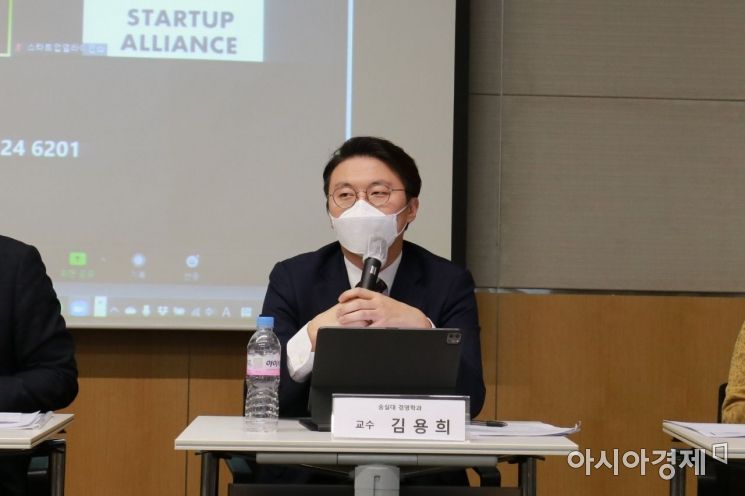 Professor Kim Yong-hee of Soongsil University’s Department of Business Administration is presenting his opinion at the 'Appropriate Royalty Rates for Music Copyrights of OTT Operators' discussion held jointly by Startup Alliance, Assemblyman Hong Jung-min’s office of the Democratic Party, and the OTT Forum on the 9th at the Federation of Korean Industries building in Yeouido.
[Asia Economy Reporter Kim Heung-soon] "The problem lies in the Korea Music Copyright Association's unilateral setting of rates as a monopoly."
Professor Kim Yong-hee of Soongsil University's Department of Business Administration criticized the negotiation stance of the Korea Music Copyright Association (KOMCA), which is demanding an increase in music copyright fees from domestic online video service (OTT) providers. On the afternoon of the 9th, at a debate on "Appropriate Music Copyright Rates for OTT Providers" jointly hosted by Startup Alliance, Assemblyman Hong Jung-min of the Democratic Party, and the OTT Forum, Professor Kim said, "Is it a reasonable transaction for KOMCA to unilaterally set rates and threaten litigation if they are not accepted?" He pointed out that "KOMCA is abusing its monopoly position."
The conflict among stakeholders over music copyright fee rates imposed on OTT content such as Netflix and Wavve has been ongoing for several months. Professor Kim Kyung-sook of Sangmyung University's Department of Copyright Protection, who attended the debate, introduced a study titled "Research on Appropriate Music Copyright Rates for OTT Video Services," and argued that "although collection methods and standards vary by country in overseas cases, a common point is that contracts are made directly between video producers and music creators, whether for original compositions or existing songs." She insisted that direct contracts between music creators and video producers should be recognized instead of relying on the collective management organization KOMCA.
According to the research results presented by Professor Kim Kyung-sook, countries such as the United States, the United Kingdom, and Japan classify music into original compositions and existing songs and implement direct copyright fee contracts between creators and users. Additionally, to prevent double charging, they stipulate that no usage fees are incurred for music works whose rights have already been cleared before video production.
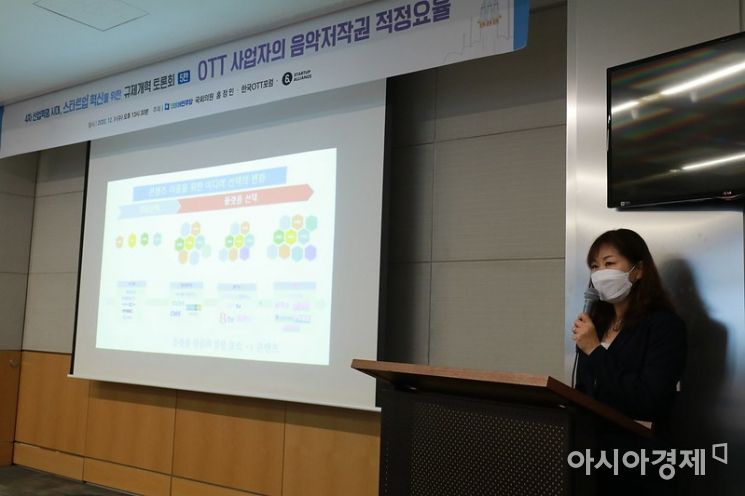 Professor Kim Kyung-sook of the Department of Copyright Protection at Sangmyung University is presenting her research findings as a speaker at the "Appropriate Royalty Rates for Music Copyrights of OTT Operators" forum, jointly hosted by Startup Alliance, the office of Hong Jung-min of the Democratic Party, and the OTT Forum, held on the 9th at the Federation of Korean Industries building in Yeouido.
According to current copyright law, when popular songs or instrumental pieces are used as background music in performances, broadcasts, or transmissions, the relevant business operator must pay a certain percentage of copyright fees to KOMCA. KOMCA demands setting the copyright fee at 2.5% of sales, citing reports published by the International Confederation of Societies of Authors and Composers (CISAC) and contracts with global OTT Netflix as grounds.
On the other hand, major domestic OTT providers such as Wavve, TVING, and Watcha argue that about 0.6% of sales is appropriate, based on the existing "broadcast retransmission service" regulations applied to broadcasters' internet catch-up services. The rates claimed by both sides differ by more than four times. The Ministry of Culture, Sports and Tourism, the competent authority, plans to finalize the OTT music copyright fee imposition standards within this month, and the industry expects the rate to be set around 1.2%, a middle ground considering both parties' positions.
Officials from the Ministry of Culture, Sports and Tourism and KOMCA did not attend the debate. Kim Jun-dong, team leader of the Broadcasting Industry Policy Division at the Ministry of Science and ICT, said, "We consider the rate claimed by KOMCA to be quite excessive," and added, "We hope the Ministry of Culture, Sports and Tourism will make a decision considering an appropriate rate level to support the growth of domestic OTTs, which are still in their early stages."
© The Asia Business Daily(www.asiae.co.kr). All rights reserved.


















