Seoul City to Reduce Public Transportation by 30% After 9 PM Starting from the 8th
Citizens: "Some People Leave Work After 9 PM," "This Creates Crowded Spaces"
Experts: "Balloon Effect Will Occur, Reducing Social Distancing Effectiveness"
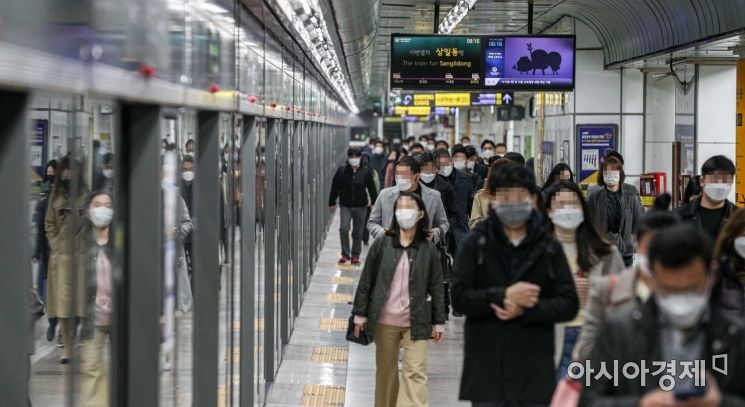 On the 13th of last month, citizens were walking at Gwanghwamun Station on Subway Line 5 in Jongno-gu, Seoul. Photo by Jinhyung Kang aymsdream@
[Asia Economy Reporter Kang Juhee] As Seoul City decided to reduce public transportation operations by 30% after 9 p.m. to prevent the spread of the novel coronavirus infection (COVID-19), some citizens are expressing inconvenience.
Critics say the policy does not consider the position of citizens who commute or must travel after 9 p.m. Some also worry that the reduction in public transportation services may actually increase crowding, making people more vulnerable to COVID-19 infection.
Experts analyzed that reducing the frequency of public transportation operations could cause a balloon effect, weakening the effectiveness of social distancing.
On the 4th, Seoul City announced a 30% reduction in subway operations within the city following the elevation of the metropolitan area's social distancing to level 2.5. This was an additional strengthened measure after the social distancing level 2 policy, implemented since the 24th of last month, showed no clear effect. City buses have already been operating at a 30% reduced capacity since the 5th.
Seoul Mayor Acting Mayor Seo Jeong-hyeop held an emergency briefing on COVID-19 on the 4th, stating, "Seoul has made the decision to stop the city after 9 p.m. to overcome the current precarious situation," adding, "This is a preemptive emergency measure to halt movement and activities except for the minimum economic and social activities necessary for livelihood." The social distancing level 2.5 measures will be applied for three weeks until the 28th.
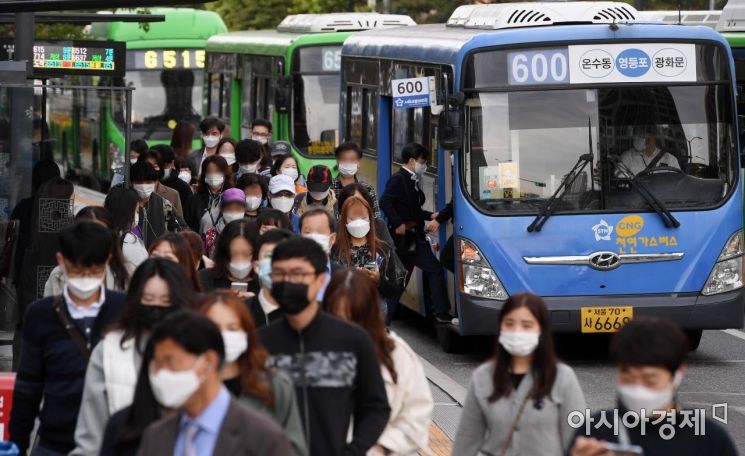 Last October, citizens wearing masks were walking at the bus stop near Sindorim Station in Guro-gu, Seoul. Photo by Hyunmin Kim kimhyun81@
However, many citizens are voicing discomfort with the public transportation reduction policy. They argue that the policy does not consider those who commute after 9 p.m.
Kim (28), an office worker who commutes by bus in Seoul, said, "Due to the nature of my work, I do not work from home, and sometimes when I work late, I get off work late, so I am confused by the bus reduction."
Kim added, "I have to wait a long time at the bus stop in the cold, and buses are often more crowded than before. While those working from home may not be affected, many people still work late or commute at night, but this policy does not consider such cases at all," criticizing the policy.
There are also concerns that the reduction in public transportation may create an environment more vulnerable to COVID-19 infection due to increased crowding.
Choi, a 30-something office worker, said, "If we want to practice social distancing, shouldn't we increase public transportation operations to disperse people rather than reduce them?" He pointed out, "We are told not to go to crowded, close-contact, and enclosed spaces, but this policy seems to create such environments."
Especially, with restaurants and bars restricted to operating until 9 p.m., the number of citizens trying to travel around that time is increasing, which may make the way home more congested.
Regarding these criticisms, Acting Mayor Seo said in an interview with YTN Radio's 'Lee Dong-hyung's News Face-off' on the 7th, "If congestion increases, it negatively affects quarantine efforts, so we are continuously monitoring it," adding, "We plan to operate flexibly in a way that does not increase congestion."
He continued, "Many have pointed out issues with public transportation use during commuting hours, so we are trying to alleviate this through staggered working hours," emphasizing, "We will continue monitoring the evening hours and take measures to ensure citizens do not feel inconvenienced."
Experts recommend implementing consistent policies that align with social distancing standards.
Professor Kim Woo-joo, an infectious disease specialist at Korea University Guro Hospital, said, "To maintain distancing, it is actually correct to increase the frequency of public transportation operations," adding, "Reducing operations naturally causes a balloon effect, leading to crowding around 9 p.m. Commuters feel more inconvenienced, and a more vulnerable environment for infection is inevitably created."
He continued, "Government quarantine policies should be based on scientific evidence with transparent and consistent messaging," pointing out, "If the government does not adhere to the established distancing standards and only appeals to citizens to follow quarantine guidelines, it increases public fatigue and undermines trust in quarantine efforts."
© The Asia Business Daily(www.asiae.co.kr). All rights reserved.
![User Who Sold Erroneously Deposited Bitcoins to Repay Debt and Fund Entertainment... What Did the Supreme Court Decide in 2021? [Legal Issue Check]](https://cwcontent.asiae.co.kr/asiaresize/183/2026020910431234020_1770601391.png)