Shinhan Bank 'Digitate Branch'
Identity Verification via Camera and Scanner
Connecting Staff and Customers through Screen
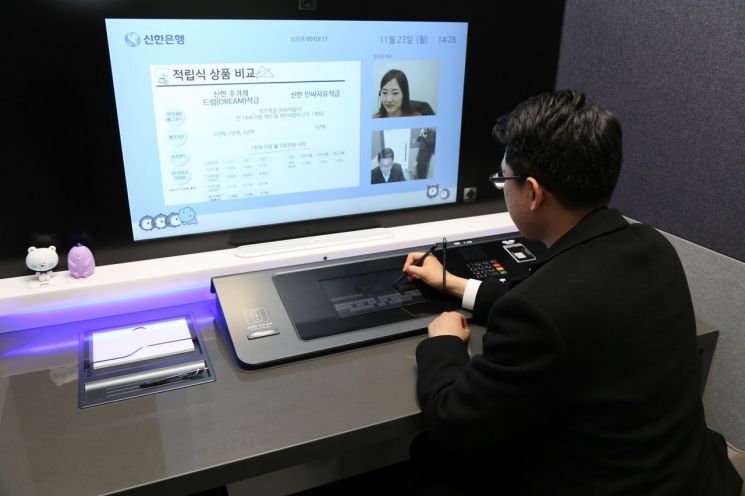
[Asia Economy Reporter Song Seung-seop] "Please remove your mask and look at the camera located at the upper center front for identity verification. You can insert your ID card into the scanner on the right."
On the 8th, I visited the video consultation room at Shinhan Bank Seosomun Branch in Jung-gu, Seoul. As I sat at the table equipped with a large screen and keypad, such instructions were played. When I pressed the 'Deposit Consultation' button to open an account, the message 'Connecting to staff' appeared, and soon a consultant appeared on the screen.
In response to the reporter’s request, "I am a young professional; please recommend a suitable savings account," the staff displayed several products on the screen. While comparing preferential interest rates, even the underlines drawn on the built-in pad appeared on the screen. After selecting a product, the necessary documents to be filled out were guided remotely. From verifying identity with a camera to final signing on the touchscreen to open the account, it took less than 15 minutes in a space of about 2 pyeong (approximately 6.6 square meters).
This place is the 'Digitate Branch' opened by Shinhan Bank on the 24th of last month as part of its digital innovation. Digitate is a compound word of 'digital' and 'contact,' referring to branches where traditional banking services can be handled via video calls. Deposit, savings, and subscription accounts can be opened, and credit, jeonse (key money deposit), and mortgage loans can be consulted without direct contact with staff or paper work.
Shinhan Bank is not the only one focusing on building digital branches. Woori Bank renewed its Gangnam Station branch into a digital financial branch in March, starting to provide non-face-to-face foreign exchange and asset management services. KB Kookmin Bank established a 'Digital Self Branch Plus' at its Donam-dong branch in Seoul and installed Smart Tele Machines (STM) that allow quick processing through vein registration.
Amid the untact (non-face-to-face) trend accelerated by the COVID-19 pandemic, bank operations are transforming into battlegrounds of 'digital competition.' According to financial and monetary authorities, in the first half of this year, face-to-face transactions accounted for only 0.75% of bank remittance (transfer) transactions (14 million out of 1.863 billion transactions). Conversely, during the same period, the number of inquiries, transfers, and loan uses via internet banking increased by 25.5% compared to the second half of last year.
Accelerated Branch Mergers and Closures Amid Intensifying Digital Competition
This phenomenon is driving the consolidation and closure of offline branches. As of the end of the first half of this year, the five major commercial banks?KB Kookmin, Shinhan, Hana, Woori, and NH Nonghyup?had 4,564 branches (including branches and sub-branches), down by 97 from 4,661 at the end of last December. Considering that 38 branches were reduced in 2019, the pace of branch consolidation is accelerating.
An official from a bank explained, "Operating a single offline branch can cost over 2 billion KRW annually in some cases. Improving profitability by reducing branches and compensating for this gap through digitalization is the challenge banks face."
However, this movement is accompanied by significant backlash. Staff reductions are a representative example. NH Nonghyup Bank received 503 applications for special retirement by the 30th of last month, an increase of 147 from 356 last year. SC First Bank also reportedly received dozens of applications for voluntary retirement by the 2nd of this month. Major banks such as KB Kookmin, Shinhan, Hana, and Woori have regularized special retirement programs, conducting retirements every December to January.
The anxiety among bank employees caught in the shadow of digitalization is also growing. On the 4th, the National Financial Industry Labor Union held a press conference in front of the Financial Supervisory Service in Yeouido, Seoul, urging the suspension of bank branch closures. They argued, "The excessive efficiency and short-term profit-driven indiscriminate closure of branches cause inconvenience to digitally vulnerable groups such as the elderly and disabled in accessing financial services."
Yoon Seok-heon, Governor of the Financial Supervisory Service, expressed concern on July 7, stating, "It is not desirable for banks to rapidly reduce branches in a short period citing COVID-19 as a reason."
© The Asia Business Daily(www.asiae.co.kr). All rights reserved.

















