After First Call Between Suga and Biden, US Mentions "Prosperous and Secure Indo-Pacific"
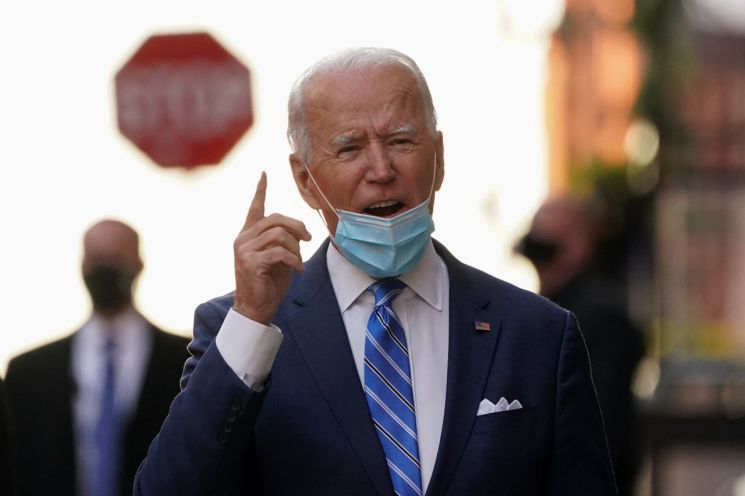
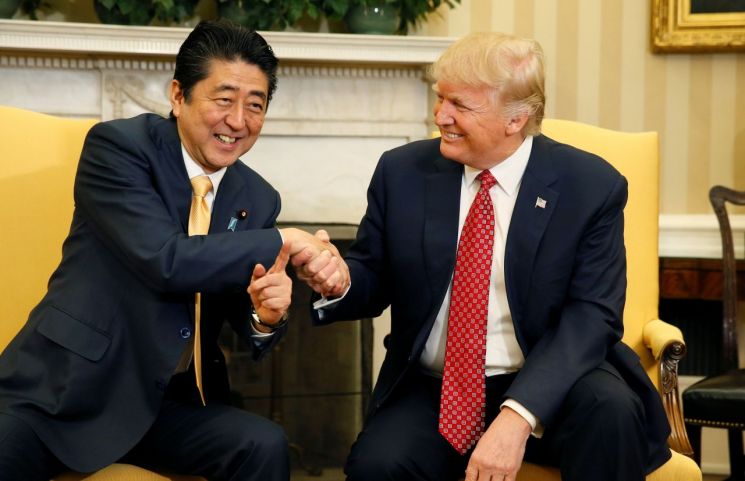 Former Japanese Prime Minister Shinzo Abe (left in photo) and U.S. President Donald Trump [Image source=Reuters Yonhap News]
[Asia Economy Reporter Jeong Hyunjin] The Asahi Shimbun reported on the 8th that the "Free and Open Indo-Pacific (FOIP)" initiative, advocated by former Japanese Prime Minister Shinzo Abe during his tenure and supported by U.S. President Donald Trump, is expected to be difficult to maintain under the incoming U.S. administration of Joe Biden.
According to the report, a senior official from Japan's Ministry of Foreign Affairs predicted, "Mr. Biden will not want to use the words of the Trump administration." Another official from the Ministry of Foreign Affairs likened it to "politicians not wearing other people's shoes even if they are expensive." It is expected that the Biden administration may modify or discard the slogan as it seeks to differentiate itself from Trump.
The Free and Open Indo-Pacific concept was announced in August 2016 when then-Prime Minister Abe gave a lecture at the Tokyo International Conference on African Development (TICAD), essentially to counter China's maritime expansion. At that time, President Trump, who was seeking an Asian policy to replace the "Rebalance" strategy advocated by the Obama administration, agreed at the U.S.-Japan summit in November 2017 to adopt the Free and Open Indo-Pacific as a common policy for both countries.
The Biden transition team has already shown signs of avoiding this term. On the 12th of last month, when Japanese Prime Minister Yoshihide Suga had his first phone call with President-elect Biden, he said, "We want to cooperate to realize a Free and Open Indo-Pacific," but the U.S. announcement related to this stated that they discussed strengthening the U.S.-Japan alliance as a foundation for a "prosperous and secure Indo-Pacific."
Then, two days after the call, on the 14th of last month, the Japanese government also refrained from using the term "Free and Open Indo-Pacific" in its message, Asahi reported. After the ASEAN+3 (South Korea, China, Japan) summit, Prime Minister Suga told reporters that he only wished to "build a peaceful and prosperous Indo-Pacific together."
Asahi noted, "With the end of the Abe administration, which advocated the Free and Open Indo-Pacific, coinciding with the change of U.S. administration, and with both the U.S. and Japan's stance toward China drawing attention, the Japanese government's external messaging is important."
© The Asia Business Daily(www.asiae.co.kr). All rights reserved.
![User Who Sold Erroneously Deposited Bitcoins to Repay Debt and Fund Entertainment... What Did the Supreme Court Decide in 2021? [Legal Issue Check]](https://cwcontent.asiae.co.kr/asiaresize/183/2026020910431234020_1770601391.png)