Credit Loan Pinpoint Regulation Is a Big Blow to Genuine Borrowers
Loan Balances at 5 Major Banks Decrease by 234.3 Billion Won in First 5 Business Days
"What Are We Supposed to Do If They Block Loans Even Though We Can Repay?" Complaints
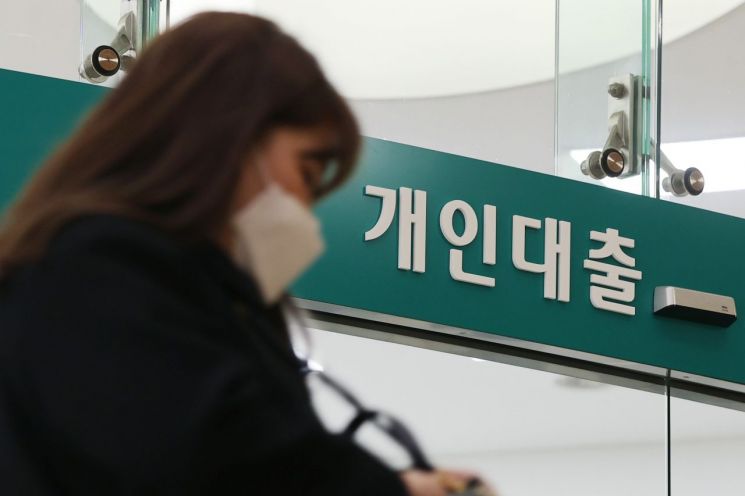
[Asia Economy Reporters Sunmi Park, Hyojin Kim] Kim Seongsu (44, pseudonym), who works at a solid large corporation with an annual income of over 80 million KRW, owns one home. His privately owned apartment is in Bundang, Gyeonggi Province, but since his workplace is in Mapo, Seoul, he rented a jeonse (long-term lease) house near his company two years ago. However, recently, the landlord asked him to vacate the apartment, saying they would move in themselves, putting him in a tight spot. He is currently looking for jeonse listings within the same complex, but due to the soaring jeonse prices, he needs to raise an additional 100 million KRW beyond his available funds. The problem is that with the recent significant tightening of credit loan regulations, securing funds has become difficult. Kim said, "Finding a jeonse house is like catching a star in the sky, and now not only jeonse loans but also credit loans are blocked. What are we supposed to do if loans are blocked for high-credit borrowers who have good credit and repayment ability?" expressing his frustration.
One week after the tightening of credit loan regulations by commercial banks, the damage to actual loan demanders is becoming a reality. There have been continuous complaints at bank counters about the stringent loan conditions, and online communities are also filled with dissatisfaction from borrowers who have sufficient repayment ability but cannot even get loan opportunities. Although the loan amounts at the five major banks have significantly decreased during the week following the strengthening of credit loan requirements, showing the regulatory effect, the anxiety of actual borrowers who have lost access to living funds is growing.
According to the financial sector on the 8th, the outstanding balance of credit loans at the five major commercial banks?KB Kookmin, Shinhan, Hana, Woori, and NH Nonghyup?has stopped increasing due to the financial authorities' 'high-income credit loan' regulation implemented from the 30th of last month. The credit loan balance, which was 133.6924 trillion KRW on the 30th of last month, decreased by 234.3 billion KRW to 133.4581 trillion KRW on the 4th, the seventh day of the regulation. This contrasts with the first week of November (Nov 2?6), before the new credit loan regulation was announced, when it increased by 179.3 billion KRW.
Since the 30th of last month, banks have applied a debt service ratio (DSR) regulation of 40% or less for high-income earners with an annual income exceeding 80 million KRW who take out credit loans exceeding 100 million KRW. If an individual who has taken out a credit loan exceeding 100 million KRW buys a house in a regulated area within one year, the credit loan will be recalled.
Actual Borrowers Struggle with Credit Loan Regulations
"Why Regulate Loans When Housing and Jeonse Prices Keep Rising?" Complaints Mount
The problem is that while the loan threshold has risen, housing sale prices and jeonse prices are soaring, and economic uncertainty has increased due to the spread of COVID-19. There is still a lot of spending to be done, and complaints are pouring in that only the funding channels for those who have the ability to repay loans are being tightened.
Choi Minseok (45, pseudonym), who lives in Jung-gu, Seoul, expressed frustration, saying, "With the failure of real estate policies causing house and jeonse prices to skyrocket, what are they trying to do by blocking loans as well?" Prospective groom Choi Sanggon (36, pseudonym), who is preparing to marry in May next year, said, "My fianc?e and I planned to each take out credit loans of 100 to 200 million KRW to buy a house, but now it's impossible," adding, "If they want to block credit loans on top of mortgage loans, they should have controlled housing prices first before implementing this."
Complaints from customers at commercial bank counters are also increasing. A representative from a bank branch in Jung-gu, Seoul, said, "Since the 30th of last month, the number of customers coming to apply for credit loans at the bank branch has noticeably decreased," adding, "Even when customers come for loan consultations, most leave after hearing about the increased interest rates and reduced loan limits." A representative from Bank B said, "Some customers who did not secure funds before the regulation was implemented inquire about the exact criteria of the regulation," and added, "Branches are responding according to the manual, but I think there will be supplementary measures for specific cases in the future."
The slowed pace of credit loan growth in the banking sector is expected to continue under the influence of the strengthened regulations for the time being. Banks are tightening loans not only by applying the new regulations but also by reducing preferential interest rates, following the authorities' request to control loan speed. Internet banks are also raising interest rates to slow loan growth, such as KakaoBank recently increasing the interest rates for salaried workers' credit loans and overdraft loans for high-credit borrowers by 0.10 percentage points and 0.25 percentage points, respectively.
© The Asia Business Daily(www.asiae.co.kr). All rights reserved.

















