Federation of Korean Industries Exclusive Interview with Heritage Foundation Founder
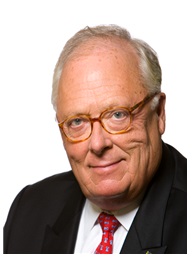
[Asia Economy Reporter Dongwoo Lee] The founder of the Heritage Foundation in the United States criticized the movement to pass the amendment to Korea's Fair Economy 3 Acts as a corporate regulation that does more harm than good to Korean companies, increasing the risk of exposure to attacks by activist funds.
The Federation of Korean Industries recently revealed on the 8th that in an exclusive written interview with Edwin Feulner, founder of the Heritage Foundation and former chairman of the Asia Center, he expressed these views regarding the impact of Korea's economic policies on the corporate management environment.
Fair Economy 3 Acts, 'Fair to Whom?'
Feulner said about the Fair Economy 3 Acts, "Calling this bill the Fair Economy Act is misleading, and I want to ask who it is fair to."
He also expressed concern that "Ultimately, it will result in limiting companies' ability to defend themselves when activist funds aggressively attempt to place outside directors aligned with their interests on the board."
He analyzed, "This amendment, under the pretext of 'fairness' and 'advancement of corporate governance,' will bring more harm than good to the foundation of Korea's private sector and companies," adding, "It seems to be another form of government-led legal regulation of companies."
Feulner also expressed negative opinions about the recently proposed amendments to the Labor Union Act, which allow unemployed and dismissed workers to join unions, and the 'Labor Director System,' which requires one outside director of listed companies to be recommended by labor representatives. He said, "There are concerns that these policies will not achieve their intended effects and that unions will become more politicized." He emphasized that freedom is essential in the labor market as in other markets.
Korea’s Tax Burden Soars to an All-Time High... Threatening Long-Term National Competitiveness
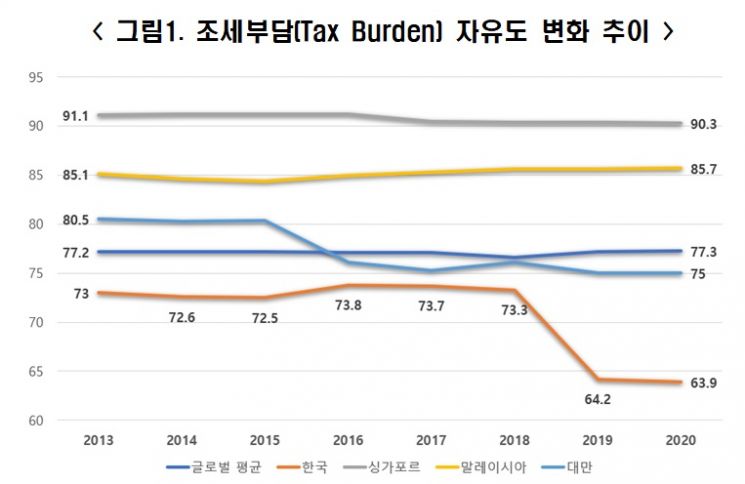
Regarding Korea's tax increase policies, Feulner said, "It is concerning that the tax burden rate has soared to an all-time high with the highest increase rate in 18 years, especially as corporate tax and capital gains tax have risen over several years."
According to the economic freedom index published by the Heritage Foundation, Korea's tax burden freedom score plummeted from 73.3 in 2018 to 63.9 in 2020. He emphasized, "The unbalanced tax system heavily dependent on large corporations has deteriorated sharply in recent years, and such a system is unsustainable and not beneficial to the country's long-term competitiveness."
Feulner stated, "Korea's top personal income tax rate is scheduled to increase from 42% to 45% next year, far exceeding the OECD average of about 35%." He warned that this tax rate hike will impose a heavier tax burden on the most productive and successful groups in the Korean economy.
Following the 2018 increase of the top corporate tax rate from 22% to 25%, this represents an additional burden. Feulner noted that these tax increase policies contradict the economic policies of other advanced countries that are lowering tax rates to encourage economic growth and corporate development, adding, "From the perspective of promoting a free and vibrant Korean economy, this is a move in the wrong direction."
Race to Deregulate Among Major Countries, Korea Falling Behind
Korea's score in the 'Business Freedom' category of the Heritage Foundation's Economic Freedom Index declined from 92.8 and 93.6 in 2013 and 2014 respectively to 90.5 in 2020.
Feulner commented, "The Business Freedom category measures the breadth and depth of deregulation compared to other countries, so the speed and intensity of regulatory reform are important," adding, "Many countries have advanced regulatory reforms over the years, but unfortunately, Korea is lagging behind in the reform race." He evaluated that although regulatory reform has been a recurring theme presented through various policies in recent years, it has always met backlash and remained merely a source of political conflict.
He further emphasized, "In innovative business areas such as autonomous electric vehicles and innovative pharmaceuticals, where venture companies cannot develop or commercialize alone, the participation of large corporations is necessary," and warned, "If the government treats large corporations only as predators to be fought for the protection of small and medium enterprises, innovation will be lost."
He argued that the Korean government needs to reflect on business-unfriendly policies such as increasing the number of public officials, sharp minimum wage hikes, mandatory reduction of working hours, and direct employment of subcontracted workers to enhance the effects of deregulation.
Limited Government Policies Must Be Implemented to Increase Economic Freedom
When asked about the most urgent sector for Korea to improve economic freedom, Feulner emphasized, "For freedom, opportunity, and economic prosperity to reach all citizens, the principle of the rule of law?equal justice under the law for every individual and limited government intervention in the economy?must be the focus." He stressed that clearly defined, limited, and predictable government policies are necessary to increase economic freedom.
He added, "Recently, disappointing results in areas such as government fiscal expenditure management have reduced the potential benefits of Korea's highly open economic system."
Kim Bongman, head of international cooperation at the Federation of Korean Industries, said, "Only when companies can operate freely can they continuously innovate in the era of the Fourth Industrial Revolution and drive Korea's economic growth in the post-COVID era," and requested, "We ask the government for active deregulation and support to increase Korea's economic freedom."
© The Asia Business Daily(www.asiae.co.kr). All rights reserved.
![User Who Sold Erroneously Deposited Bitcoins to Repay Debt and Fund Entertainment... What Did the Supreme Court Decide in 2021? [Legal Issue Check]](https://cwcontent.asiae.co.kr/asiaresize/183/2026020910431234020_1770601391.png)















