[Report] SMEs and Workers at Korean Shipbuilding Partners Struggle After Implementing 52-Hour Workweek
Technicians with Reduced Income Desperately Seek Side Jobs, Partners Struggle to Meet Deadlines
Industry Questions Whether Government Understands Reality
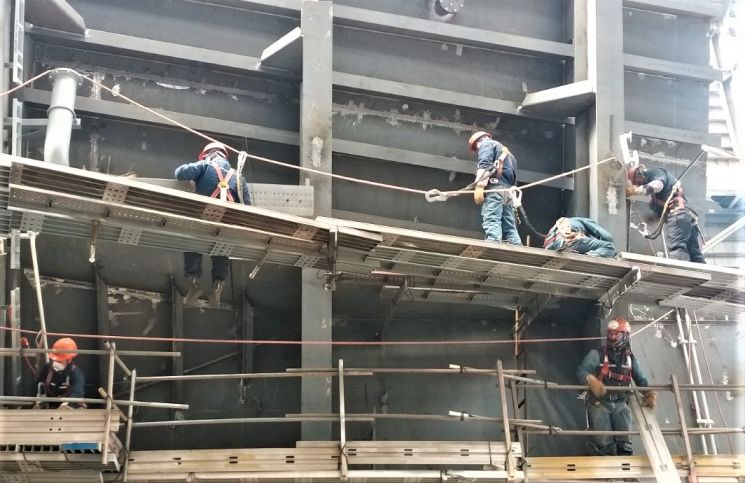 On the afternoon of the 4th, subcontractor employees from Inhyang were working on shipbuilding at Hyundai Heavy Industries Ulsan Shipyard in Ulsan Metropolitan City. Yang Chung-saeng, the CEO of the company, expressed concern, saying, "If the 52-hour workweek system is introduced, skilled workers will take on side jobs or move to other positions due to reduced wages, which will worsen the labor shortage." Photo by Kim Hee-yoon
[Ulsan=Asia Economy Reporter Kim Heeyoon] "It just feels like preaching to the deaf. What else could it mean but telling everyone to become lawbreakers?"
Yang Choongsaeng, CEO of Inhyang, a subcontractor of Hyundai Heavy Industries located in Jeonhadong, Ulsan, vented his frustration ahead of the end of the grace period for the 52-hour workweek system for workplaces with 50 to 299 employees. He explained that the system enforcement completely ignores the nature of shipbuilding, where outdoor work alone takes about seven months. CEO Yang said, "When the shipowner orders a ship and sets the delivery date, the entire subsequent schedule is planned accordingly, so if the delivery is delayed, the penalty fees are enormous." He raised his voice, saying, "Since work is difficult during extreme heat or cold, and if typhoons are frequent like this summer, delays in work are inevitable, making extended working hours essential on site, but none of these circumstances were considered."
CEO Yang also said, "If employees who used to earn 4 million won per month receive only 2 million won, how can they make a living?" In companies applying the 52-hour workweek system from this year, it is already well known in the region that welding technicians work part-time welding jobs at other factories on weekends, and low-experience, unskilled workers do substitute driving at night. This is to earn at least baby milk money and maintain their existing income and living standards to some extent.
CEO Yang appealed, "When working extended hours during busy times, it is an extension of familiar tasks, but if they do unrelated work to compensate for reduced income, rest becomes even more difficult, leading to decreased work concentration and increased risk of safety accidents."
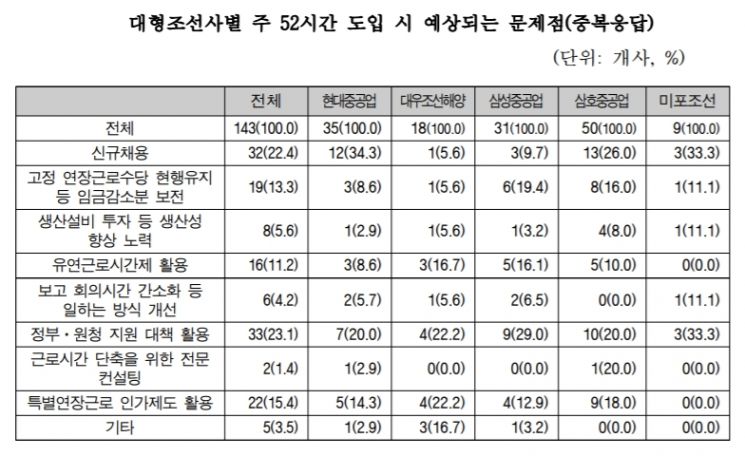 Expected Issues When Introducing a 52-Hour Workweek by Major Shipbuilding Companies. Table = Korea Small Business Institute
According to a survey by the Small and Medium Business Research Institute on working hours at subcontractors in the shipbuilding industry, about 78% of subcontractors exceed the 52-hour workweek due to the continuous nature of processes, design changes by shipowners, work delays caused by weather, and the importance of meeting deadlines, which are characteristics of shipbuilding. 76% responded that they frequently work extended hours. Subcontractor workers showed the highest turnover rate due to low wages, and it is expected that wages in assembly parts could decrease by up to 40% based on annual salary standards if the 52-hour workweek system is introduced.
The small and medium business sector is raising its voice about the implementation of the 52-hour workweek system for workplaces with 50 to 299 employees, questioning whether the government truly understands the reality. Initially, the government said it would discuss the matter through a public-private task force on reducing working hours for small and medium enterprises to facilitate a smooth transition to the 52-hour workweek system starting this January. However, the task force composed of the Ministry of Employment and Labor, the Ministry of SMEs and Startups, and the Korea Federation of SMEs has not held a single regular meeting for 10 months since February, citing the spread of COVID-19. The government's explanation that "we have been identifying and discussing companies' difficulties through close and continuous consultations" sounds unconvincing.
Professor Lee Jung of the Department of Law at Hankuk University of Foreign Studies pointed out, "If the 52-hour workweek system is introduced to small and medium enterprises already facing a crisis due to the prolonged COVID-19 pandemic, the impact on management will be doubled." He added, "Especially in manufacturing SMEs, the economic side effects of reducing working hours are expected to be significant, so it is urgent to prepare supplementary measures such as flexible working hours to mitigate the shock before the system is introduced."
© The Asia Business Daily(www.asiae.co.kr). All rights reserved.


















