Prolonged COVID-19 Causes Business Slump
Deterioration of Various Profitability Indicators
Hotel Shilla, Lotte, and Others Face Consecutive Downgrades
[Asia Economy Reporter Park Ji-hwan] Major tourism sectors such as duty-free, hotels, and casinos are facing a series of credit rating downgrades in addition to deteriorating performance. This is attributed to the prolonged business slump caused by the spread of the novel coronavirus infection (COVID-19) and the rapid worsening of various profitability indicators.
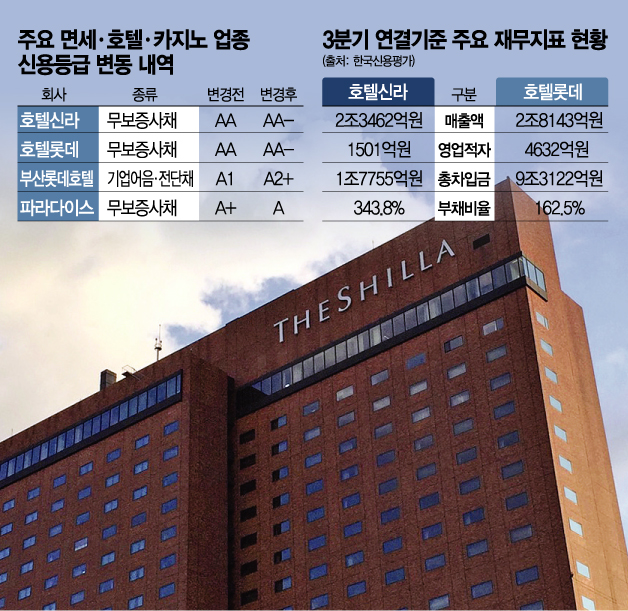
According to the credit rating industry on the 7th, Korea Ratings downgraded Hotel Shilla's unsecured bonds credit rating from AA to AA- on the 4th. Korea Ratings also downgraded Hotel Lotte's unsecured bonds credit rating from AA to AA- on the 24th of last month. The corporate commercial paper and short-term bonds credit rating of Busan Lotte Hotel were also lowered from A1 to A2+.
The recent rating adjustments for the duty-free and hotel sectors are largely due to the prolonged business slump caused by COVID-19. Quarantine measures such as mandatory self-isolation for overseas arrivals have led to a decrease in the number of foreign visitors, coupled with avoidance of multi-use facilities, resulting in a sharp drop in demand.
Hotel Shilla's cumulative consolidated sales for the third quarter amounted to 2.3462 trillion KRW, a 44% plunge compared to the same period last year. In particular, the operating loss reached 150.1 billion KRW. Although there was a positive atmosphere with signs of recovery in scale due to increased sales from Chinese proxy buyers and domestic travel demand in the second half, the recent resurgence of COVID-19 has reversed this trend to a decline. Similarly, Hotel Lotte's cumulative consolidated sales for the third quarter were 2.8143 trillion KRW, down 48% year-on-year, with an operating loss of 463.2 billion KRW during the same period.
As the business slump prolongs, the financial structure is rapidly deteriorating. Hotel Shilla's total borrowings, which stood at 1.5615 trillion KRW at the end of last year, increased by 13.7% to 1.7755 trillion KRW by the end of the third quarter this year. The borrowing burden to cover fixed costs continues to rise, and with ongoing large-scale pre-tax losses, the debt ratio surged sharply from 282.6% to 343.8% in just nine months. In the case of Hotel Lotte, borrowings increased from 7.9727 trillion KRW at the end of last year to 9.3122 trillion KRW by the end of September this year. The debt ratio also rose from 130.9% to 162.5% during the same period. The debt dependency ratio increased to 47.2%, indicating a significant rise in financial leverage compared to the past.
The possibility of continued credit rating downgrade cascades cannot be ruled out. Shinsegae Chosun Hotel also posted an operating loss of 47.3 billion KRW for the cumulative third quarter due to the direct impact of COVID-19. Sales were 104.4 billion KRW, down 29.3% year-on-year. Korea Ratings stated, "With the prolonged contraction in room demand due to the spread of COVID-19 and high uncertainty about the timing of normalization of the business environment, a continued deficit in cash flow is expected," adding, "Close monitoring of future business performance trends is required." Additionally, Hanwha Hotels & Resorts has recently triggered warning signs of credit rating downgrades.
Credit rating agencies have also taken action on the representative casino sector, Paradise. In October, NICE Investors Service downgraded Paradise's unsecured senior corporate bond credit rating from A+ to A. Korea Ratings also downgraded it from A+ to A. The market response was cold. At that time, Paradise conducted a demand forecast (pre-subscription) targeting institutions for a 100 billion KRW (3-year maturity) corporate bond issuance but did not receive a single purchase order. However, Paradise eventually succeeded in securing funds as the government's Special Purpose Vehicle (SPV) for corporate liquidity support purchased 70 billion KRW, and joint lead managers Mirae Asset Daewoo and SK Securities acquired 10 billion KRW and 20 billion KRW respectively. Researcher Park So-young of Korea Ratings evaluated, "Financial stability has deteriorated due to the business slump caused by COVID-19, and the possibility of recovery in the short term is limited," adding, "The borrowing burden is expected to continue expanding due to capital costs amounting to 50 billion KRW annually."
© The Asia Business Daily(www.asiae.co.kr). All rights reserved.
![Clutching a Stolen Dior Bag, Saying "I Hate Being Poor but Real"... The Grotesque Con of a "Human Knockoff" [Slate]](https://cwcontent.asiae.co.kr/asiaresize/183/2026021902243444107_1771435474.jpg)











