Nuclear Research Institute Develops In-House Robot
Establishes Unmanned Disaster Prevention System for Nuclear Accident Response
Continues Efforts for Industrial Use and International Cooperation
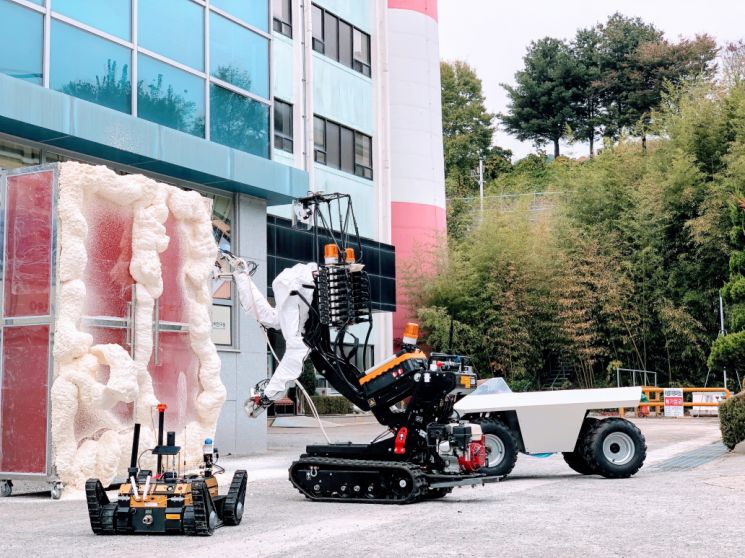 The nuclear robot developed in-house is playing an active role in the radiation disaster prevention training at the Korea Atomic Energy Research Institute. / Provided by Korea Atomic Energy Research Institute
[Asia Economy Reporter Junho Hwang] South Korea is joining the era of robotic disaster prevention for nuclear accidents. On the 7th, the Korea Atomic Energy Research Institute announced that it has established a disaster prevention system to respond to nuclear accidents using robots developed in-house, putting it on par with other advanced countries engaged in robotic disaster prevention. Attention is focused on whether this will become a fundamental measure to reduce secondary radiation exposure damage caused by human intervention at accident sites, such as the Chernobyl accident in Russia or the Fukushima nuclear accident in Japan.
Deployment of Robots in Nuclear Accidents
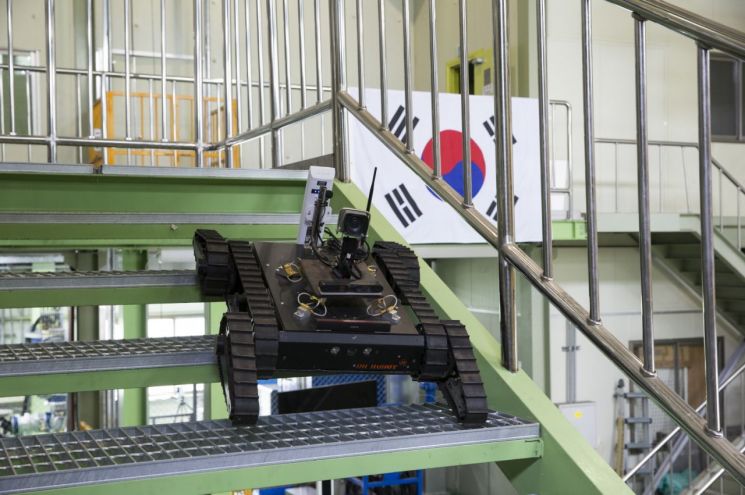 ) The indoor monitoring robot Tiram is climbing the stairs while capturing a 360-degree view of the site. / Provided by Korea Atomic Energy Research Institute
The core of the unmanned disaster prevention system built by the institute is robots. Indoor monitoring robot 'T-RAM', outdoor monitoring robot 'RAM', accident response robot 'Armstrong', and aerial radiation monitoring drones operate as a single team to respond at nuclear accident sites.
This system recently participated in an actual disaster prevention drill to prove its effectiveness. T-RAM is a small armored vehicle-type robot with a body height of only 30 cm, equipped with radiation and temperature detectors. T-RAM climbs stairs and obstacles and transmits real-time data on radiation levels, thermal imaging information, and 3D maps of the accident site to the outside.
RAM is a robot remotely controlled by a commercial ATV. It can carry radiation detection equipment and travel at speeds up to 60 km/h across the wide power plant site. The institute combined RAM with drones for aerial monitoring, enabling multi-angle observation and radiation contamination mapping from both ground and air.
Armstrong is a robot equipped with a hydraulic system that can freely move objects weighing up to 200 kg with both arms and traverse rough terrain using continuous tracks.
It operates by moving a human-arm-shaped 'master device,' which causes Armstrong's arms to move in the same way. It is capable of tasks ranging from assembling heavy pipes to delicate operations like plugging in LAN connectors.
Effectiveness Verified Through Actual Drills Since 2016
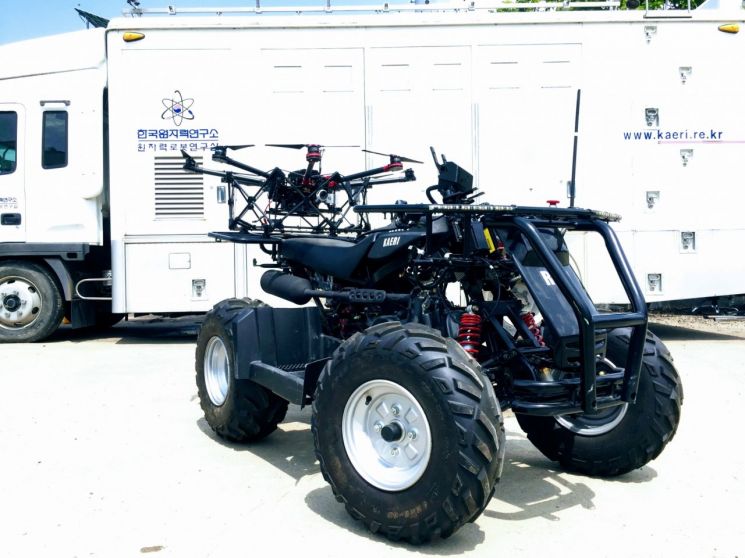 The outdoor monitoring robot Ram can rapidly move to the site together with a drone through remote control. / Provided by Korea Atomic Energy Research Institute
The institute conducts radiation emergency response drills more than twice a year with various scenarios to verify the effectiveness of its disaster prevention measures. Since 2016, robots have been deployed in six actual drills to verify effectiveness and improve the robots.
In particular, during this year's drill, the T-RAM robot successfully entered a building and transmitted the situation to the control room, while Armstrong successfully completed the task of sealing the entrance of a building leaking radioactive materials by spraying urethane foam.
Jung Kyung-min, head of the Robot Application Research Department, said, "The establishment of the institute's own robotic disaster prevention system is only the first step. We will strive to maintain a thorough readiness so that the public can feel safe even in the event of an accident through continuous improvements."
Park Jin-ho, director of the Nuclear Safety Research Institute, stated, "We will actively incorporate Fourth Industrial Revolution technologies to complete the second stage, where our robots support the national response system, and the third stage, which firmly establishes an international cooperation system with overseas disaster prevention agencies."
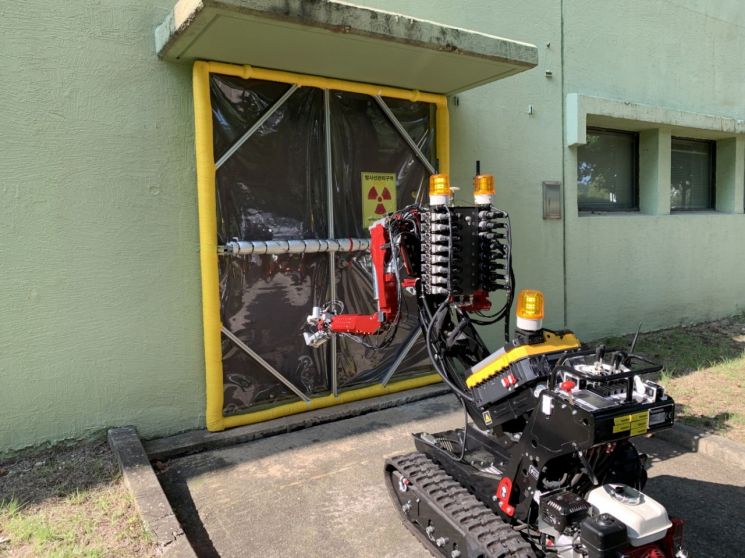 The Armstrong robot developed by the Korea Atomic Energy Research Institute is installing a shielding wall. / Provided by Korea Atomic Energy Research Institute
© The Asia Business Daily(www.asiae.co.kr). All rights reserved.



















