COVID-19 Cases Back to 600s in One Day... Additional Damage Inevitable
Additional Groups Likely to Include Low-Income People Beyond Small Business Owners
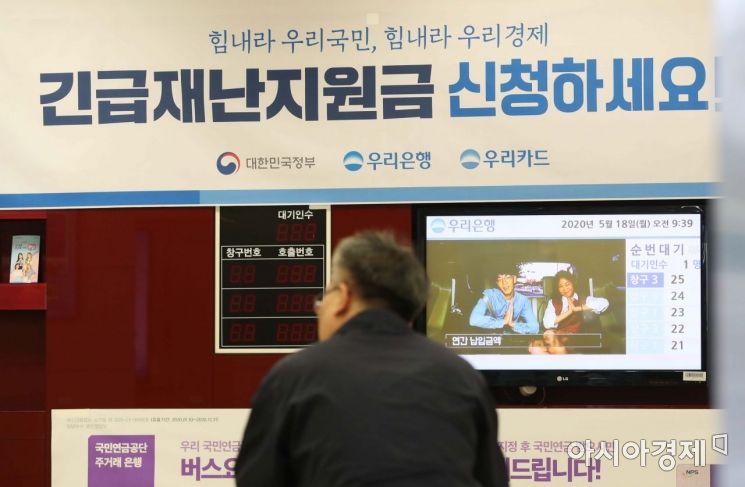 On the first day of on-site applications for the emergency disaster relief fund provided by the government to all citizens due to the novel coronavirus disease (COVID-19) crisis, a citizen is waiting for consultation regarding the emergency disaster relief fund at the Woori Bank Euljiro branch in Jung-gu, Seoul on the 18th. Photo by Moon Honam munonam@
[Asia Economy Reporter Jang Sehee] The 3 trillion won budget for customized support against the novel coronavirus infection (COVID-19) reflected in next year's budget by the National Assembly and the government has been revealed to be funds allocated for self-employed individuals and small business owners.
This means that the recipients of the third disaster relief fund are currently limited to self-employed individuals and small business owners who have suffered business losses due to the escalation of social distancing measures. However, the government may additionally provide support to low-income groups and small and medium-sized enterprises after assessing the extent of COVID-19 damage.
A government official stated, "The initial target requested by both ruling and opposition parties was small business owners." In this regard, Deputy Prime Minister and Minister of Economy and Finance Hong Nam-ki appeared on YTN News Special on the 2nd, when next year's budget was passed, and explained, "We judged it inevitable for the government to provide tailored support to the affected groups," adding, "Considering that about 3 trillion won was required for the Small Business Hope Fund payment, we allocated 3 trillion won this time."
During the formation of the 4th supplementary budget, the government allocated 3.3 trillion won for the Small Business Hope Fund, but the actual disbursed amount was 2.8 trillion won. In other words, the 3 trillion won budget for the third support fund was reflected considering only the scale of the small business support fund budget.
This means that the employment stability package (1.5 trillion won) for vulnerable employment groups such as special types of workers and youth, and the low-income package (400 billion won) reflected in the 4th supplementary budget are not included in the 3 trillion won support fund budget reflected in next year's budget.
Currently, only self-employed individuals and small business owners are included as recipients of the third support fund, but there is room for expansion to vulnerable employment groups or low-income groups in the future. According to the Central Disease Control Headquarters, as of 0:00 on the 6th, 631 new COVID-19 cases were confirmed, bringing the cumulative total to 37,546.
Depending on the additional spread of COVID-19, if there is a need to support these groups, it is expected that the scale, recipients, and timing of the support fund payments can be expanded.
In other words, if the scale of damage increases, additional funds such as reserves or contingency funds beyond the 3 trillion won reflected in next year's budget may be mobilized, and if that is still insufficient, the possibility of forming a supplementary budget remains open.
Meanwhile, the government intends to finalize the scale, recipients, and methods of payment within next year. The most likely timing for payment at present is before the Lunar New Year holiday.
© The Asia Business Daily(www.asiae.co.kr). All rights reserved.

















