Government Announces 11·19 Support Measures for Housing Stability of Low- and Middle-Income Classes
Seoul Apartment Jeonse Price Increase Rate Maintains at 0.15% Afterwards
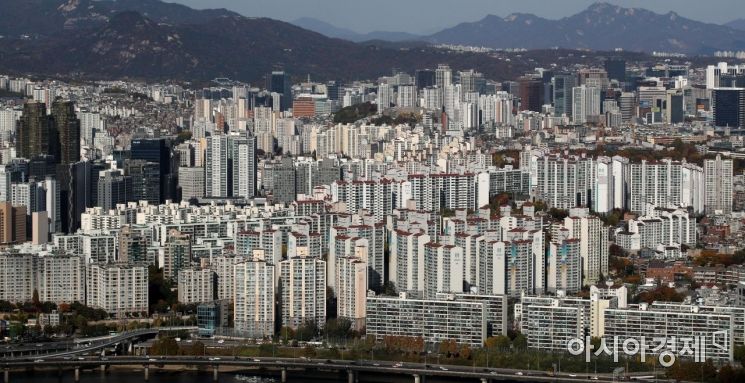 The Democratic Party of Korea and the government have settled on a property tax relief criterion for single-homeowners at "under 600 million won." The major shareholder requirement for stock capital gains tax will be maintained at the current 1 billion won with a grace period. The photo shows the view of Seoul apartments from the observatory of the 63 Building on the 3rd. Photo by Hyunmin Kim kimhyun81@
[Sejong=Asia Economy Reporter Joo Sang-don] Despite the government's announcement on the 19th of last month of the so-called 'additional Jeonse measures' to support housing stability for low- and middle-income classes, the upward trend in Jeonse prices has not subsided.
According to the Korea Real Estate Board on the 6th, the weekly Jeonse price of apartments in Seoul for the 5th week of November (as of November 30) rose by 0.29%. This is slightly lower than the 0.30% recorded in the 3rd week of November (as of the 16th), before the announcement of the '11·19 additional Jeonse measures', and the 0.30% in the 4th week of November (as of November 23).
However, Seoul maintained the rate of increase prior to the additional Jeonse measures. The Seoul apartment Jeonse price increase rate expanded from 0.10% at the end of October to 0.12% in the 1st week of November, 0.14% in the 2nd week, and 0.15% in the 3rd week. Afterwards, both the 4th and 5th weeks recorded an increase rate of 0.15%. This means that the price stabilization effect of the additional Jeonse measures has yet to appear.
Earlier, the government announced housing stability measures that include changing the supply method of vacant rental housing and converting empty commercial spaces or hotels to release '114,000 households' of Jeonse supply by 2022. The plan is to supply 114,000 households through ▲utilization of public rental housing vacant for more than 3 months (39,100 households) ▲public Jeonse housing (18,000 households) ▲newly built purchase agreements (44,000 households) ▲remodeling of vacant non-residential spaces such as commercial buildings, offices, and lodging facilities (hotels) (13,000 households). The government decided to accelerate the supply. Although previous measures such as the 5·6 and 8·4 plans announced supply measures with move-in possible after 2023, this time the plan is to focus on supplying 49,000 households nationwide, which is more than 40% of the total supply volume, including 24,000 households in the metropolitan area by the first half of next year, and to release the rest to the market by the end of next year.
The government expects these measures to calm the recent Jeonse supply and demand instability, but the effect has not yet appeared. Regarding this, Hong Nam-ki, Deputy Prime Minister and Minister of Economy and Finance, said in a recent interview with a media outlet, "The Jeonse market has still not stabilized, and as an official, I feel sorry. The government will do its utmost to stabilize the Jeonse market as much as possible." He added, "With the moving season easing and various short-term housing supply measures by the government taking effect, I believe that the instability in the Jeonse market can be significantly alleviated."
© The Asia Business Daily(www.asiae.co.kr). All rights reserved.
!["The Woman Who Threw Herself into the Water Clutching a Stolen Dior Bag"...A Grotesque Success Story That Shakes the Korean Psyche [Slate]](https://cwcontent.asiae.co.kr/asiaresize/183/2026021902243444107_1771435474.jpg)
















