Choo Mi-ae on "Political Investigation" Warrants Issued for 'Wolseong Unit 1'... Yoon Overcomes a Major Hurdle
Prosecutor General Yoon Files Constitutional Appeal Against 'Prosecutor Disciplinary Act,' Minister Choo Responds with Immediate Appeal
Controversy Over New Vice Minister Lee Yong-gu, Announcement of Prosecutor 'Drinking Entertainment' Investigation Results, and Focus on Lee Sung-yoon's Position
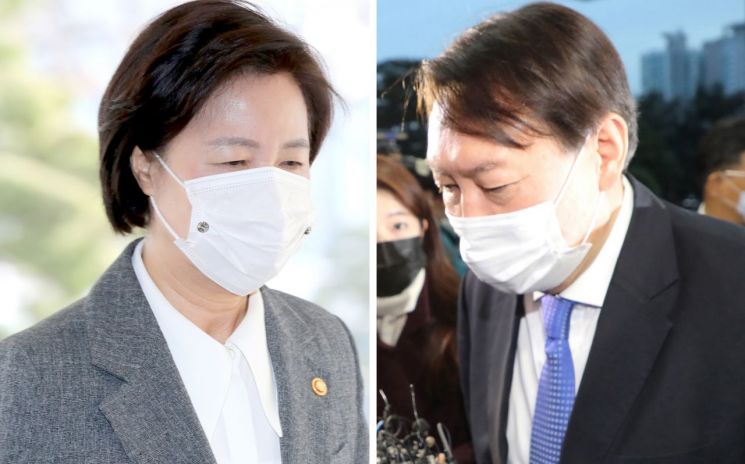 Minister of Justice Choo Mi-ae (left) and Prosecutor General Yoon Seok-youl. [Image source=Yonhap News]
[Asia Economy Reporter Choi Seok-jin] As the conflict between Justice Minister Choo Mi-ae and Prosecutor General Yoon Seok-yeol escalates into a legal battle ahead of the disciplinary committee meeting scheduled for the 10th, arrest warrants for those involved in the ‘alleged manipulation of the economic feasibility evaluation of Wolseong Unit 1’ case, on which the two had starkly different views, were issued by the court on the 4th.
Regarding the claims by Minister Choo and the ruling party that “this is not subject to investigation as it relates to government policy” and that Prosecutor General Yoon initiated the investigation for political purposes, Yoon’s side had countered that “this is not an investigation into the government’s nuclear power policy but a criminal investigation into the manipulation of the economic feasibility evaluation and obstruction of the Board of Audit and Inspection’s audit to enforce the policy.” The judiciary’s decision has, to some extent, confirmed the validity of Yoon’s argument.
With the arrest of the working-level officials who obstructed the audit and destroyed evidence, the prosecution’s investigation is expected to move up the chain of command to former Minister of Trade, Industry and Energy Baek Woon-kyu and then-Blue House Industrial Policy Secretary Chae Hee-bong (currently President of Korea Gas Corporation). Given the uncertainty over when Prosecutor General Yoon might step down or have his duties suspended, the Daejeon District Prosecutors’ Office is likely to expedite the investigation related to Wolseong Unit 1 as much as possible.
Director and Secretary of the Ministry of Industry Deny Charges but Are Detained
On the afternoon of the 4th, Judge Oh Se-yong, in charge of warrants at the Daejeon District Court, issued arrest warrants for a director-level official A and a secretary B of the Ministry of Industry, who were charged by the prosecution with violating the Board of Audit and Inspection Act and damaging official electronic records, stating, “They deny the crimes and there is a risk of evidence destruction.”
Official A is suspected of ordering B to delete documents related to Wolseong Unit 1 just before the Board of Audit and Inspection requested the submission of materials. B is accused of entering the Ministry of Industry office at the Government Sejong Complex around 11 p.m. on December 1 last year, after a meeting with the Board of Audit and Inspection auditor was scheduled for December 2, and deleting 444 documents related to Wolseong Unit 1 over about two hours.
At that time, B reportedly modified file names and deleted documents so that even if restored later, the original content would be unrecognizable for documents deemed important, and later, judging there were too many materials, simply deleted files or entire folders, as revealed by the Board of Audit and Inspection’s audit results.
However, Judge Oh rejected the arrest warrant for Manager C, who was also charged, stating, “The suspect generally admits the alleged crimes, and considering the evidence already secured, it is difficult to see a risk of evidence destruction or flight. Also, the suspect has pledged to sincerely cooperate with the investigation and trial. Therefore, at this stage, there is insufficient necessity or appropriateness for detention.”
Although one of the three individuals for whom the prosecution requested arrest warrants was denied, since the suspect admits the charges, the court can be seen as recognizing to some extent the seriousness and clarity of the prosecution’s allegations.
Court’s Issuance of Warrants Likely to Favor Yoon in Disciplinary Committee and Legal Battles
The court’s issuance of arrest warrants related to the ‘manipulation of the economic feasibility evaluation of Wolseong Unit 1’ case is expected to work in favor of Prosecutor General Yoon in the disciplinary committee meeting scheduled for the 10th and the ensuing full-scale legal battles.
If the court had dismissed the prosecution’s arrest warrants, it could have strengthened Minister Choo’s position, who criticized the Daejeon District Prosecutors’ Office’s search and seizure of the Ministry of Industry by accusing Prosecutor General Yoon of revealing political ambitions.
However, with the court’s issuance of the warrants allowing the prosecution to overcome the first hurdle in the Wolseong Unit 1 investigation smoothly, it has been confirmed through a neutral judiciary judgment that Yoon’s judgment was not wrong.
This situation could lend weight to opposition party claims that Minister Choo and the ruling party tried to remove Prosecutor General Yoon to block investigations, including those targeting the Blue House, beyond just the Ministry of Industry’s upper echelons.
In particular, Minister Choo requested disciplinary action against Yoon and ordered his suspension on the 24th of last month, when the Daejeon District Prosecutors’ Office’s report on the arrest warrants for Ministry of Industry officials was received by the Supreme Prosecutors’ Office, further arousing suspicion of such circumstances.
At the disciplinary committee meeting on the 10th, newly appointed Deputy Minister Lee Yong-gu, selected by Minister Choo, is expected to lead the meeting to reach a conclusion on severe disciplinary action against Yoon, replacing Minister Choo who cannot attend due to recusal provisions. From the perspective of the two prosecutors and three external members appointed by Minister Choo, the court’s issuance of arrest warrants is likely to be a factor that burdens the decision to impose severe disciplinary action on the Prosecutor General amid an ongoing important investigation.
Yoon’s Constitutional Complaint Against the Prosecutor Disciplinary Act vs. Minister Choo’s Immediate Appeal Against Court’s Suspension Decision
On the 4th, Yoon’s side filed a constitutional complaint and a provisional injunction to suspend the effect of Article 5, Paragraph 2, Items 2 and 3 of the Prosecutor Disciplinary Act, which allows the Minister of Justice to appoint or designate members of the Prosecutor Disciplinary Committee.
Among the seven disciplinary committee members, excluding the ex officio minister and deputy minister, five members remain. Of these, two are prosecutors appointed by the Minister of Justice (Item 2), and the other three are a lawyer, a law professor, and a person with extensive knowledge and experience, each appointed by the Minister of Justice (Item 3). This arrangement is argued to undermine fairness when the Prosecutor General, who is supposed to request disciplinary action, becomes the subject of the disciplinary charge, thus violating the Prosecutor General’s right to hold public office and equality rights.
Article 7 of the Prosecutor Disciplinary Act stipulates that while the Prosecutor General requests disciplinary action for prosecutors other than himself, the Minister of Justice must request disciplinary action against the Prosecutor General.
Meanwhile, Yoon’s side also requested a provisional injunction to suspend the effect of these provisions until the constitutionality is decided in the main case and to suspend the effect of Minister Choo’s disciplinary request and the appointment of disciplinary committee members made under these provisions.
Some argue that if the Constitutional Court accepts Yoon’s constitutional complaint, all disciplinary actions against prosecutors under the Prosecutor Disciplinary Act would become invalid. However, Yoon’s complaint is limited to cases where the Prosecutor General is the subject of disciplinary charges, so if the Constitutional Court rules the provisions unconstitutional, the ruling will be a limited unconstitutionality stating that “Article 5, Paragraph 2, Items 2 and 3 of the Prosecutor Disciplinary Act are unconstitutional insofar as they apply when the subject of disciplinary charges is the Prosecutor General.” Thus, except for former Prosecutor Generals who were previously disciplined, others will not be affected by the decision.
Another consideration is the subsidiarity of constitutional complaints. Article 68, Paragraph 1 of the Constitutional Court Act stipulates that constitutional complaints can only be filed after all other legal remedies have been exhausted if such remedies exist. For example, if the disciplinary committee decides to dismiss Yoon and the President dismisses him, and Yoon immediately files a constitutional complaint claiming infringement of fundamental rights due to dismissal, the Constitutional Court would dismiss the complaint on the grounds that there are other remedies such as administrative litigation to challenge the dismissal.
However, Yoon’s constitutional complaint is a constitutional complaint against the Prosecutor Disciplinary Act itself (so-called statutory complaint), filed before any unconstitutional administrative action occurs but when such action is imminent, requesting the court to judge the unconstitutionality of the law itself. The Constitutional Court has recognized an exception to subsidiarity for statutory complaints and has conducted substantive hearings on such complaints.
Meanwhile, on the day Yoon’s constitutional complaint was made public, Minister Choo filed an immediate appeal against the court’s suspension decision.
An immediate appeal is a procedure to appeal to a higher court against a court’s decision.
This move came three days after the Ministry of Justice stated it “respects the court’s decision” following the Seoul Administrative Court’s decision on the 1st to suspend the effect of Minister Choo’s order to suspend Yoon’s duties. It appears to be a countermeasure against Yoon’s constitutional complaint, considering public opinion trends.
If the Constitutional Court accepts Yoon’s complaint, the relevant provisions of the Prosecutor Disciplinary Act will be declared unconstitutional for infringing fundamental rights and will not apply at least to the Prosecutor General. Usually, the Constitutional Court urges the National Assembly to amend the law to remove unconstitutionality. However, under the Constitutional Court Act, the court’s unconstitutionality ruling on laws or provisions, except for penal provisions, generally has prospective effect without retroactivity. Therefore, whether the ruling affects Yoon himself, who filed the complaint, may be subject to differing opinions.
However, Yoon’s side also requested a provisional injunction to suspend the effect of Minister Choo’s disciplinary request and the appointment of disciplinary committee members under the relevant provisions. If the Constitutional Court accepts this, Yoon can continue to serve as Prosecutor General until the final decision is made, regardless of the disciplinary committee’s outcome on the 10th.
Meanwhile, Minister Choo’s immediate appeal challenges the “court’s suspension decision on the order to suspend Yoon’s duties.” If the higher court overturns the decision, the suspension order will be reinstated, and Yoon will again be excluded from his duties.
However, if the disciplinary committee decides on severe disciplinary actions such as dismissal or removal and executes them, Yoon’s duties to be suspended will cease to exist, so the immediate appeal’s effect will be limited to suspending duties until Yoon is dismissed or removed.
With the disciplinary committee meeting scheduled, it seems unlikely that the court or Constitutional Court will quickly decide on the immediate appeal or provisional injunction. However, there is a possibility of a confusing situation where the court accepts Minister Choo’s immediate appeal, suspending Yoon’s duties again, while the Constitutional Court accepts Yoon’s provisional injunction, halting the suspension order.
If the disciplinary committee on the 10th decides and executes dismissal or removal, the ongoing lawsuits or suspension injunctions against Minister Choo’s suspension order will become meaningless, as the position of Prosecutor General subject to suspension will no longer exist. In that case, Yoon is expected to file a lawsuit to cancel the disciplinary action and request a suspension of its effect again.
Ultimately, the most important factor is the outcome of Yoon’s lawsuit to cancel the disciplinary action. Considering the usual litigation period and that Yoon’s term has only about eight months left, the court’s acceptance of suspension and the Constitutional Court’s acceptance of provisional injunction will carry much greater significance than in other cases.
Adverse Developments Related to Deputy Minister Lee Yong-gu Ahead of the Disciplinary Committee on the 10th
Meanwhile, the controversy over Deputy Minister Lee Yong-gu’s Telegram chatroom, who replaced former Deputy Minister Ko Ki-young as an ex officio member of Yoon’s disciplinary committee, is likely to work against Minister Choo’s side.
On the previous day, Deputy Minister Lee was caught on camera exchanging messages such as “Yoon seems to be a bad hand” regarding Yoon’s constitutional complaint in a Telegram group chat during a closed session of the Legislation and Judiciary Committee at the National Assembly in Yeouido, Seoul, discussing the amendment of the High-ranking Officials’ Crime Investigation Office (HOCI) bill.
Notably, the chatroom included Minister Choo’s policy advisor and a participant named Lee Jong-geun 2, sharing the same name as Lee Jong-geun, head of the Supreme Prosecutors’ Office Criminal Division. This sparked controversy. Even if Minister Choo trusts the individual, if a senior Supreme Prosecutors’ Office official assisting the Prosecutor General discussed disciplinary measures with the Ministry of Justice Deputy Minister, the legitimacy of the disciplinary process against Yoon could be questioned.
The Ministry of Justice hastily explained that Lee Jong-geun 2 is not Director Lee Jong-geun but his wife, Park Eun-jung, the Ministry’s Inspection Officer. However, some media outlets raised suspicions of a “false explanation,” noting that Park joined Telegram about 50 minutes after the conversation between Deputy Minister Lee and Lee Jong-geun 2 took place.
Deputy Minister Lee was already controversial before his appointment for having previously represented former Minister of Industry Baek Woon-kyu, a key suspect in the Wolseong Unit 1 case.
Conscious of these controversies, he issued a statement shortly after taking office, saying, “Please do not prejudge the outcome and watch closely,” and “I promise to perform my duties solely according to due process and legal principles.”
However, just days after his appointment, the discovery of biased chat content seemingly aimed at dismissing Yoon during disciplinary discussions raises doubts about whether fair law enforcement can be expected.
Additionally, it was reported on the 5th that Park Eun-jung, the Inspection Officer, investigated former Minister of Justice Park Sang-ki regarding allegations related to Yoon at Deputy Minister Lee’s office in mid-last month. The Ministry of Justice explained that Park Sang-ki was using one room in Deputy Minister Lee’s office at the time, but it is unusual for an inspection officer to conduct an investigation related to a case under prosecution in the office of a lawyer representing a key suspect.
Based on these circumstances, Yoon’s side is highly likely to file a ‘challenge’ request against Deputy Minister Lee, an ex officio member.
If the Ministry of Justice does not provide the list of disciplinary committee members before the meeting, Yoon’s side will have no choice but to review the members on-site on the day of the meeting and submit a written ‘challenge’ against any members whose fairness is in doubt.
However, according to the Prosecutor Disciplinary Act, decisions on challenge requests require a majority of the total members present and a majority of those voting. Since the committee is composed mainly of members appointed or designated by Minister Choo, the likelihood of the ‘challenge’ being accepted is low.
If all ‘challenge’ requests against Deputy Minister Lee and prosecutors appointed by Minister Choo are rejected and the disciplinary committee proceeds to impose severe disciplinary action, the controversy over fairness is expected to intensify.
Next Week’s Announcements on Prosecutor ‘Drinking Entertainment’ Investigation, Judges’ Meeting, Lee Nak-yeon Investigation, and Lee Sung-yoon’s Position Also in Focus
The Seoul Southern District Prosecutors’ Office, which has been investigating allegations of ‘drinking entertainment’ involving former Star Mobility Chairman Kim Bong-hyun (indicted in custody), is expected to announce the investigation results next week.
The prosecution is reportedly preparing to indict Kim, lawyer Lee who arranged the drinking party, and three prosecutors on charges of violating the Improper Solicitation and Graft Act.
Whether the drinking party actually occurred and whether the prosecutors knew that Kim would pay for the drinks will be determined in court, but the key point is whether the prosecution’s announcement will reveal that Yoon was informed beforehand or that he covered up the case after receiving the report.
Some speculate that bribery charges could apply to prosecutors who joined the Lime investigation team after the drinking party, but since the prosecution has not yet requested arrest warrants for any involved parties, it is more likely that only charges under the Improper Solicitation and Graft Act will be applied with non-custodial indictments.
Meanwhile, attention is also on whether the Judges’ Representative Meeting scheduled for the 7th will include the agenda on the so-called ‘judge surveillance documents.’
Since opinions on the legality of these documents, which Minister Choo cited as a key disciplinary reason against Yoon, are divided even within the judiciary, whether this issue will be discussed in the judges’ meeting and what conclusions will be drawn could significantly influence Yoon’s disciplinary committee and subsequent trials.
Additionally, new allegations have emerged regarding Lee Nak-yeon, former Deputy Chief of Staff to the Democratic Party leader, who recently died by suicide during a prosecution investigation, raising questions about whether the prosecution will investigate connections to the party leader. Also, whether Lee Sung-yoon, head of the Seoul Central District Prosecutors’ Office and a representative ‘Choo line’ figure who has lost organizational control to the extent that his subordinates have urged him to resign, will continue to hold his position and lead investigations related to Yoon is another factor that could indirectly affect Yoon’s disciplinary process and future trials.
© The Asia Business Daily(www.asiae.co.kr). All rights reserved.

















