Consumer Price Inflation Rate in the 0% Range for Two Consecutive Months… Impact of Low Oil Prices, Free Education, and COVID-19
However, Fruit Prices and Jeonse Prices Continue to Rise
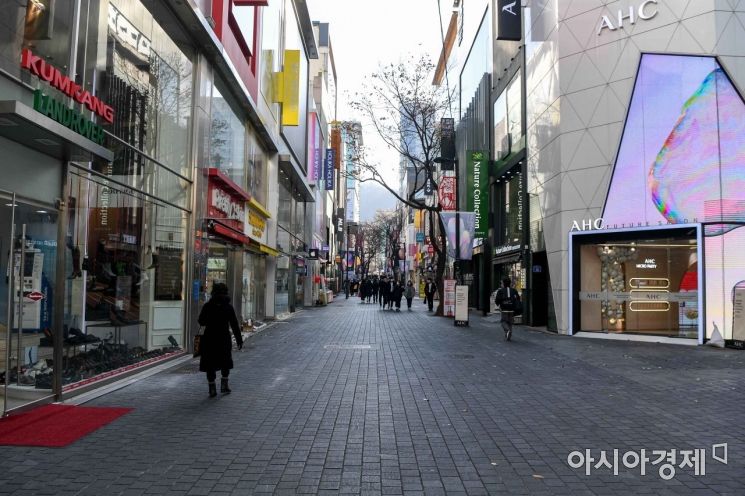 On the 3rd, as measures to curb the spread of the 'third wave' of the novel coronavirus infection are being strengthened in the metropolitan area, Myeongdong in Jung-gu, Seoul, shows a quiet scene. Photo by Jinhyung Kang aymsdream@
[Sejong=Asia Economy Reporter Joo Sang-don] The low inflation situation in the 0% range has continued for two consecutive months. This is the result of a combination of low oil prices, reduced education expenses due to the expansion of free education, and a slowdown in the rise of dining-out prices caused by the COVID-19 pandemic. However, fruit prices, which surged due to the rainy season and typhoons, are still soaring, and the rate of increase in jeonse (long-term lease) prices has reached the highest level since December 2018, making it difficult to feel the effects of low inflation.
According to Statistics Korea on the 5th, the consumer price index for November was 105.50 (2015=100), rising 0.6% compared to the same month last year. Although the rate of increase was 0.5 percentage points higher than the previous month (0.1%), the low inflation situation in the 0% range still continued.
Lee Doo-won, head of the Price Trends Division at Statistics Korea, said, "As the effect of the telecommunications fee support, which was a factor in the price drop in October, disappeared, the decline in public service prices narrowed (-6.6% → -2.0%), causing the consumer price inflation rate to increase from 0.1% to 0.6%. However, due to the decline in petroleum prices, public service support policies in the education sector, and the reduced rise in dining-out prices, the inflation rate remained low in the 0% range."
In fact, petroleum prices fell by 14.8% compared to the same period last year. Accordingly, industrial product prices dropped by 0.9%. Urban gas prices, linked to oil prices, decreased by 10.3%, causing electricity, water, and gas prices to fall by 4.1%. Additionally, high school tuition fees decreased by 74.4%, lowering public service prices by 2.0%. Dining-out prices rose by only 0.9%, compared to a 1.2% increase in November last year.
Despite these downward factors, the defense against 'negative inflation' was due to agricultural, livestock, and fishery products and housing rents. Agricultural, livestock, and fishery products rose by 11.1%, contributing to a 0.9% increase in commodity prices. Pork prices increased by 18.4%, and domestic beef rose by 10.5%. Particularly, the fresh food index, which is composed of 50 items with price fluctuations depending on seasonal and weather conditions, jumped 13.1% compared to the same month last year. Apples surged by 36.4%, causing fresh fruit prices to rise by 25.1%, while fresh fish and fresh vegetables increased by 7.1% and 7.0%, respectively. Lee explained, "Fruit prices fell by 11.2% compared to the previous month as autumn supplies came in, but due to the base effect of a good harvest last year, they rose compared to the same month last year."
Jeonse prices continue to rise. Housing rents, which fell by 0.2% year-on-year in November last year, rose by 0.6% in November this year. Both jeonse and monthly rents saw increased rates of rise. Jeonse increased from 0.6% in October this year to 0.8% in November, and monthly rent rose from 0.3% to 0.4%. The rate of increase in jeonse prices is the highest in 23 months since December 2018 (0.9%).
© The Asia Business Daily(www.asiae.co.kr). All rights reserved.

















