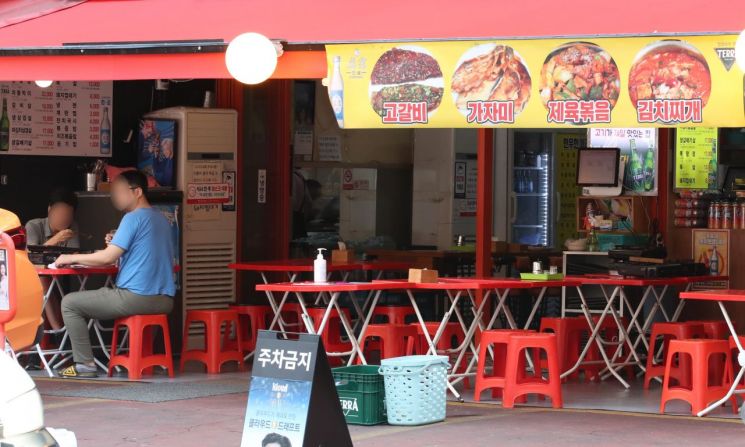
[Asia Economy Reporter Kim Eun-byeol] As the third wave of the novel coronavirus infection (COVID-19) continues, self-employed business owners are being pushed into the worst situation. The number of self-employed people who are putting their stores up for rent because they cannot afford the rent or are holding on with loans has significantly increased. Since the shock to face-to-face service industries such as lodging and food service is expected to continue for the time being, the government is also expected to provide additional financial support.
According to the Bank of Korea's "Loans by Industry of Depository Institutions in the 3rd Quarter" statistics on the 6th, loans to non-corporate enterprises (self-employed) by deposit banks reached a record high of 387.9 trillion won at the end of the third quarter this year. This is an increase of 9.1 trillion won compared to the end of the second quarter. Although the increase in loans to self-employed in the third quarter was smaller than the previous quarter (21.2 trillion won), loans still increased by more than 9 trillion won in just one quarter. The increase was the second largest since the fourth quarter of 2018, when related statistics began to be compiled, following the second quarter of this year.
The Bank of Korea has expanded and published detailed statistics on loans by corporate type, including corporate and non-corporate enterprises, by industry of deposit banks. Non-corporate enterprises refer to entities that are not corporate enterprises, including individual business owners, associations, organizations, and non-profit organizations. Given the significant economic impact of the COVID-19 crisis on self-employed business owners, this new statistic aims to provide an analysis of their loan status.
The government reflected 3 trillion won as a contingency reserve despite controversy, incorporating the budget for the third emergency disaster relief fund for this reason. The government plans to selectively provide disaster relief funds to small business owners, similar to the second emergency disaster relief fund payment.
Deputy Prime Minister and Minister of Strategy and Finance Hong Nam-ki recently stated, "We reflected a budget of 3 trillion won because there are small business owners suffering from difficulties due to the third wave of COVID-19 and support for damages is necessary," adding, "the actual support targets will be selected after analyzing the extent of the damage, but there is a precedent of 3.3 trillion won support for small business owners in the previous Hope Fund case."
He continued, "The scale of disaster relief funds will be supported at 3 trillion won plus alpha (α) by adding other budgets secured," emphasizing, "The government is preparing to make payments before the Lunar New Year holiday in February."
Since the number of self-employed people who cannot afford rent and employee salaries is already increasing, and with the third wave of COVID-19 overlapping, the government intends to step in and provide support funds as the impact on self-employed businesses is expected to be significant.
According to Statistics Korea, as of August, the number of self-employed with employees decreased by 172,000 to 1,363,000, while the number of self-employed without employees increased by 66,000 to 4,193,000. Due to the self-employed downturn, business income (991,000 won) also decreased by 1.0%, marking a decline for two consecutive quarters following the 4.6% drop in the second quarter. As sales plummeted, self-employed business owners who had been employing staff laid them off and more are now running their businesses alone.
© The Asia Business Daily(www.asiae.co.kr). All rights reserved.
![Clutching a Stolen Dior Bag, Saying "I Hate Being Poor but Real"... The Grotesque Con of a "Human Knockoff" [Slate]](https://cwcontent.asiae.co.kr/asiaresize/183/2026021902243444107_1771435474.jpg)











