Global Times of China "China is the Global Standard for the Kimchi Industry"
Kimchi Food Standards Already Registered with the UN
World Kimchi Research Institute "No Basis for China's Claim"
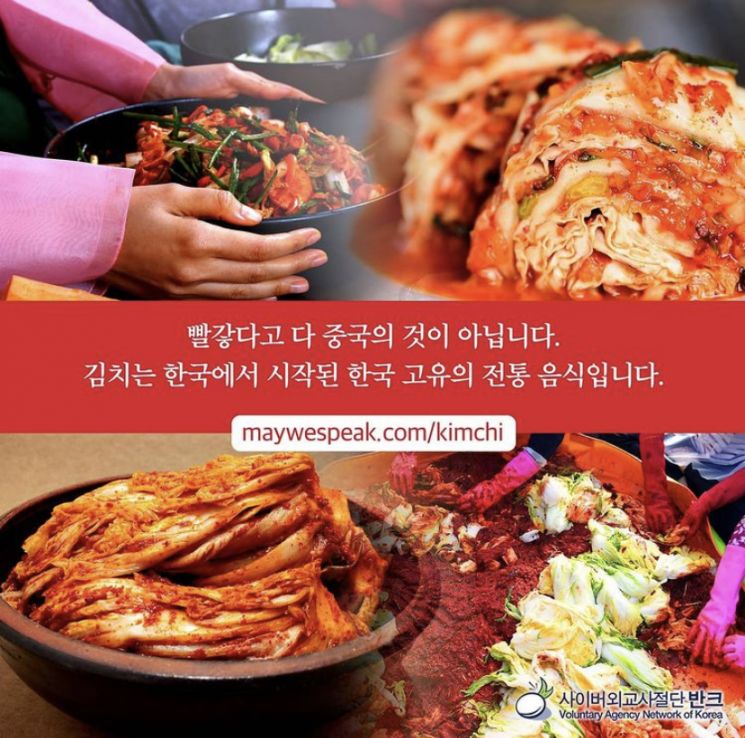 This is a digital poster created by the cyber diplomacy group VANK on the 3rd. Photo by VANK official Instagram post capture.
[Asia Economy reporters Han Seung-gon and Kim Young-eun] Recently, a Chinese media outlet sparked controversy by distorting the fact that "China is the global standard for the kimchi industry." In response, domestic and international public opinion has opposed this as an unacceptable false report.
On the 29th of last month, China's Global Times reported, "Since the International Organization for Standardization (ISO) has set the Chinese pickled vegetable pao cai (泡菜) as an international standard, Korean kimchi also falls under pao cai, so now China is the global standard for the kimchi industry." Additionally, on the Chinese search engine company Baidu, it was stated that "Kimchi is a long-standing cultural heritage of China, and the origin of kimchi is China."
However, all of this is distorted reporting. The Global Times falsely reported as if kimchi was included in the international standard for pao cai. The International Organization for Standardization (ISO) clarified that "kimchi is not applied to the pao cai standard."
Regarding the 'kimchi origin country' controversy between the two countries, Hua Chunying, spokesperson for the Chinese Ministry of Foreign Affairs, showed evasion at the regular briefing on the 1st by saying, "Is there a controversy about this? I don't really know," which sparked public outrage.
In response, the Ministry of Agriculture, Food and Rural Affairs stated, "It is inappropriate to report Sichuan's pao cai as indistinguishable from our kimchi," and added, "Food standards related to our kimchi were already established as international standards by member countries at the Codex Alimentarius Commission (CODEX) under the United Nations (UN) Food and Agriculture Organization (FAO) in 2001."
Foreign media also reported this prominently and refuted the Chinese reports. The British public broadcaster BBC reported on the 30th of last month (local time) that "South Korea rejected the false report that China had internationally recognized the manufacturing method of the traditional Korean food kimchi." It introduced the ingredients and kimjang culture of Korean kimchi and explained that it is different from Chinese kimchi.
Furthermore, the cyber diplomatic mission VANK, upon learning of this news, posted a request for correction on the world's largest petition site 'Change.org,' which has about 400 million members, targeting the Global Times and Baidu Encyclopedia, China's representative portal site, for spreading distorted information about kimchi on the 3rd.
VANK created a digital poster with the phrase "Not everything red belongs to China. Kimchi is a unique traditional Korean food," and announced that it would counter China's 'kimchi project' by distributing this poster in Korean, English, and Chinese through social networking services (SNS).
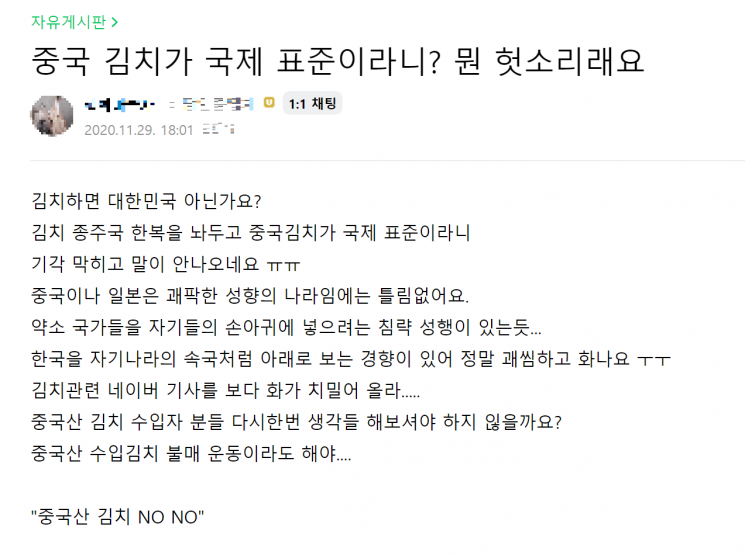
Citizens are also voicing their incomprehension. Online communities such as gourmet sharing cafes are responding with comments like "At this rate, they might say kimchi was made by China over time," "It's so absurd, I'm speechless," and "Seeing this news during kimjang season is even more ridiculous."
An office worker, Mr. A, said, "Recently, with hanbok and other things, it feels like China keeps trying to take something away," and added, "When it comes to traditional Korean food, kimchi is the first thing that comes to mind, and of course, kimchi is our country's food, so what nonsense is this?" He expressed frustration, saying, "I hope we actively respond to such false reports so that no unfair incidents occur in the future."
Experts also dismissed China's claim that kimchi is Chinese food as baseless. On the 3rd, Jo Jung-eun, head of strategic planning at the World Kimchi Research Institute, explained on CBS Radio's 'Kim Hyun-jung's News Show' that "China's pao cai is a pickled food, and general pickled foods are common not only in China but also in Japan, Germany, and other countries."
He continued, "However, kimchi is made by salting raw vegetables, then seasoning them with chili, garlic, etc., and undergoing two fermentation processes, during which functional substances like lactic acid bacteria, which were not present in the raw materials, are produced, making it a nutritionally excellent food."
Regarding the controversy, he said, "China is making various efforts to commercialize pao cai, and as part of that, it seems they established the ISO international standard. The problem started when Chinese media exaggerated the establishment of the pao cai standard as a standard for kimchi."
Jo added, "Kimchi has already received international standards from the Codex Alimentarius Commission under the UN, so there is not a strong need to receive a kimchi standard from the private organization ISO. Nevertheless, we are considering reviewing the registration of the ISO kimchi standard."
© The Asia Business Daily(www.asiae.co.kr). All rights reserved.


















