Securing Maximum Friction Regardless of Moisture
Unveiling the Hidden Role of Fingerprints
 Hyundai Motor Company Develops Smart Fingerprint Authentication Entry and Start System / Unrelated to the Article
When we grasp an object, which hand holds better: a wet hand or a dry hand?
Professor Park Geon-sik's research team at Seoul National University, together with Professor Kim Seong-wan from the same university's College of Medicine, Professor Michael J. Adams from the University of Birmingham in the UK, and Professor Lee Min-geol from Yonsei University, recently published their findings addressing this question in the Proceedings of the National Academy of Sciences of the United States of America, announced on the 5th.
Both Wet and Dry Hands Achieve 'Maximum Frictional Force'
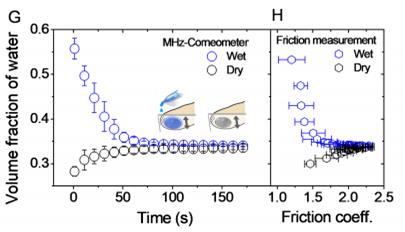 A graph illustrating that the fingertips maintain an optimal moisture level to maximize friction regardless of the presence of moisture.
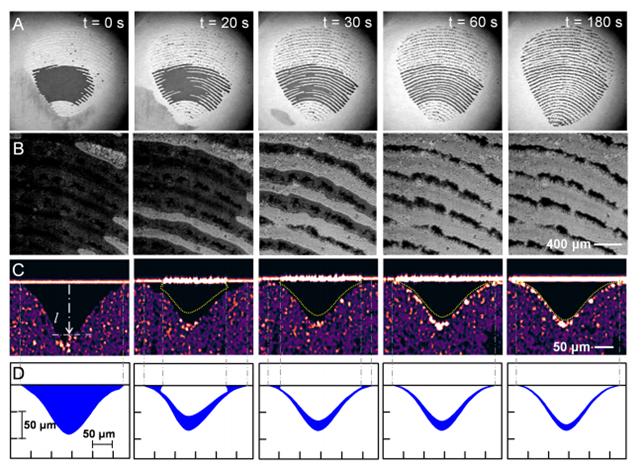
The research team examined fingerprints on fingertips using a femtosecond laser-based polarization-adjustable terahertz spectroscopy, OCT utilizing infrared light, and a moisture meter employing MHz waves. They observed fingerprints contacting a glass surface under varying moisture conditions.
The results showed that fingertips secure maximum frictional force whether wet or dry. In the case of dry fingers, sweat secretion at the fingertip increased skin plasticity. Subsequently, friction at the fingertip increased, allowing the fingerprint ridges and surface to adhere sufficiently, effectively blocking sweat glands.
On the other hand, for wet fingers, capillary evaporation occurred in the fingerprint grooves, removing excess moisture. The research team explained, "Regardless of whether the fingertip was initially wet or dry, the moisture level always reached a value corresponding to maximum friction between the finger and the object."
Potential Applications in Touch Screens and More
The research team described this as "a study revealing the previously unknown role of fingerprints," explaining that "primates evolved epidermal ridges (fingerprints) on their palms and soles and developed higher sweat gland density in areas with fingerprints, providing an answer to this question."
They added, "Understanding this fundamental mechanism will play an important role in applications involving ubiquitous contact, such as fingertip pads contacting flat screens, and is expected to contribute to improving haptic feedback performance."
© The Asia Business Daily(www.asiae.co.kr). All rights reserved.



















