Novelist Sangmun Lee Returns with New Book 'Red Eyes'
[Asia Economy Reporter Park Byung-hee] In the film about the Vietnam War, "Apocalypse Now" (1979), a French woman who lost her husband tells the protagonist Captain Willard, "There are two people inside you. The one who loves and the one who kills."
Among the works in the National Museum of Modern and Contemporary Art's collection, there is an oil painting titled "Beast-like Man." It depicts a human head with horns on both sides attached to the body of a four-legged beast. This piece was painted in 1986 by artist Choi Dong-yeol, who served as a Marine Corps intelligence officer and participated in the Vietnam War for two years.
Isn't war a chaos where the boundaries between friend and foe blur, and a monster hidden inside me, unknown even to myself, emerges?
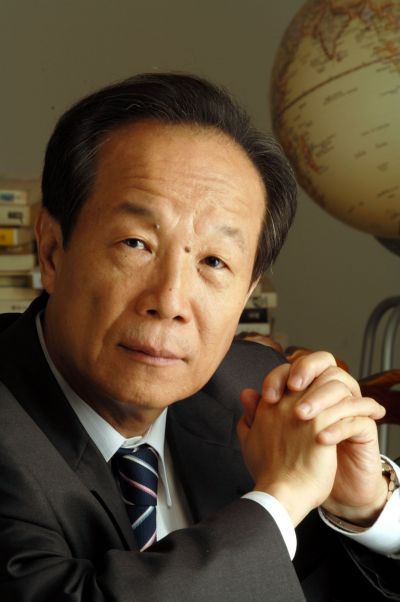
In the new novel "Red Eyes," written by novelist Lee Sang-moon, who also uses the Vietnam War as a theme, two characters with extreme contrasts, Hwang Deok-su and Gu Jong-gu, appear. When I met the author at a restaurant in Sinsa-dong on the 1st, he explained, "Hwang Deok-su is portrayed as the most human-like figure, while Gu Jong-gu is depicted as the most beast-like."
Lee Sang-moon is a Vietnam War veteran. He was in Vietnam from March 1970 to January 1972. He debuted in 1983 by winning the Monthly Literature New Writer Award with his short story "Bullet Wound," which dealt with the Vietnam War. In 1987, he became a bestselling author with the three-volume novel "Yellow Man," which also focused on the Vietnam War. In 1994, he published the five-volume novel "The Taegukgi Flutters in the Wind."
"Red Eyes" is the author's fourth Vietnam War novel, published after 26 years. The title means bloodshot eyes. It represents the struggle to survive in extreme situations.
"It took five nights and six days to travel by ship from Vietnam back to Korea. I saw quite a few people with bloodshot eyes on the ship. I thought, 'That person must have suffered a lot.' Most special forces soldiers have red eyes. They have seen many tragic scenes and always move risking their lives. Even after returning to Korea, those people suffer for three to four months because of their red eyes."
Hwang Deok-su and Gu Jong-gu are special forces soldiers. Gu Jong-gu is the bravest but also the most cruel among the unit members. He is like a demon. Hwang Deok-su instinctively feels repulsion toward Gu Jong-gu. A Vietnamese high school girl named Thi?u Mai becomes entangled between them. About 40 years after returning from Vietnam, Gu Jong-gu contacts Hwang Deok-su. "That wild boar Gu Jong-gu, that inhuman guy, called me."
After returning from the war, Hwang Deok-su marries a woman named Jung Mi-yeon, with whom he exchanged consolation letters. However, Jung Mi-yeon suffers from diabetes and depression and eventually commits suicide. The author explains that Jung Mi-yeon is a secondary victim of the Vietnam War. "Hwang Deok-su appears fine on the outside but is sick inside. Since his own situation is so bad, he doesn't realize how much pain his wife is going through because of him. There is no way to comfort or explain, so secondary victims occur."
The novel unfolds by alternating between Hwang Deok-su meeting his wife in dreams and meeting Gu Jong-gu in reality. Hwang Deok-su reconciles with his deceased wife, sharing the words they couldn't exchange while she was alive. He also reconciles with Gu Jong-gu.
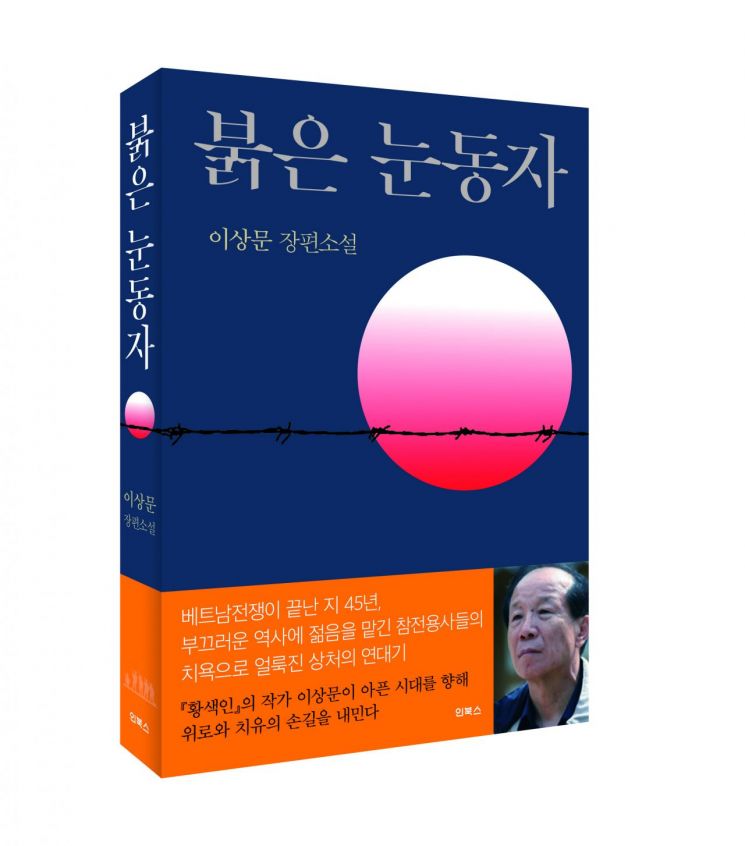
Fourth Vietnam War Novel by Veteran Author of Bestseller "Yellow Man"
Hwang Deok-su: Human but Sick Inside · Gu Jong-gu: Beast-like but Good-hearted
Contrasting Characters Depict the Horrors of War "I Consider This My Last and Do My Best"
The author explained that Gu Jong-gu is a link between the Korean War and the Vietnam War. "Gu Jong-gu is a character close to absolute evil, but inside he still has humanity. Seeing officers busy taking care of their own interests, he thinks he must take care of his own as well. He intends to be compensated for the Vietnam War and help the victims of the Korean War after returning. Because this thought is so strong, he had to build up his military record. People around him find this pitiful and sometimes see him as a demon."
The author said that the Vietnam War should be considered in connection with the Korean War. This is necessary to properly understand the tragedy of our nation. "If the Korean War (6·25) had not happened, the relationship between our country and the United States would have been different. Our tragedy should be seen as continuing from the Korean War, division, and the Vietnam War."
In April 1990, the author visited Vietnam as a guest reporter for the Seoul Shinmun. At that time, Vietnam had not yet established diplomatic relations with Korea, so he had to obtain a visa in Thailand. Moreover, Vietnam was a unified country under North Vietnam, which the author had fought against as an enemy. The author said he was somewhat fearful before arriving in Vietnam. But it was a needless worry. At that time, Vietnam had just introduced an opening policy, and the safety of foreigners was an important issue.
Saigon Airport (now Tan Son Nhat International Airport), which he stepped on again after about 20 years, was just as he remembered. The blackened runway stood out. "They had burned it because they had no herbicides." North Vietnam won the war but failed to solve poverty. In 1989, it introduced the reform and opening policy called "Doi Moi." Thanks to that, Lee Sang-moon, from a non-diplomatic country Korea, was able to enter Vietnam.
In December of the same year, Lee Sang-moon visited Vietnam again with support from the Busan Ilbo. He published two reportage books titled "Vietnam Ballad" and "The Revolution Is Not Over," documenting his two visits to Vietnam.
Lee Sang-moon said he will no longer write novels related to the Vietnam War. He said he is exhausted. The current society is mainly composed of generations who only know the Vietnam War intellectually. There is inevitably a gap with the author, who has the war engraved in his bones. The memories that come to mind when writing are painful for the author. What is more difficult is that stories about the Vietnam War no longer resonate in society and are buried.
"I often wonder if I am just flailing about. 'Red Eyes' is a novel I wrote with the thought that it would be my last, so I gave it my all. The Vietnam War had a tremendous impact on our country. We need to properly understand how we went, why we went, what happened, and what kind of wounds the returnees carry. I think someone has to do this, so I have written novels until now. History is said to be a dialogue between the past and the present. If the past is false and hidden, there can be no dialogue, so there is no future. There may be a future, but it will not be a true future."
The author said he plans to publish a book related to hanji (traditional Korean paper) next year and has already written about 500 pages.
© The Asia Business Daily(www.asiae.co.kr). All rights reserved.
![Clutching a Stolen Dior Bag, Saying "I Hate Being Poor but Real"... The Grotesque Con of a "Human Knockoff" [Slate]](https://cwcontent.asiae.co.kr/asiaresize/183/2026021902243444107_1771435474.jpg)

















