Statistics Korea Announces '2020 First Half Employment Indicators for Women by Number of Children' on the 4th
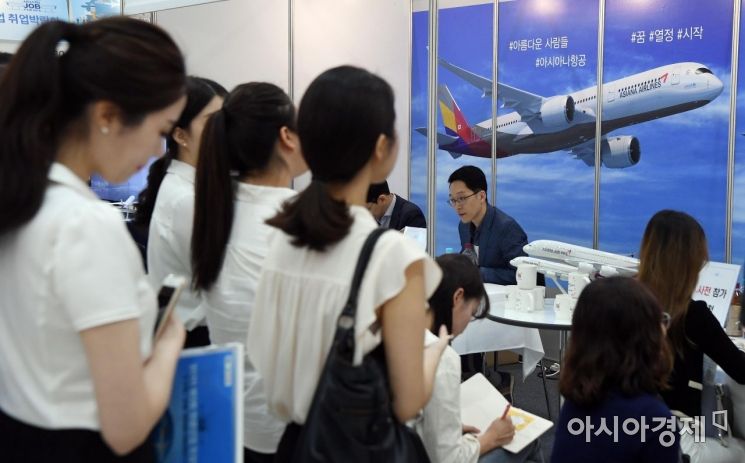 On the 5th, job seekers are waiting in line to receive employment consultations at the 2nd Aviation Industry Job Fair held at the International Terminal of Gimpo International Airport in Gangseo-gu, Seoul. Photo by Hyunmin Kim kimhyun81@
[Asia Economy Reporter Jang Sehee] Due to the novel coronavirus infection (COVID-19) and other factors, the employment rate of married women aged 15 to 54 with children under 18 years old fell for the first time since related statistics began to be compiled in April this year. In particular, the employment rate of women was lower when they had younger and more children.
According to the "2020 First Half Regional Employment Survey (Additional Items) Employment Indicators of Women by Number of Children" released by Statistics Korea on the 4th, as of last April, there were 8.578 million married women aged 15 to 54, accounting for 60.8% of women aged 15 to 54. Among married women, 4.81 million lived with children under 18, accounting for 56.1% of married women.
The overall economic activity participation rate and employment rate also decreased. The economic activity participation rate of married women aged 15 to 54 was 61.9%, down 1.7 percentage points from the previous year, and the employment rate fell 1.8 percentage points to 60.1%.
The employment rate of married women living with children under 18 was lower the more children they had and the younger the children were. When there was one child, the employment rate was 57.1%. For two children (54.8%) or three or more children (51.0%), the employment rate was lower than this.
Among working women living with children, 40% earned less than 2 million won per month. The distribution was 31.5% earning between 2 million and 3 million won, 30.9% earning between 1 million and 2 million won, and 14.9% earning between 3 million and 4 million won. Those earning less than 1 million won accounted for 8.4%, and those earning more than 4 million won accounted for 14.4%.
By industry and occupation characteristics, business, personal, and public service sectors (53.6%) and wholesale, retail, accommodation, and food service sectors (21.3%) showed the highest proportions.
Meanwhile, by employment status, there were 2.17 million wage workers (81.2%) and 502,000 non-wage workers (18.8%). Among wage workers, 1.662 million were regular workers (76.6%), and 507,000 were temporary or daily workers (23.4%).
© The Asia Business Daily(www.asiae.co.kr). All rights reserved.
!["The Woman Who Threw Herself into the Water Clutching a Stolen Dior Bag"...A Grotesque Success Story That Shakes the Korean Psyche [Slate]](https://cwcontent.asiae.co.kr/asiaresize/183/2026021902243444107_1771435474.jpg)
















