Ministry of Foreign Affairs and Korea National Diplomatic Academy Hold '2020 Northeast Asia Peace Cooperation Forum'
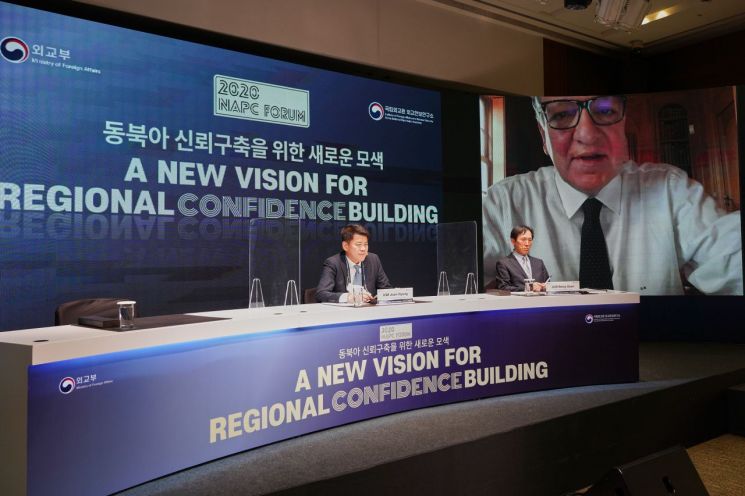
[Asia Economy Reporter Lim Cheol-young] On the 3rd, the Ministry of Foreign Affairs and the Korea National Diplomatic Academy held the ‘2020 Northeast Asia Peace and Cooperation Forum’ under the theme ‘A New Vision for Regional Confidence Building.’
The ‘Northeast Asia Peace and Cooperation Forum’ is a key implementation measure of the South Korean government’s project to establish a ‘Northeast Asia Peace and Cooperation Platform,’ aimed at accumulating practices of multilateral dialogue and cooperation within the Northeast Asian region. Each year, private experts from participating countries in the region?South Korea, China, Japan, the U.S., Russia, Mongolia?and external dialogue partners attend.
This year’s meeting was held in a hybrid format considering the COVID-19 situation, combining small-scale attendance by domestic speakers, remote video conference participation by overseas figures, and live streaming on a YouTube channel. In his opening remarks, Kim Jun-hyung, President of the Korea National Diplomatic Academy, emphasized that the South Korean government’s ‘Northeast Asia Peace and Cooperation Platform’ is useful as a multilateral platform to discuss confidence building and future visions for peace and prosperity in the geopolitically tense Northeast Asian region.
The first keynote speaker, Manuel Barroso, former European Commission Commissioner, highlighted that reconciliation in Cold War-era Europe was achieved through countries continuously creating shared economic interests for political integration. He pointed out that internal problem-solving capabilities, such as strong leadership and commitment from regional political leaders, are more important than external conditions.
The second keynote speaker, Federica Mogherini, former High Representative of the EU for Foreign Affairs and Security Policy, emphasized that the reason Europe, once marked by intense conflicts and disputes, could establish a security cooperation system was that European countries created shared economic interests and established institutions recognizing each other as one community. She added that it was possible because European political leaders showed generous wisdom and courage for integration while securing support for European integration from external countries.
The first session, moderated by Kim Jun-hyung, President of the Korea National Diplomatic Academy, featured a discussion on ‘The Future of Confidence Building in Northeast Asia Based on the European Case.’
Jamie Shea, former Deputy Assistant Secretary General for Emerging Security Challenges at NATO, advised in his keynote speech that considering China’s rise in Asia and the North Korean nuclear issue, NATO should strengthen relations with Northeast Asian countries and play a more active role in the Asian region.
Following this, Wang Zhiqiao, Director of the Center for Sino-Foreign Humanities Exchange at Peking University, stated that based on Europe’s integration experience, confidence building in Northeast Asia requires resolving disputes through dialogue and consultation, establishing order based on norms, and envisioning a comprehensive multilateral mechanism involving various participating countries.
Yoshihide Soeya, Professor at Keio University, emphasized that historical reconciliation is not a prerequisite for regional cooperation and that reconciliation can be induced through positive synergy in the cooperation process. He pointed out that the current Korea-Japan relationship is a significant loss to East Asian multilateralism politically and economically. He also mentioned that cooperation among the middle powers Quad [MPQ], consisting of ASEAN, Japan, South Korea, India, and Australia, is a strategy for regional countries to coexist amid U.S.-China competition.
Jeon Bong-geun, Professor at the Institute of Foreign Affairs and National Security of the Korea National Diplomatic Academy, proposed measures for confidence building in the region, including normalization of relations among South Korea, China, and Japan; establishment of a denuclearized peace regime on the Korean Peninsula; institutionalization of the ‘Northeast Asia Peace and Cooperation Platform’; building solidarity among middle powers in the region; formation of multilayered minilateralism; establishment of a shared consciousness community to promote regionalism; and expansion of nuclear-weapon-free zones including Asia and the South Pacific to build an East Asian peace and prosperity community.
The second session, moderated by Kim Ki-jung, President of the National Security Strategy Institute, discussed ‘Exploring Initial Confidence-Building Measures among South Korea, China, and Japan.’ Wang Junsheng, Professor at the Chinese Academy of Social Sciences, proposed that the three countries, which have relatively well managed COVID-19 globally, conduct joint research and create cooperation mechanisms in non-traditional security fields such as health security, disaster relief, and social security. Park Chang-hee, Professor at the Korea National Defense University, suggested launching the ‘Northeast Asian Defense Dialogue,’ a consultative body where the three countries discuss common security issues to enhance mutual understanding, trust, and military transparency.
Following this, Endo Ken, Professor at Hokkaido University, stated that normative consensus among regional countries and U.S. support are necessary for Northeast Asian regional cooperation. He also mentioned the need to actively utilize not only the trilateral cooperation system among South Korea, China, and Japan but also various regional cooperation bodies within the region.
On the second day of the conference, the 4th, a closed special session titled ‘Regional Cooperation Initiatives for Responding to the COVID-19 Pandemic’ was held under the moderation of Oh Young-joo, Director of the Institute of Foreign Affairs and National Security. In this special session, experts from Northeast Asian countries including South Korea, China, Japan, Russia, and Mongolia discussed concrete regional cooperation measures for pandemic response.
© The Asia Business Daily(www.asiae.co.kr). All rights reserved.

















