Mapo, Yongsan, Seongdong Districts 84㎡ Surpass 1 Billion Won
Seodaemun, Dongdaemun Districts Major Complexes Reach 900 Million Won
ePyeonhansesang Sinchon Agent "No Listings Below 1 Billion Won"
Even Outlying Nowon District's Top School Complexes Surpass 800 Million Won
Rising Trend Continues Despite Government Jeonse Measures
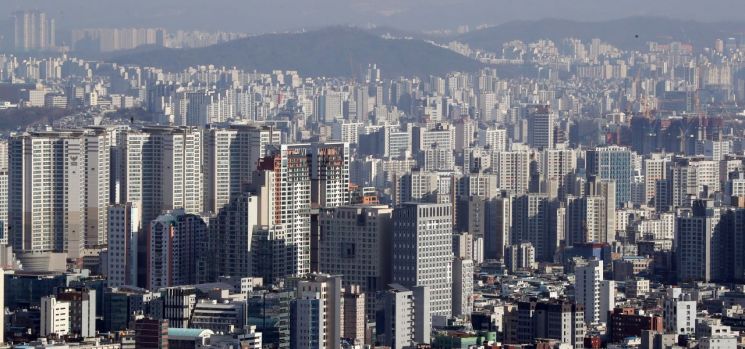
[Asia Economy Reporter Onyu Lim] Salarymen are being pushed out of downtown areas due to skyrocketing apartment jeonse (long-term lease) prices. This is because even jeonse living on the outskirts of downtown Seoul for a family of four now requires at least 1 billion KRW. Concerns are growing that the implementation of the 'Lease 2 Laws,' including the right to request contract renewal and the rent and jeonse price cap system, is seriously threatening the housing stability of the middle class.
According to frontline real estate agencies and the Ministry of Land, Infrastructure and Transport's actual transaction price disclosure system on the 4th, the jeonse prices of major complexes around 84㎡ (exclusive area) in the Seodaemun and Dongdaemun districts of Seoul are approaching 1 billion KRW one after another. Following the trend where jeonse prices for apartments of the same size in Mapo, Yongsan, and Seongdong districts (collectively known as 'Mayongseong') have surpassed 1 billion KRW, neighboring areas are also simultaneously adjusting their prices upward.
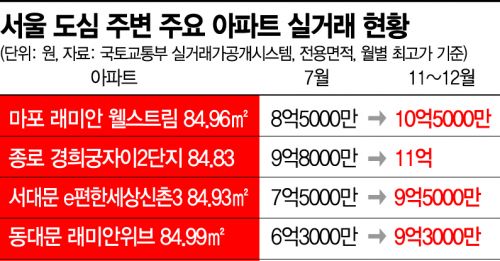
On the 1st, an 84.93㎡ unit in E-Pyeonhansesang Sinchon 3 Complex in Bukahyeon-dong, Seodaemun-gu, was leased for 950 million KRW. This is the first case where an apartment under 85㎡ in Seodaemun-gu recorded a jeonse price in the 900 million KRW range. Previously, the jeonse price for this apartment was 756 million KRW at its peak in September, meaning it jumped by nearly 200 million KRW in just two months. A representative from A Real Estate Agency in the area said, "There are nearly 2,000 households in this complex, but there are only one or two 84㎡ units available for jeonse, so the supply is extremely scarce," adding, "Currently, no landlord is offering a price below 1 billion KRW."
On the same day, a new record for jeonse contracts exceeding 900 million KRW was reported in Dongdaemun-gu as well. An 84.99㎡ unit in Dapsimni-dong's Raemian Weave was leased for 930 million KRW. In this complex, an 84.98㎡ jeonse unit was traded for 900 million KRW for the first time in Dongdaemun-gu on the 13th of last month. Currently, the asking price for jeonse units of the same size has risen to as high as 950 million KRW.
Generally, 84㎡ corresponds to a supply area of about 32 to 34 pyeong, featuring three bedrooms and two bathrooms, making it a typical residence for a family of four. Because of this, industry insiders assess that considering recent prices and market trends, the benchmark for middle-class apartment jeonse prices in the outskirts of downtown has effectively risen to the 1 billion KRW level. Due to the soaring jeonse prices, even the middle class is facing the risk of being pushed out not only from the Gangnam area, known for its excellent educational environment, but also from the downtown outskirts where the advantage of proximity to work is enjoyed.
In the 'Mayongseong' area, popular in the northern part of Seoul, 84㎡ apartment jeonse prices have already surpassed 1 billion KRW. In Mapo-gu, an 84.96㎡ unit in Hyunseok-dong's Raemian Wellstream was traded on the 8th of last month for 1.05 billion KRW, which is 100 million KRW higher than the previous jeonse price. In Yongsan-gu, an 84.96㎡ unit in Ichon-dong's Hangaram was leased for 1 billion KRW. In Seongdong-gu, an 84.99㎡ unit in Hawangsimni-dong's Centras was leased for 1.02 billion KRW on the 13th of last month, and an 84.92㎡ unit in Oksu-dong's Oksu Park Hills was leased for 1 billion KRW on the 16th of last month.
Industry sources say that jeonse prices in outer areas are also not a situation to be reassured about. The jeonse price increase is fierce even in relatively affordable areas such as Nodogang (Nowon, Dobong, Gangbuk) and Geumgwan-gu (Geumcheon, Gwanak, Guro). Some apartments in Nowon-gu, where there is high demand due to school districts and academies, have already seen 84㎡ jeonse prices exceed 800 million KRW. An 84.77㎡ unit in Cheonggu 3rd Complex in Junggye-dong, despite being 25 years old, was leased for 800 million KRW on the 24th of last month. A representative from B Real Estate Agency near this apartment said, "Units on higher floors within the complex that have been remodeled are even listed at 890 million KRW."
The government's lease market stabilization plan announced on the 19th of last month has also failed to calm the market. Despite the government's announcement to supply 71,400 jeonse-type rental units in the metropolitan area by 2022, jeonse prices are rising even more steeply. According to KB Kookmin Bank, the average jeonse price for housing in Seoul surged 2.39% month-on-month last month, marking the highest increase in 18 years and 8 months since March 2002.
The Korea Construction Industry Research Institute explained, "After subtracting 15,700 units utilizing existing public rental vacancies and 29,500 units converted to jeonse from previously announced supplies in the 5th, 6th, and 8th, 4th measures, the actual new supply is 26,200 units," adding, "When analyzed in total volume, this is only about 1.3 times the average monthly new jeonse and monthly rental transactions in Seoul in 2020, so it is necessary to observe the market impact of the supply volume."
It is also pointed out that the government's supply mainly focuses on multi-family houses and officetels rather than apartments, which are the epicenter of the jeonse shortage, reducing the effectiveness of the measures. Yang Ji-young, director of R&C Research Institute, said, "The core of the recent jeonse shortage is the lack of apartment supply," adding, "There are limits to dispersing demand to multi-family houses, multiplex houses, and officetels in outer areas with poorer residential environments."
© The Asia Business Daily(www.asiae.co.kr). All rights reserved.


















