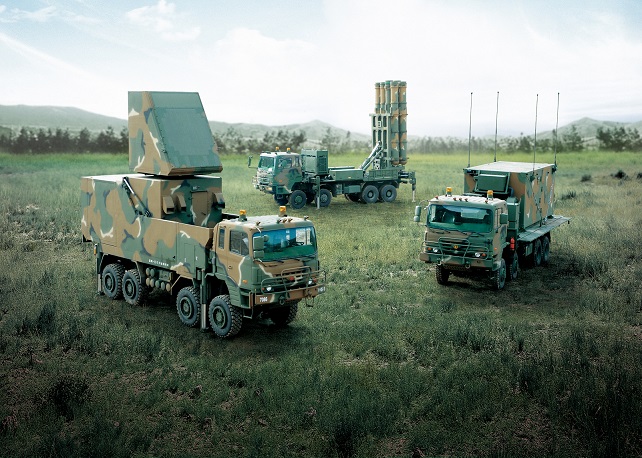
[Agency for Defense Development]At the time the development of Cheongung began, the Air Force was operating the Hawk and Nike systems, which were developed by the U.S. Air Force in the 1950s, as air defense assets. Considering the obsolescence of these weapon systems and long-term defense technology strategies, a plan to pursue research and development of a medium-range surface-to-air guided missile was reviewed, and the Joint Chiefs of Staff decided on the requirements in 1994, reflecting the timing for deployment and military performance needs.
The Agency for Defense Development started developing core technologies through system concept research and exploratory development from 1998, then officially began system development of Cheongung under the project name ‘Chunmae-II’ in 2006, completing development by the end of 2011. At the time Cheongung development was initiated, only countries such as the United States, Russia, France, Japan, and Israel?which was developing the Arrow ballistic missile defense system?had developed medium- to long-range surface-to-air guided missiles. The plan to domestically develop a medium-range surface-to-air guided missile, which only a few advanced countries had succeeded in, raised many concerns.
However, the necessity to domestically develop a weapon system to replace the aging Hawk was compelling. Another major consideration was that developing Cheongung, which required the application of many core technologies, could elevate South Korea’s missile guidance technology to a new level.
At that time, the agency had experience developing the Hyunmoo surface-to-surface guided missile, the short-range surface-to-air guided missile Chunma, and the ship-to-ship guided missile Haeseong. The major challenge was how to successfully develop the essential weapon system with limited technology and budget.
▲ How was the initial spin method of the Cheongung missile finalized?= The Cheongung missile demands high speed and high maneuverability. Although the agency had design experience with the Chunma missile, designing a high-speed, highly maneuverable missile shape with only tail fins was a different level of technology. Until the end of 1999, the agency struggled to finalize the missile’s shape.
The biggest issue was deciding on the initial spin method to change the missile’s flight direction after launch. Early in development, a jet vane method using some of the thrust from the propulsion system was chosen, and components were manufactured for various tests. The design was to be finalized based on test results, but the missile’s weight increased significantly beyond initial estimates.
Additionally, the heavy jet vane mounted at the rear shifted the missile’s center of gravity backward, making it difficult to secure guidance and control stability. After much debate, the research team ultimately removed the jet vane and adopted an initial spin method using side thrusters that generate separate thrust from the missile’s sides.
This was a new initial spin method never before attempted by any advanced country. The side thrusters were originally designed for use during the terminal phase of guidance and control, but some were used during the initial spin phase as well. The initial spin method using side thrusters became one of Cheongung’s distinctive features.
▲ An unforgettable gift from a fisherman= During Cheongung’s exploratory development phase, three missile firing tests were conducted. The first and second firing tests, conducted from April 2004, both failed. The failure of the first test was suspected to be due to malfunctions in the propulsion system and missile body. The second test failure was tentatively concluded to be mainly caused by a design error in the launch tube’s ejection plate.
However, as preparations for the third firing test scheduled for early July 2005 were underway, a fisherman delivered missile debris recovered from the sea in front of the test site to the comprehensive test unit.
Upon checking the part numbers, it was astonishingly confirmed that the debris was from the missile used in the first firing test. After disassembling the debris and inspecting the propulsion system, a hole was found near the nozzle assembly of the combustion chamber. This supported the cause analysis that if a hole occurred in the propulsion system near the end of combustion after the first firing test, side thrust could be generated, explaining the missile malfunction. The propulsion system research team, which had insisted that holes in the propulsion system were impossible, began reviewing the design from scratch to understand this unprecedented phenomenon.
The propulsion system structure includes heat-resistant material attached inside to protect against heat, and bubbles generated in this heat-resistant material were the cause. Thanks to this, the research team was able to correct the early development error and developed a new manufacturing method to improve reliability. Subsequently, the missile firing test conducted on May 20, 2011, succeeded, marking the successful completion of the 14-year Cheongung development project. Cheongung was finally delivered to the military in April 2020. By succeeding in developing a medium-range surface-to-air guided missile, a culmination of advanced guided weapon technology, South Korea’s defense science and technology took a significant leap forward.
© The Asia Business Daily(www.asiae.co.kr). All rights reserved.

















