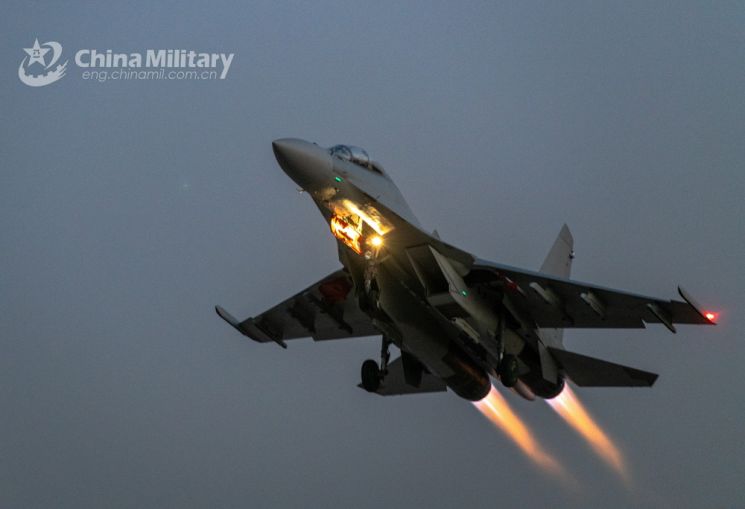
 The Chinese version of the Strike Eagle, the J-16, performs air-to-air, air-to-ground, and air-to-ship missions, with a range of up to 4000 km. Photo by the Chinese Ministry of National Defense
[Military Analyst Kim Daeyoung] The J-16 is a fighter jet developed by China by replicating and upgrading the Russian Su-30MKK, which is operated by the Chinese Air Force and Navy. It boasts performance comparable to or exceeding that of the American F-15E, earning it the nickname "Chinese Strike Eagle." It was produced by Zhonghang Shenfei, the same company that developed and manufactured the J-11, the Chinese version of the Su-27.
The J-16, first identified on the Chinese internet in 2012, successfully completed its maiden flight on October 17, 2011, and its existence gradually became more apparent starting in 2013. In November 2016, satellite images captured several J-16 fighters deployed at a Chinese Air Force experimental training base located in Gansu Province in northwest China. Later, on July 30, 2017, during the 90th anniversary military parade of the Chinese armed forces, five J-16 fighters flew in a tight formation through the parade ground, confirming their operational deployment. China CCTV, which broadcast the parade, introduced the J-16 as a fighter jet with significantly enhanced electronic warfare capabilities.
After the Gulf War in 1990, the Chinese military sought to improve its air power, which lagged far behind that of the U.S. military, by acquiring Su-27 and Su-30MKK fighters from Russia. Among these, the Su-30MKK was specially developed for China. The original Su-30 is a multirole fighter developed by Russia, known as a rival to the American F-15E Strike Eagle, with both air-to-air and air-to-ground capabilities. Like the F-15E, it was developed based on the Su-27 air superiority fighter and is used by more than ten countries, including Russia. Over 500 units have been produced, boasting various derivatives.
Starting in 2000, the Chinese military imported the Su-30MKK fighters, deploying about 100 units across the Chinese Air Force and the Chinese Naval Aviation. Unlike the original Su-30, the Su-30MKK uses carbon fiber reinforced plastic, a type of composite material, in its airframe to extend its range. The J-16, developed based on the Su-30MKK, is equipped with China’s domestically developed active electronically scanned array radar, PL-15 medium-range air-to-air missiles, PL-10 infrared-guided air-to-air missiles, as well as air-to-ground and anti-ship missiles. Its engines are the domestically produced WS-10B turbofan engines.
It is also known to use radar-absorbent materials to reduce the radar cross-section of the fighter. Additionally, a variant called the J-16D, similar to the U.S. Navy’s EA-18G Growler electronic warfare aircraft, is reportedly under development based on the J-16. Nearly 200 J-16 fighters have been deployed to the Chinese Air Force as of this year, with priority given to the Eastern Theater Command, which would lead any invasion of Taiwan. Most recently, deployment of the J-16 has accelerated in the Northern Theater Command, which covers the Korean Peninsula operational area. The 3rd Brigade of the Chinese Air Force under the Northern Theater Command, based in Qiqihar, Heilongjiang Province in northeast China, operated the J-7 fighter, the Chinese version of the MiG-21, until last year but has completed the transition to the J-16 this year.
© The Asia Business Daily(www.asiae.co.kr). All rights reserved.

















