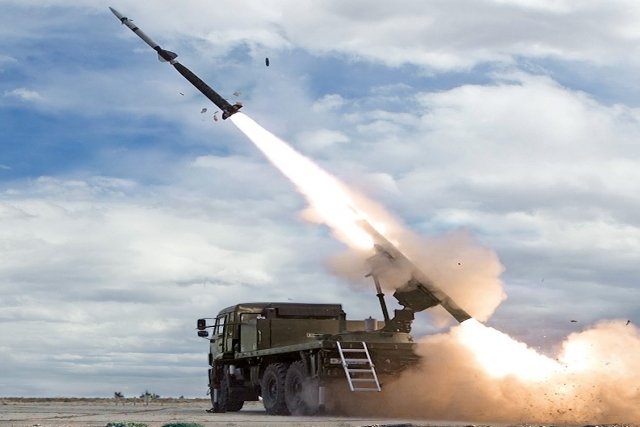
[Researcher Dain Kim, Aviation Guidance Research Team 3, Defense Technology Quality Institute] A Russian defense company has begun developing a tactical hypersonic surface-to-surface missile based on the Hermes guided weapon system.
This missile has been given the development name Klevkov-D2 and is expected to provide an intermediate capability between the Iskander-M missile, operated by dedicated missile brigades at the army group level, and the BM-30 Smerch multiple rocket launcher deployed in artillery battalions.
According to preliminary performance specifications, the missile’s weight must not exceed 150 kg to allow launch from multiple platforms. Additionally, the missile’s caliber must not exceed 207 mm, which is the caliber of the Hermes missile series it is based on, and it must be equipped with a 57 kg warhead capable of defeating armored vehicles, light fortifications, and buildings.
The missile is expected to achieve a top speed of Mach 5 during the cruise phase by using a ramjet engine and to provide initial acceleration through a separable launch motor. Separately, according to a procurement announcement published on September 9, 2020, in Russia’s integrated procurement information system, a contract was signed with the Tula Design Bureau for the development of an extended-range version named Klevkov-D2-Calibre missile.
This development can be seen as part of Russia’s ongoing efforts to introduce powerful military capabilities into its force structure. The Russian Ministry of Defense has emphasized the need for remote weapons and has extensively pursued long-range precision munitions linked to real-time reconnaissance systems.
The Klevkov-D2 development project is being promoted as an attempt to transfer these capabilities to the tactical level, aiming to prevent ground forces from relying solely on the Iskander-M missile, ship-launched Kalibr cruise missiles, and BM-30 missiles, which provide less accurate area-effect munitions.
© The Asia Business Daily(www.asiae.co.kr). All rights reserved.

















