Piloted and Unmanned Aircraft Form a Team in 'MUM-T'
Not Science Fiction but Military Power Development Nearing Reality... Preparing for Deployment
[Monthly Aviation Editor-in-Chief Kim Jae-han] One of the technologies gaining attention in today’s global military aircraft market is the ‘MUM-T’ or ‘Manned-Unmanned Teaming’ system. As the name suggests, it is a concept where manned aircraft with pilots onboard and unmanned aircraft without pilots operate as a team to carry out missions. Just a decade ago, this was a scene likely to appear only in science fiction movies, but it has now become a reality.
▲Basic Specifications of Future Fighter Jets= The MUM-T concept actually emerged in the early 2000s. It was introduced by the U.S. Air Force to increase the success rate of attacks on critical targets in Afghanistan. At that time, the U.S. Air Force implemented a team operation concept by applying a data link that allowed real-time data sharing between the AC-130 gunship, a ground-attack aircraft, and the MQ-1C Predator, an armed reconnaissance UAV. In this first MUM-T operation, the Predator transmitted video footage captured by its sensors to the AC-130 in real time, enabling the AC-130 to accurately strike important targets based on the video data.
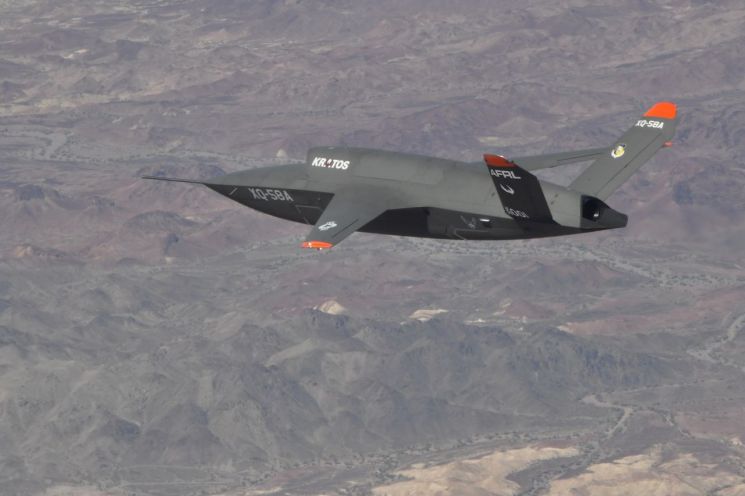
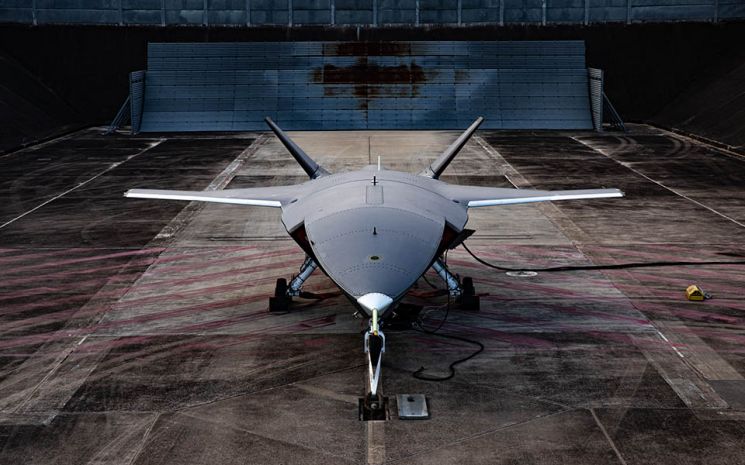
The modern MUM-T concept, evolved from this initial idea, has become the basic specification for the 6th generation fighter jets currently being developed by some countries. In the case of the U.S. Air Force, they are currently developing the ‘Loyal Wingman,’ a faithful escort aircraft designed to perform dangerous missions in place of the pilot.
According to the U.S. Air Force, the Loyal Wingman is controlled by artificial intelligence (AI) and can operate as a team with other aircraft. It uses various onboard sensors to conduct reconnaissance and surveillance of the forward area, engage enemies when necessary, and protect manned fighters from threats. Since it performs missions in high-threat areas, it is designed to be inexpensive and mass-producible due to the high risk of loss.
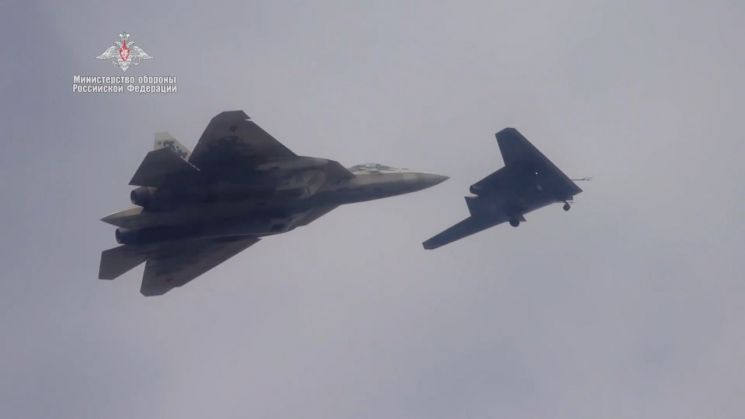
Russia is also accelerating the adoption of the MUM-T concept. The Russian version of the Loyal Wingman, the S-70 Okhotnik-B, is expected to be delivered to the Russian military in 2024. Estimated to be 14 meters long, with a wingspan of 20 meters and weighing about 20 tons, the S-70 will operate alongside the 5th generation Su-57 fighter jet, expanding detection range and transmitting target information through stealthy infiltration, effectively acting as a hunting dog for the Su-57.
The Royal Australian Air Force, which is rapidly advancing the introduction of the Loyal Wingman, unveiled its prototype in May. Developed in partnership with Boeing, the Loyal Wingman will be deployed alongside Australia’s F/A-18F, F-35A fighters, EA-18G electronic attack aircraft, E-7A airborne early warning aircraft, and P-8A maritime patrol aircraft. Notably, Australia’s Loyal Wingman will autonomously perform missions based on AI once mission instructions are given by manned aircraft.
USA - Developing ‘Loyal Wingman’ to perform dangerous missions in place of pilots
Russia - Developing S-70 Okhotnik-B to operate with Su-57, delivery imminent
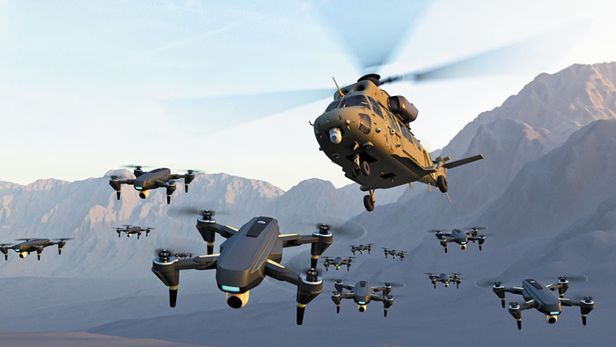
KAI - Showcased MUM-T concept combining unmanned aircraft with Surion helicopter, drawing attention
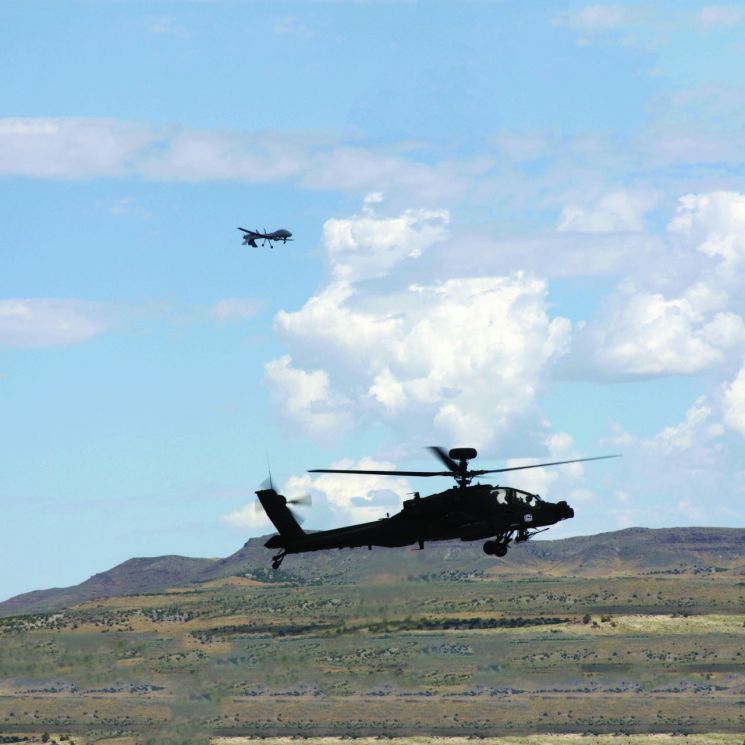
▲Widely Applied to Helicopters= The MUM-T concept is also being applied to helicopters performing various missions beyond fighter jets. A representative example is the combination of the AH-64 Apache attack helicopter and the MQ-1C Gray Eagle armed reconnaissance UAV. In actual operational concepts, the Gray Eagle arrives at the mission area before the Apache, collecting various information about the area and transmitting it to the Apache in real time. Based on the transmitted information, the Apache can plan its operation in advance, deciding whether to infiltrate the mission area directly or attack from a rear position, enabling safer mission execution.
Especially when attacking ground targets, the Apache can directly strike based on the transmitted target information, or if the area is too dangerous for the Apache’s survival, the armed Gray Eagle can conduct the attack. This not only enhances pilot survivability on the battlefield but also prevents the loss of expensive combat aircraft, significantly reducing war costs.
Moreover, the MUM-T concept is utilized in maritime operations as well. Unmanned helicopters equipped with electro-optical/infrared (EO/IR) cameras capable of capturing images of large and small ships, maritime surveillance radars optimized for sea environments, and synthetic aperture radars (SAR) that provide high-resolution observation regardless of weather, greatly expand the limited mission scope of manned helicopters or perform missions in threat areas on their behalf. Particularly, if equipped with sonobuoys capable of detecting submarines, they can also conduct anti-submarine warfare operations.
▲MUM-T Concept Unveiled Domestically= As MUM-T is expected to become widespread in future air operations, a platform applying the MUM-T concept was recently unveiled domestically. At the ‘2020 Defense Expo Korea (DX Korea)’ held last November, Korea Aerospace Industries (KAI) showcased a MUM-T concept combining the Surion helicopter and a small armed helicopter (LAH) with unmanned aircraft as a future combat platform.
According to KAI, when a pilot onboard a manned helicopter such as the Surion or LAH launches an unmanned aircraft, the UAV can perform search and rescue missions through reconnaissance and also attack key targets using warheads built into the UAV according to the assigned mission.
The Apache helicopters currently operated by the Army are also expected to enhance mission effectiveness and survivability by performing MUM-T missions in the future. However, to apply MUM-T capabilities, upgrades are needed to enable real-time data sharing with unmanned helicopters, including video data acquisition and streaming video.
© The Asia Business Daily(www.asiae.co.kr). All rights reserved.



















