"Option Contracts 90%, Ending This Month... Extension Unlikely"
Amazon, Facebook, and Other Tech Stock Investments Expected to Continue
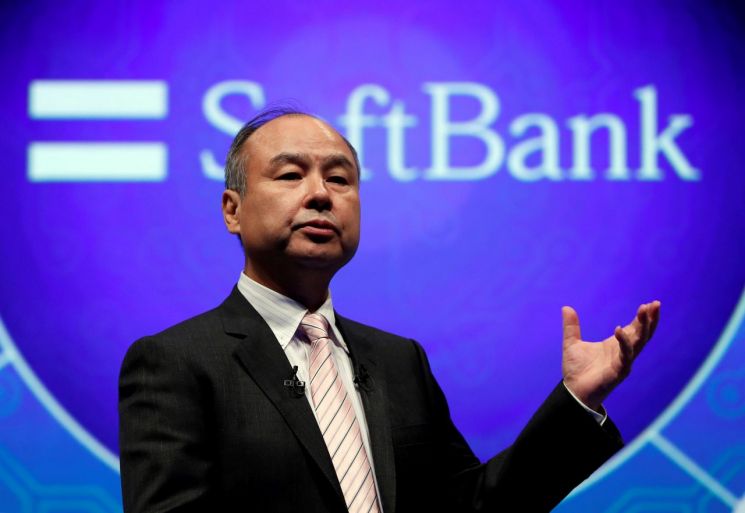
[Asia Economy Reporter Jeong Hyunjin] SoftBank, a Japanese company nicknamed the "whale of Nasdaq" for buying large amounts of stock options related to major U.S. IT companies such as Amazon, Facebook, and Alphabet, has begun to gradually reduce its technology stock options trading. This move is interpreted as a step back after investors expressed disappointment and found it difficult to secure profits, as SoftBank Chairman Masayoshi Son's investment approach, which had focused on promising companies from a long-term perspective, turned speculative.
On the 2nd (local time), Bloomberg News reported, citing sources, that SoftBank is quietly abandoning its controversial derivatives strategy after continuous backlash from investors. According to the sources, SoftBank decided not to maintain option positions by renewing them at option expiration dates. About 90% of the option contracts are short-term and are expected to expire at the end of this month, the sources explained. However, SoftBank is expected to continue investing in stocks of major IT companies such as Amazon and Facebook.
The interpretation that SoftBank quietly gave up its derivatives investment strategy is largely seen as a move conscious of investors. When news of SoftBank investing in derivatives emerged last September, investors expressed disappointment, causing the company's stock price to plunge 14% within a week. The corporate value also decreased by up to $17 billion (approximately 18.7 trillion KRW). Considering that SoftBank had maintained an investment approach focusing on promising startups over several years, investors found it hard to accept that the company jumped into derivatives for profit. Some investors reportedly continued to express such dissatisfaction to SoftBank. A SoftBank employee told foreign media, "We should not become day traders."
In terms of profitability, SoftBank's options trading was also unimpressive. This investment was made through SB Northstar, an asset management subsidiary of the SoftBank Group. According to foreign media, SB Northstar purchased $17 billion worth of stocks in major U.S. IT companies such as Amazon, Facebook, Zoom, and Alphabet, and invested $3.4 billion in derivatives such as options. SB Northstar announced in its earnings report last month that it recorded a $3.7 billion loss in the third quarter (July to September) of this year. Of the total loss, $2.7 billion occurred in derivatives. Bloomberg reported that SB Northstar earned only $1 million from this investment over six months until the end of September, which is a surprising result considering most tech stocks showed an upward trend.
One source told Bloomberg, "SoftBank's earnings from options trading improved in this quarter (fourth quarter)," but added, "However, with the intense U.S. presidential election over and the emergence of COVID-19 vaccines, market volatility has decreased, making it increasingly difficult for SoftBank to generate profits from derivatives."
Moreover, SoftBank is embroiled in governance issues and loan controversies. In October, SB Northstar caused controversy by borrowing $6 billion using SoftBank's Alibaba shares as collateral to secure funds for purchasing U.S. company stocks. This indicates a high proportion of borrowed funds in the investment capital. Additionally, one-third of SB Northstar's shares are personally owned by Chairman Son. This allows him to directly reap corresponding profits and also borrow from SoftBank through SB Northstar, raising governance concerns. David Gibson, an analyst at Astris Advisory, said, "A structure where a company's CEO takes 33% of profits from one division is unacceptable from the perspective of environmental, social, and governance (ESG) investment."
© The Asia Business Daily(www.asiae.co.kr). All rights reserved.

















