Development of Next-Generation Solar Cell Additives
17% Increase in Solar-to-Electric Conversion
80% Efficiency Maintained for 1600 Hours
[Asia Economy Reporter Junho Hwang] Perovskite solar cells, which are gaining attention as next-generation solar cells due to their high efficiency and low cost. A domestic research team has developed an additive that contributes to the commercialization of these cells. The research team led by Professors Hyesung Park and Changdeok Yang at Ulsan National Institute of Science and Technology announced on the 3rd that they improved the moisture, heat, and light stability of perovskite solar cells by adding a small amount of organic compounds to the core material, perovskite.
Perovskite has a polycrystalline structure composed of small crystal grains, which easily decompose due to interfacial defects between these grains when exposed to external stimuli. As a result, charge carriers generated by sunlight disappear, reducing the efficiency of converting solar energy into electricity.
Growing Perovskite Crystals to Prevent Defects
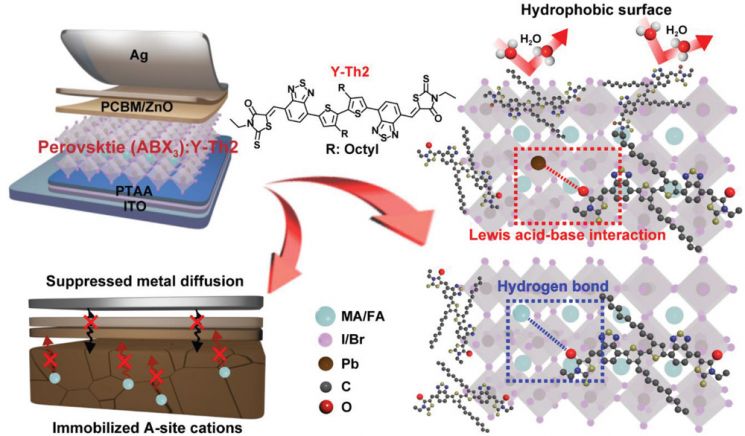
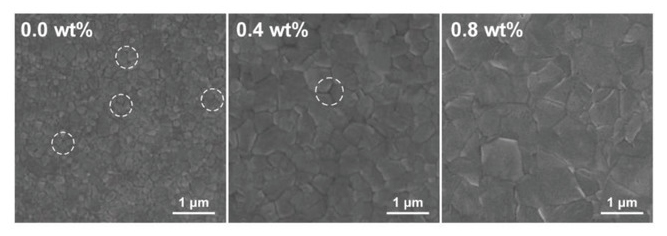
To solve this problem, the research team developed an additive (Y-Th2) that can reduce interfacial defects in perovskite. This additive reduces the number of perovskite crystal grains while increasing their size. When the number of grains decreases and their size increases, interfacial defects are also reduced. In particular, using this additive allows crystals to grow slowly, enabling atoms inside the crystal grains to arrange evenly, thereby improving efficiency.
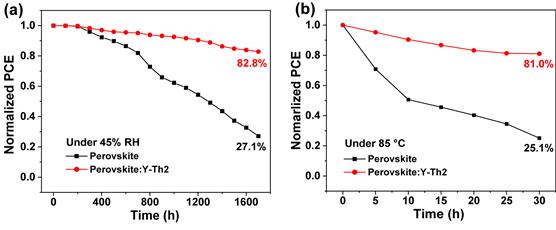
The team reported that solar cells with the additive showed a photoelectric conversion efficiency about 17%P (21.5%) higher than the control group. Especially, the stability against external stimuli improved comprehensively, maintaining more than 80% of the initial conversion efficiency even after 1600 hours of operation under 40% humidity conditions. The control group’s efficiency dropped to 30% of the initial value.
Photoelectric Conversion Efficiency 21.5%
Donghwan Koo, the first author and a doctoral researcher in the Department of Materials Science and Engineering, explained, "When this additive is added to perovskite, it forms large crystal grains with excellent crystallinity (degree of atomic arrangement) through Lewis acid-base reactions and hydrogen bonding."
Professor Hyesung Park said, "This study improved both the complex stability and photoelectric properties of perovskite materials using a single additive," and added, "The additive developed this time is expected to greatly contribute not only to solar cells but also to the development of various perovskite-based optoelectronic devices such as perovskite LEDs (PeLEDs)."
Meanwhile, the results of this research were recently published in the international journal Advanced Energy Materials.
© The Asia Business Daily(www.asiae.co.kr). All rights reserved.



















