Deadline Met for the First Time in 6 Years Since the Implementation of the National Assembly Advancement Act
2.2 Trillion Won Net Increase...First Time in 11 Years
3 Trillion Won for Disaster Relief Funds and 900 Billion Won for Vaccine Procurement Included
20 Billion Won Increase for Gadeokdo New Airport Research Service and 11.7 Billion Won Increase for Sejong Assembly Hall Design Fees
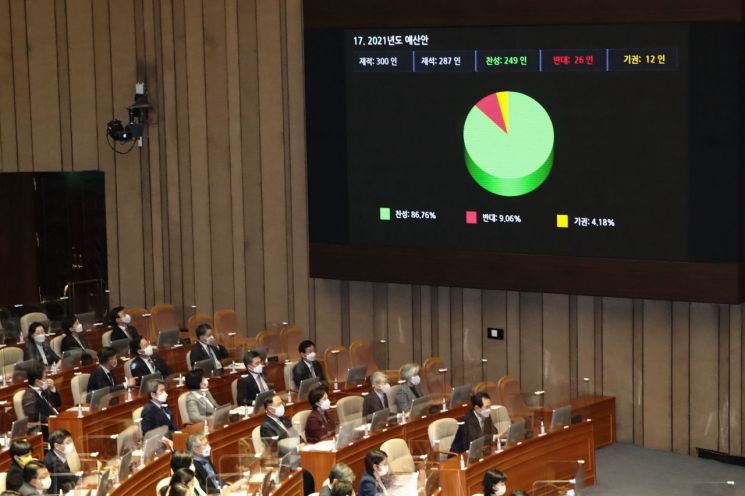
[Asia Economy Reporter Kim Hyemin] On the 2nd, the National Assembly held a plenary session and passed the next year's budget bill worth 558 trillion won.
It is the first time in six years since the implementation of the National Assembly Advancement Act in 2014 that the budget bill was processed by the legal deadline (December 2). The revised budget bill, reviewed by the National Assembly, was approved by 249 out of 278 members present, with 26 opposing and 12 abstaining.
The approved budget bill increased by 2.1972 trillion won from the government's proposal of 555.79 trillion won. It is the largest ever, and it is the first time in 11 years since 2010 that the final budget bill has increased compared to the government proposal.
Through the National Assembly review, 8.0848 trillion won was added, and 5.8876 trillion won was cut. Government bonds will increase by 3.5 trillion won. Due to a decrease in revenue, the shortfall will be covered by issuing government bonds.
Specifically, 3 trillion won was newly allocated for support related to the COVID-19 damage (third disaster relief fund). The goal is to provide the support before the Lunar New Year holiday, and the method will be decided later.
An additional 900 billion won budget was also allocated to secure 44 million doses of COVID-19 vaccines.
To expand emergency management funds for small business owners, the budget was increased by 110 billion won, and to prepare for the prolonged employment shock caused by COVID-19, the employment retention subsidy was increased by 181.4 billion won for 100,000 people.
326 billion won was added to the project for low-emission conversion of old diesel vehicles to respond to climate change. The budget for newly introducing public rental housing and expanding purchased rental housing for the housing stability of low-income households was increased by 682.9 billion won.
The increase rate of childcare fees for infants aged 0 to 2 was decided to be 4%, which is 1 percentage point higher than the government proposal. The early childhood education fee for ages 3 to 5 was finalized at 260,000 won, an increase of 20,000 won compared to the government proposal. To this end, the childcare fees and support budget for infants and toddlers were increased by 26.4 billion won and 262.1 billion won, respectively.
The honorarium for veterans and merit honorarium were each increased by 20,000 won, increasing the budget by 42 billion won compared to the government proposal. The budget to additionally establish infectious disease specialized hospitals in three regions was also increased by 2.3 billion won.
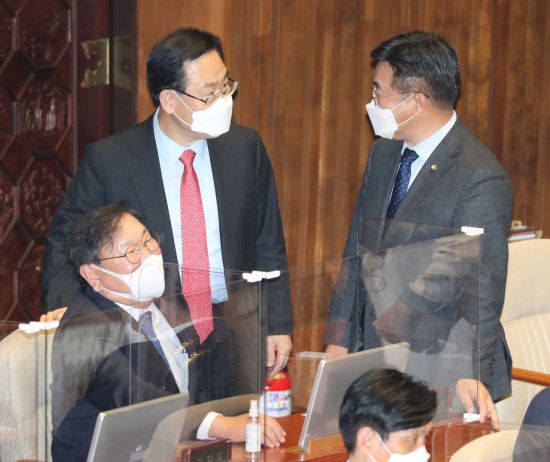 Kim Tae-nyeon, floor leader of the Democratic Party of Korea, Joo Ho-young, floor leader of the People Power Party, and Yoon Ho-jung, chairman of the National Assembly Judiciary Committee, are seen talking during the plenary session held at the National Assembly on the 1st. Photo by Yoon Dong-joo doso7@
In addition, 2 billion won was added for a feasibility study on the new airport in Gadeokdo. However, a supplementary opinion was attached stating that the budget will be executed if related bills are prepared according to the agreement between the ruling and opposition parties. The design fee for the construction of the National Assembly Sejong branch was increased by 11.7 billion won, finalizing at 14.7 billion won.
The Korean New Deal budget, worth 21.3 trillion won, was cut by 500 to 600 billion won.
With the issuance of about 9.2 billion won in deficit government bonds, the national debt will increase to 956 trillion won. The national debt ratio compared to the Gross Domestic Product (GDP) is 47.3%.
Meanwhile, at the plenary session on the same day, 104 agenda items were processed, including ▲ the amendment to the Infectious Disease Control and Prevention Act to allow temporary non-face-to-face medical treatment during infectious disease crisis situations such as COVID-19 ▲ the so-called 'Jodusun Prevention Act' expanding the disclosure range of sex offenders' addresses and actual residences to road names and building numbers ▲ amendments to the Elementary and Secondary Education Act and the Early Childhood Education Act to completely block sex offenders from obtaining teaching qualifications ▲ the amendment to the Child Welfare Act introducing the 'immediate separation measure' to immediately separate and temporarily protect children strongly suspected of abuse ▲ and the amendment to the Medical Service Act to supervise illegal medical institutions such as office hospitals.
© The Asia Business Daily(www.asiae.co.kr). All rights reserved.


















