Net Increase of 26.8 Billion KRW Compared to Government Plan... Renewable Energy Up 36% Compared to This Year
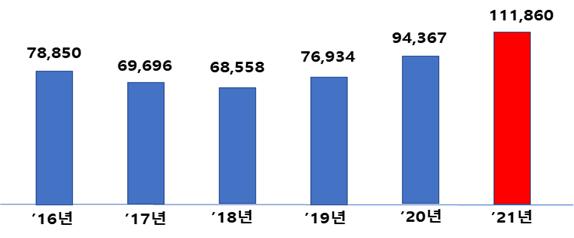 Annual Budget Status of the Ministry of Trade, Industry and Energy. (Unit: 100 million KRW, Source: Ministry of Trade, Industry and Energy)
[Asia Economy Reporter Moon Chae-seok] The Ministry of Trade, Industry and Energy announced on the 2nd that the budget for next year, confirmed by the National Assembly, is 11.186 trillion won. This is an 18% increase from this year's 9.4367 trillion won. The budget for renewable energy will increase by 36% compared to this year to achieve carbon neutrality by 2050.
The budget related to renewable energy for next year is 1.671 trillion won, a 36% increase from this year's 1.2226 trillion won.
Specifically, increases were made to ▲rural solar power loans (2.285 trillion won this year → 3.205 trillion won next year) ▲industrial complex solar power facility loans (100 billion won → 150 billion won) ▲resident participation fund loans (36.5 billion won → 37 billion won). Green guarantees of 50 billion won and urban solar power loans of 20 billion won will be newly added next year.
Budgets for research and development (R&D) to secure core technologies related to renewable energy and support for overseas expansion of small and medium-sized enterprises in new and renewable energy were also increased. The technology development budget will rise from 253.4 billion won this year to 283.9 billion won next year, and the overseas expansion support budget will increase from 4.8 billion won to 6.9 billion won.
The budget for hydrogen production bases and green hydrogen (hydrogen produced from renewable energy rather than fossil fuels) increased, and budgets for hydrogen transportation equipment construction (tube trailers) and hydrogen charging station monitoring were newly added.
In detail, these include ▲hydrogen production base construction (29.9 billion won → 66.6 billion won) ▲green hydrogen production and storage system technology development (40 billion won in this year's supplementary budget → 100 billion won) ▲hydrogen distribution infrastructure establishment (3.6 billion won newly allocated).
Additionally, ▲clean factory construction within industrial complexes (supplementary budget 3.1 billion won → 20.3 billion won) ▲support for underground power line installation (20 billion won newly allocated) ▲public energy storage system (ESS) construction to expand renewable energy grid capacity (18.2 billion won newly allocated) all exceeded 10 billion won.
Budgets to promote digitalization of manufacturing sites, and to foster future growth engines such as materials, parts, equipment, and the Big 3 industries (future cars, bio-health, system semiconductors) were mostly increased.
Representative increases include ▲materials and parts technology development (602.7 billion won → 886.6 billion won) ▲materials and parts technology infrastructure establishment (183.3 billion won → 195.4 billion won) ▲machinery equipment industry technology development project (100.5 billion won → 133.2 billion won) ▲pan-ministerial full-cycle medical device R&D (30.2 billion won → 64.1 billion won) ▲industrial complex smart manufacturing advanced workforce training (14.7 billion won → 35 billion won).
Newly budgeted fields for next year include ▲autonomous driving technology development innovation project (20 billion won) ▲industrial intelligence leading value chain cultivation (7.6 billion won) ▲global K-Fabless fostering technology development (6 billion won).
The export support budget was significantly increased to support early cash conversion of export receivables for small and medium-sized enterprises and mid-sized companies through contributions to the trade insurance fund.
Fields with increased budgets next year include ▲trade insurance fund contributions (296 billion won → 350 billion won) ▲export support infrastructure utilization (export vouchers) (73.1 billion won → 81.7 billion won) ▲cash support for foreign-invested companies (55 billion won → 60 billion won) ▲domestic return investment subsidies (supplementary budget 20 billion won → 50 billion won).
A new budget of 1 billion won was allocated to support the entry and exit of businesspeople due to the spread of COVID-19.
An official from the Ministry of Industry said, "As the budget for next year has been significantly increased to promote innovative growth and boost economic vitality, the Ministry of Industry plans to thoroughly prepare for budget execution, including establishing project plans, to ensure prompt budget spending."
© The Asia Business Daily(www.asiae.co.kr). All rights reserved.

















