74% of Designers "Postpone or Advance Insurance Enrollment... Adjust Performance Themselves"
"Reducing Salary and Receiving Unemployment Benefits Will Worsen Employment Insurance Finances"
[Asia Economy Reporter Oh Hyung-gil] "Since the outbreak of the novel coronavirus infection (COVID-19), while some insurance agents have struggled to make a living due to difficulty in increasing their performance, a significant number have adjusted their commissions to reduce income and even received disaster relief funds. Who can guarantee that after enrolling in employment insurance and preparing to change jobs, they will not claim unemployment benefits?"
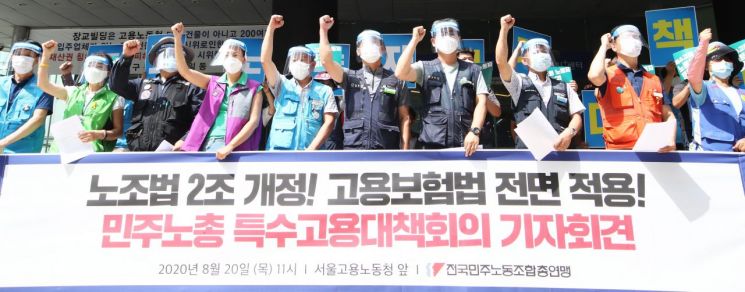
As the government pushes for mandatory employment insurance enrollment for special employment workers (SEWs), a heated debate over 'moral hazard' is emerging in the insurance industry. Many posts expressing concerns about this issue have also appeared on internet portal communities.
Insurance agents, who are 'sole proprietors,' can voluntarily postpone insurance contracts and adjust their income at will, raising concerns that this aspect could be exploited.
According to the insurance industry on the 2nd, a recent survey conducted by the Insurance Agency Association targeting 1,245 insurance agents found that 74% of respondents said they could control their workload (performance) themselves.
Since they conduct one-on-one sales with clients, it is entirely possible to offer better terms to expedite contracts or postpone them to the next month. Depending on the contract, commissions can also be received at the desired timing.
The insurance industry points out that the high voluntary turnover rate of agents and their ability to adjust income could cause confusion after enrolling in employment insurance. There are concerns about side effects such as agents delaying contracts to reduce their income for a certain period and then receiving unemployment benefits.
According to the survey, the most common average monthly income for agents is in the 1.5 to 2 million KRW range (21.7%). A simulated calculation of unemployment benefits based on 2 million KRW shows that one could receive 60,000 KRW per day, totaling 9 million KRW over five months. If an agent postpones contracts and quits the insurance company, they can receive unemployment benefits and then sign contracts again after reemployment.
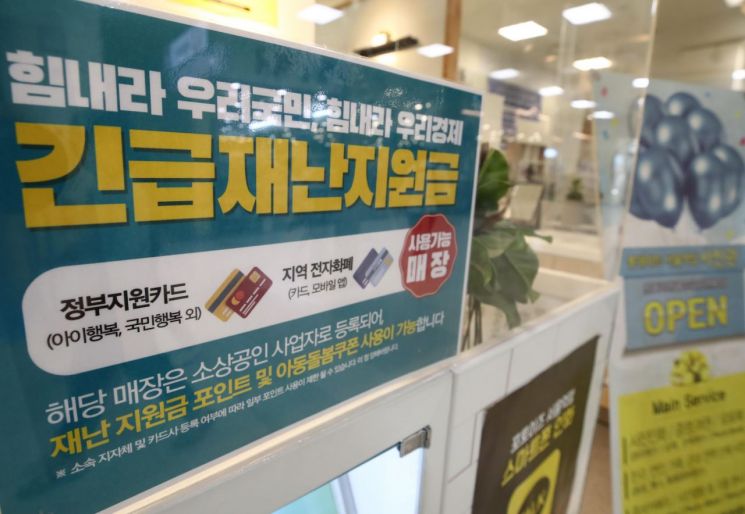
Previously, when the first and second rounds of disaster relief funds were distributed, the criteria were based on health insurance premiums, leading to cases where agents earning over 60 million KRW annually also received support funds.
For insurance agents, the simple expense ratio is 77.6% for income up to 40 million KRW and 68.6% for income exceeding 40 million KRW, allowing a large portion of income to be treated as expenses even if earnings are high. This means that even if they earned 60 million KRW, the health insurance premium burden was low, making them eligible for support funds.
A considerable number of agents do not want to enroll in employment insurance due to concerns about their income being exposed. In a survey conducted by the Korea Chamber of Commerce and Industry targeting 249 SEWs, 46.2% opposed mandatory employment insurance for SEWs.
The most common reason for not wanting to enroll in employment insurance was "almost no risk of unemployment" at 42.1%. This was followed by "concerns about income exposure" (31.4%) and "burden of employment insurance premiums" (20.7%).
Additionally, a survey commissioned by the Korea Economic Research Institute to the polling agency Mono Research in September, targeting 234 SEWs from four occupations including insurance agents, delivery workers, and golf caddies, revealed that 62.8% opposed blanket mandatory application.
An official from the Insurance Agency Association said, "We understand that the government is considering a plan to allow unemployment benefits if income decreases beyond a certain level," adding, "If moral hazard arises where agents adjust their income to receive benefits, it could negatively impact the employment insurance fund."
© The Asia Business Daily(www.asiae.co.kr). All rights reserved.


















