Bio and Semiconductors Lead Exports... Petrochemicals, Steel, and Machinery Recover
"Exports to Grow Over 6% Next Year"
"Quarantine Measures for Businesspeople Need Easing"
"Supplementary Measures Needed for 52-Hour Workweek"
"Labor Market Flexibility Must Be Discussed Alongside Social Safety Nets"
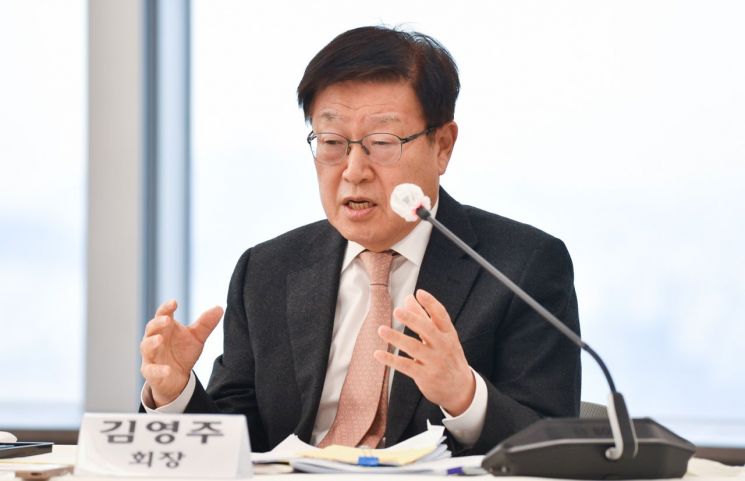
[Asia Economy Reporter Hwang Yoon-joo] Kim Young-joo, Chairman of the Korea International Trade Association (KITA), said on the 2nd, "This year has been the most difficult year in decades, but next year, Korean exports are expected to increase by more than 6%."
At a meeting held at the Trade Tower in Gangnam-gu, Seoul, Chairman Kim stated, "Biohealth, digital, and semiconductor items are leading exports, and petrochemicals, steel, and machinery items, which were greatly contracted this year, will also recover."
◆ Korea’s exports drive growth… Semiconductors, eco-friendly cars, and biohealth as breakthroughs
Regarding Korea’s exports this year, Chairman Kim said, "While the world seems to be returning to normal after the shock, Korea is in a growth situation," and evaluated, "In this process, the role of trade (exports) was very significant." This year, due to the impact of COVID-19, the OECD’s economic growth rate is expected to plummet to -4.2%. Korea is expected to perform relatively well with a -1.1% growth rate. In particular, "Korea’s Q3 GDP this year rose about 2.1% compared to the previous quarter, but domestic demand recorded -1.4," and "exports drove the growth rate up to 2.1%," he praised.
He added, "In Q2 this year, the average daily export amount was -15.8% compared to the same period last year, marking the worst situation, but it has been improving since Q3 (-4.8%)," emphasizing, "It’s not just the numbers that changed, but the economic structure has changed."
Chairman Kim said, "The hopeful signs are that semiconductors, eco-friendly cars, biohealth, and computers are becoming breakthroughs for export recovery," and "Exports in sectors with strong demands for eco-friendliness and digitalization have increased by 40% and 70%, respectively, making next year an opportunity to turn crisis into chance."
Chairman Kim especially praised the fact that despite the COVID-19 shock, the decline in exports by small and medium-sized enterprises (SMEs) was less than expected. He said, "The export share of SMEs has risen to 17%, 18%, and 19.4%."
He also explained, "We relied heavily on Japanese-made parts, but among 100 imported items from Japan, 68 saw a significant decrease in share," adding, "Dependence on Japan has decreased."
◆ Government support was significant, but... "Businesspeople’s self-quarantine and easing of 52-hour workweek for SMEs needed"
Chairman Kim evaluated that the government played a major role in the export performance of Korean companies despite the COVID-19 shock. However, he said that there are still many difficulties in expanding exports, which is the consensus in the trade industry.
He said, "When we asked companies what their export difficulties were, 51% answered 'movement is impossible,'" and "The biggest difficulty for businesspeople is the 14-day self-quarantine due to COVID-19 within the country." He explained the need to reasonably ease the self-quarantine standards for businesspeople.
He also pointed out the 52-hour workweek system, which will apply to SMEs starting January 1 next year, as a difficulty. Chairman Kim said, "It would be good to extend the flexible working hours unit period to 6 months or 1 year as a supplementary measure," and "If extending the guidance period is difficult, supplementary measures should be prepared."
He added, "There is no official plan to make a formal request regarding the 52-hour workweek, but if economic organizations ask to raise their voices together, I am willing to participate."
Regarding the recently mentioned "labor market flexibility" in the political sphere, he said, "Labor market flexibility is not easy," and "It is practically difficult to find a solution by looking at only one aspect of labor market rigidity, and social safety nets must be complemented together."
On the conclusion of the U.S. 'Huawei export restrictions,' he said, "It is unknown," and "The consensus is that even with the Joe Biden administration, resolving Huawei restrictions will not be easy."
He then said, "At first, I was worried that the semiconductor industry would be hit, but seeing that exports are steadily coming out, it seems to be somewhat manageable," and predicted, "Huawei restrictions will not be easily resolved."
Meanwhile, Chairman Kim’s term as KITA chairman expires in February next year. Reflecting on the past three years, he said, "I have tried to let member companies and companies that will become members know that the association is a practically helpful institution," expressing gratitude to the staff. Regarding reappointment, he said, "There are still two and a half months left in my term, so it is not appropriate to talk about it now," and refrained from further comment.
© The Asia Business Daily(www.asiae.co.kr). All rights reserved.

















