Jeju Autonomous Police Maintain Current Dual System
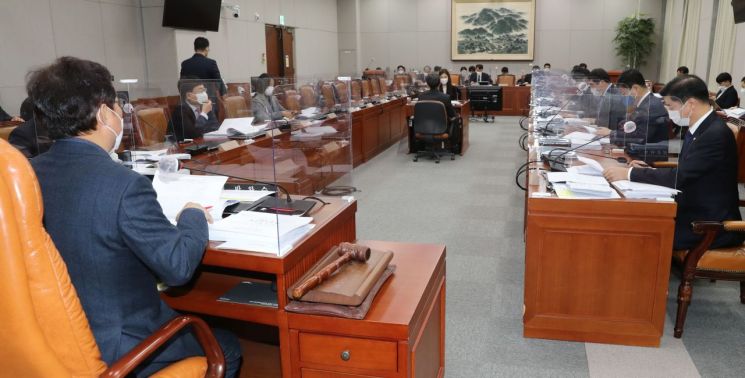
[Asia Economy Reporter Lim Chun-han] On the 2nd, the National Assembly's Public Administration and Security Committee unanimously approved a compromise bill on the complete revision of the Police Act and the Police Officers Act regarding the introduction of autonomous police, the establishment of the National Investigation Headquarters, and the reform of intelligence police.
The members of the 2nd Subcommittee on Bill Review of the Public Administration and Security Committee held a press conference at the National Assembly Communication Hall on the same day and stated, “The amendment broadly divides the current police duties into national police duties and autonomous police duties, with the autonomous police duties being commanded and supervised by the City/Province Autonomous Police Committee. It also establishes the National Investigation Headquarters to take charge of investigative functions transferred to the police through the adjustment of investigative authority between the prosecution and the police.”
They explained, “The introduction of the autonomous police system fundamentally distinguishes between national police duties and autonomous police duties, but does not separately separate the status of individual police officers, which is called a unified model. Each city and province will form a City/Province Autonomous Police Committee, and autonomous police duties will be operated centered on the committee. However, the investigative part of the autonomous police duties will be subject to the command of the newly established National Investigation Headquarters Chief according to the amendment.”
Regarding the Jeju Autonomous Police, they said, “The Jeju Autonomous Police, which has been operating since 2006, will maintain the current dual system. However, the current affiliation under the governor has been changed to the Jeju Autonomous Police Committee to improve operational fairness with other cities and provinces.”
Regarding the establishment of the National Investigation Headquarters, they stated, “In accordance with the adjustment of investigative authority between the prosecution and the police, investigative functions transferred to the police will be exclusively handled by establishing the National Investigation Headquarters. The head of the National Investigation Headquarters will hold the rank of Police Commissioner General, and the original 3-year term for the headquarters chief under the amendment has been adjusted to 2 years. Along with the prohibition of consecutive terms for the chief, if the constitution or laws are violated, the National Assembly can impeach and prosecute, strictly stipulating the duties and responsibilities of the National Investigation Headquarters' top official.”
Regarding the reform of intelligence police, they said, “Among the duties of the national police under the current Police Act, ‘collection, preparation, and distribution of security information’ has been amended to ‘collection, preparation, and distribution of information related to the prevention and response to risks to public safety,’ thereby specifying the scope of intelligence police duties more concretely. This can be seen as a basic provision linked to the intelligence police reform bill currently pending separately in our subcommittee.”
© The Asia Business Daily(www.asiae.co.kr). All rights reserved.

















