Returned to Earth after collecting stormy sea soil
Third lunar surface study following China, the USA, and the former Soviet Union upon return
[Asia Economy Beijing=Special Correspondent Jo Young-shin] The unmanned lunar probe 'Chang'e 5,' which is undertaking the mission to collect lunar surface samples and return them to Earth for the first time in China, has successfully landed on the moon.
China National Space Administration (CNSA) announced that Chang'e 5 landed at the planned site at 11:11 PM local time on the 1st and sent back photos of the lunar surface, according to Chinese media including Global Times on the 2nd.
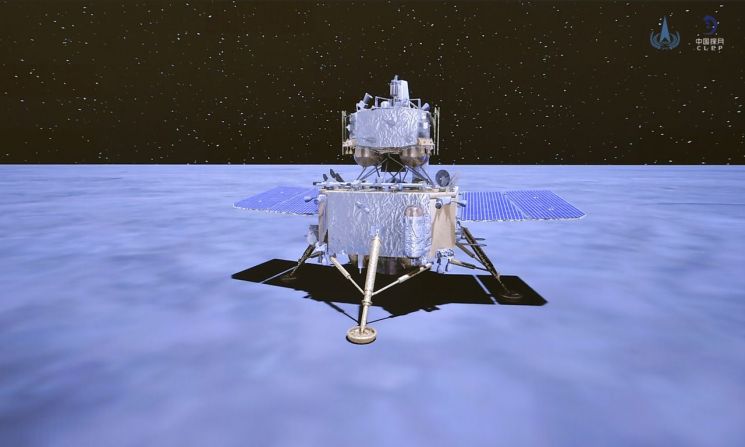 China's unmanned lunar probe Chang'e 5 landed on the moon's surface at 11:11 PM (Beijing time) on the 1st. (Photo by Global Times)
Chang'e 5 was launched from the Wenchang Space Launch Site in Hainan Province on the 24th of last month. After two orbital adjustments, it reached an altitude of 400 km above the lunar surface on the 28th of last month. Subsequently, on the 30th, the combined module for landing, exploration, and ascent separated from the main body, and at 10:57 PM on the 1st, it began reducing its speed from 1.7 km/s at 15 km above the lunar surface and landed on the surface.
This is the third lunar landing by a Chinese probe, following Chang'e 3 in December 2013 and Chang'e 4 in January 2019.
The landing site of Chang'e 5 is the northwestern part of the moon's 'Oceanus Procellarum,' visible to the naked eye from Earth, which has never been explored by humanity before.
Chang'e 5 plans to collect surface soil and other samples from this site, which is estimated to have formed 3.2 to 4 billion years ago.
Using a robotic arm and drill to dig up to 2 meters deep, it plans to collect about 2 kg of lunar subsurface samples over two days.
China expects to obtain extensive geological information about the composition and formation period of the materials in this area through these samples.
After collecting the samples, Chang'e 5 will take off again from the lunar surface and dock with the return vehicle waiting in lunar orbit about 380,000 km from Earth. These operations are the first of their kind in the history of Chinese space exploration.
The return vehicle will then travel at a speed of 11 km/s and re-enter Earth's atmosphere, returning to Siziwang in the Inner Mongolia Autonomous Region of northern China.
The mission to collect lunar samples and return them to Earth is the first in over 40 years since the United States and the former Soviet Union conducted similar missions in the 1960s and 1970s. China is the third country to attempt success in such a mission after the US and the Soviet Union.
© The Asia Business Daily(www.asiae.co.kr). All rights reserved.

















