Successful Fabrication and Characterization Imaging of 3D Nano-Structured Piezoelectric Materials
Triple Elastic Strain Compared to Existing, Applicable to Tactile Enhancement Technology
[Asia Economy Reporter Hwang Junho] A highly elastic piezoelectric ceramic material has been developed. This material has an elastic strain rate three times higher than conventional ceramic materials and is expected to be used as a tactile augmentation material in the implementation of virtual reality and augmented reality in the future.
The research team led by Professor Hong Seungbeom of the Department of Materials Science and Engineering at the Korea Advanced Institute of Science and Technology (KAIST) announced on the 2nd that they developed a piezoelectric ceramic material with an elastic strain rate three times higher by utilizing a 3D nano structure for use in tactile or tactile augmentation technologies. The research results were recently published in the international journal Nano Energy.
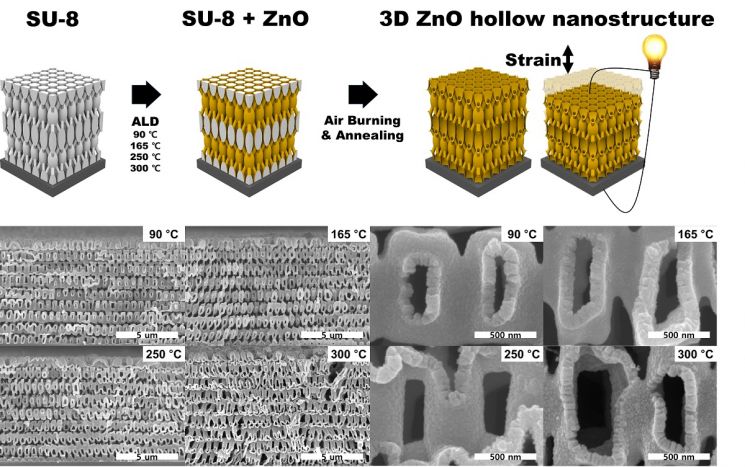
The research team fabricated zinc oxide (ZnO) ceramic with a three-dimensional nano truss structure using near-field nano patterning technology and atomic layer deposition technology. They demonstrated the high mechanical properties and piezoelectric characteristics of the fabricated structure using nano indentation technology and piezoelectric force microscopy technology.
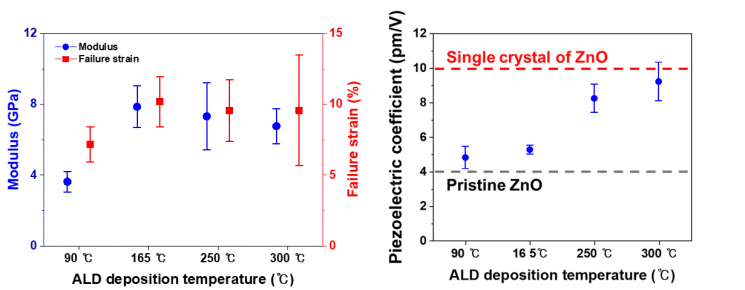
The structure developed by the research team has a thickness of less than 100 nanometers (nm) and is hollow inside. By limiting the size of internal defects in the ceramic to the nanometer scale, the mechanical strength of the material was increased. Accordingly, the elastic strain rate of this structure was about 10%, which is three times larger than that of conventional zinc oxide. The piezoelectric coefficient was also more than twice as large as that of thin-film zinc oxide, measuring 9.2 pm/V.
Professor Hong Seungbeom stated, "Some process improvements are needed before this research result can be directly applied to tactile augmentation devices," adding, "This research overcame the mechanical limitations of ceramic devices, which had been a major obstacle in material utilization, and opened up the possibility of applying piezoelectric ceramic devices."
© The Asia Business Daily(www.asiae.co.kr). All rights reserved.


















