Departure Hall Duty-Free Store After SM Duty-Free Store Exit
Public Bidding at the End of December...Interest from Small and Medium Enterprises
Temperature Difference Compared to Departure Hall Duty-Free Store That Failed Three Times
Key Variable Is the Presence of Minimum Guarantee Fee
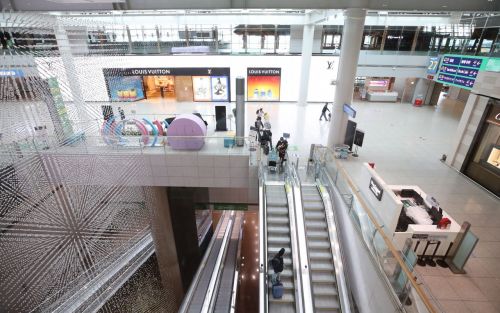
[Asia Economy Reporter Cha Min-young] As the duty-free business rights at the Departure Hall of Incheon International Airport Terminal 1 (T1) have been repeatedly failed to be awarded, it is reported that multiple companies are showing interest in the arrival hall duty-free store space vacated by SM Duty Free. The minimum guaranteed amount required for the departure hall duty-free business rights does not apply to the arrival hall duty-free business rights, leading to evaluations that it is a "fight worth trying."
Arrival Hall Duty-Free Stores, Interest from SMEs
An official from Incheon International Airport Corporation stated on the 2nd, "A public bidding for the arrival hall duty-free store space vacated by SM Duty Free is scheduled to take place at the end of this month (December)," adding, "The rental fee calculation method, including the minimum operating rate system, will remain the same as the existing conditions without any changes."
The arrival hall duty-free store, which SM Duty Free exited prematurely due to the COVID-19 situation, is a bonded area totaling 380㎡ on the east and west sides of Incheon Airport T1. It allows small and medium-sized enterprises (SMEs) to handle all product categories (perfume, cosmetics, tobacco, liquor). Originally, tobacco was a prohibited item, but it was added to the sales items due to initially poor sales performance at the arrival hall duty-free store.
The key rental fee calculation method is expected to be a category-specific operating rate collection method linked to sales. In February last year, Incheon Airport Corporation proposed a minimum operating rate of 21.5% to 26.3% of sales as the rental fee in the bidding announcement for the arrival hall duty-free store. Previously, rental fees were paid as a fixed amount monthly, but this was the first time rental fees were calculated based on sales, which was considered unusual. At that time, the competition was intense, with a total of nine bidders participating.
As the situation worsened to the point where SM Duty Free voluntarily withdrew, there were speculations that Entas Duty Free might also give up midway, but the actual response from market participants is positive. An industry insider said, "Companies such as Entas Duty Free, City Plus, and Grand Tourist Hotel are showing interest," adding, "The growth potential due to the improvement of the COVID-19 situation and the fact that rental fees are linked to operating rates are attractive factors."
Prime Spots for Cosmetics and Perfume... Large and Small Enterprises 'Give Up' on Departure Hall
The popularity of the arrival hall duty-free store sharply contrasts with the situation in the bidding for the departure hall duty-free stores at Incheon Airport conducted earlier. Six duty-free business rights at Incheon Airport T1 for large and small enterprises (DF2, 3, 4, 6, 8, 9 zones) failed to be awarded three times. Not only the four large enterprises but also the SMEs that initially won the bids all gave up midway. The negotiated contracts proposed by the corporation to the duty-free stores in mid-last month were also rejected by the duty-free operators because the bidding conditions remained unchanged. The third contract conditions included lowering the minimum guaranteed amount to 30%, the same as the previous bid, and paying only operating fees without a minimum guarantee until passenger demand recovers to 60% of the same period last year.
Accordingly, the duty-free industry has consistently voiced the need for fundamental institutional improvements, such as the rental fee imposition method by Incheon International Airport Corporation. As the pandemic signs of COVID-19 intensify in the cold weather, it is explained that no one will operate duty-free businesses at a loss unless the corporation offers groundbreaking contract conditions. In fact, in 2019, the rental fees paid by duty-free stores to Incheon Airport amounted to about 1.0761 trillion KRW, accounting for 38.9% of the total revenue of Incheon International Airport Corporation.
An industry official explained, "Airport duty-free stores have been operating at a loss every year due to high rental fees, and these losses were offset by downtown duty-free store sales," adding, "This year, overall sales have decreased by more than 50%, and individual cosmetics brands are also reducing support such as manpower, making (duty-free store) operations even more difficult."
Meanwhile, SM Duty Free was selected in March last year as one of the first two operators of arrival hall duty-free stores in Korea, along with Entas Duty Free, but voluntarily returned the duty-free business rights due to COVID-19 and other reasons, ceasing operations as of the 31st of last month.
© The Asia Business Daily(www.asiae.co.kr). All rights reserved.

















