Lee Nak-yeon "PCC Law to be Settled in This Regular National Assembly"
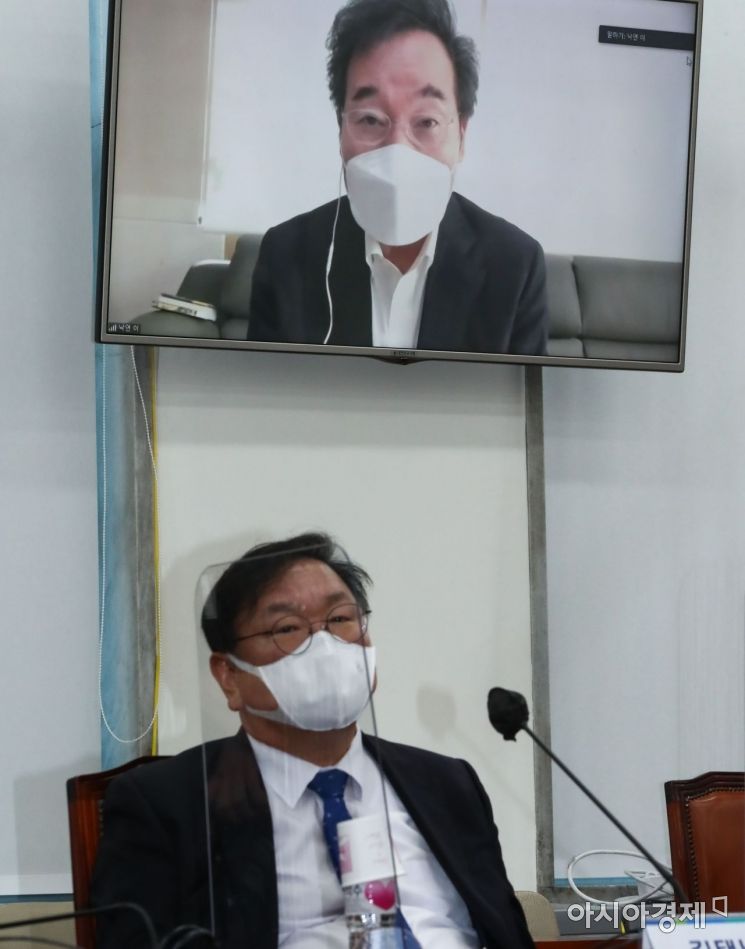 On the 1st, Lee Nak-yeon, leader of the Democratic Party of Korea, attended the Southeast New Airport Promotion Task Force joint meeting held at the National Assembly via video conference and delivered an opening remark. Attending the meeting via video conference were Lee Nak-yeon, Kim Kyung-soo, Governor of Gyeongnam Province, Byun Sung-wan, Acting Mayor of Busan, Han Cheol-soo, Chairman of Gyeongnam Chamber of Commerce, Song Cheol-ho, Mayor of Ulsan Metropolitan City, Heo Young-do, Chairman of Busan Chamber of Commerce, and Jeon Young-do, Chairman of Ulsan Chamber of Commerce. Photo by Yoon Dong-joo doso7@
[Asia Economy Reporter Kang Nahum] The Democratic Party of Korea has launched a strong drive to pass legislation reforming power institutions. They are willing to pass the High-ranking Officials' Crime Investigation Office (HCIO) Act and the National Intelligence Service Act solely in the plenary session, indicating that conflicts between the ruling and opposition parties are expected to intensify.
On the 1st, Lee Nak-yeon, leader of the Democratic Party, posted a letter titled "A Letter to Party Members" on the party bulletin board, stating, "I understand that your concerns about prosecutorial reform are even greater," and added, "The amendment to the HCIO Act will begin processing in the Legislation and Judiciary Committee this week and will be concluded within the regular session."
He continued, "Prosecutorial reform does not end with the launch of the HCIO. Continuous and ongoing reform is necessary," and said, "We will continue efforts to stabilize the adjustment of investigative authority between the prosecution and police and to strengthen human rights protection."
Accordingly, the Democratic Party plans to sequentially process major reform bills such as the HCIO Act and the Police Act amendments in standing committees and then pass them in the plenary session on the last day of the regular session, next month on the 9th.
The Police Agency Act amendment is scheduled to be processed consecutively in the Administrative Safety Committee's bill subcommittee and full committee meetings on the same day. The amendment aims to improve the excessive concentration of police power following the adjustment of investigative authority between the prosecution and police, focusing on the introduction of the autonomous police system and the establishment of the National Investigation Headquarters.
In particular, the HCIO Act amendment, which had its decision postponed twice despite discussions in the bill subcommittee, is scheduled to be deliberated again in the subcommittee on the 4th for a vote.
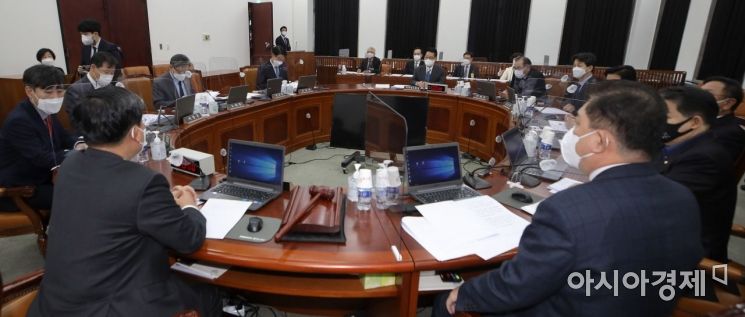 Jeon Hae-cheol, Chairman of the National Assembly Intelligence Committee, is presiding over the full meeting of the Intelligence Committee held at the National Assembly on the 30th. Photo by Yoon Dong-joo doso7@
However, sharp disagreements between the ruling and opposition parties over these bills make political deadlock inevitable if the ruling party pushes for passage in the plenary session. Conflicts between the parties were also evident during the processing of the National Intelligence Service Act amendment in the standing committee the previous day. The core of the amendment, which passed the Intelligence Committee's full meeting, is to remove the 'counterintelligence investigative authority'?the power to investigate crimes violating the National Security Act such as espionage?from the National Intelligence Service.
Opposition intelligence committee members abstained from voting, citing concerns over the excessive concentration of police power. Ha Tae-kyung, the intelligence committee secretary of the People Power Party, told reporters after leaving the full meeting, "We tried to fix the toxic clauses until the end," but "the Democratic Party and the National Intelligence Service did not yield." He expressed concern, saying, "The police monopolize domestic intelligence," and "If the police's domestic intelligence collection authority and investigative authority are combined, it would be equivalent to establishing the Security Headquarters of the 5th Republic era."
The situation regarding the HCIO Act amendment is expected to unfold similarly. For now, the People Power Party plans to participate in discussions to record their opposition but is known to abstain from voting.
© The Asia Business Daily(www.asiae.co.kr). All rights reserved.


















