Agreement on next year's budget at 558 trillion won... 7.5 trillion won increase and 3.3 trillion won decrease
3 trillion won for disaster relief funds and 900 billion won for vaccines included
Ruling party cuts 'Korean New Deal' and opposition accepts 'national bond issuance,' accelerating agreement
[Asia Economy Reporters Kim Hyemin and Im Chunhan] The ruling and opposition parties will hold a plenary session at 2 p.m. on the 2nd to pass the next year's budget bill worth 558 trillion won. This marks the first time in six years since the enactment of the 2014 National Assembly Advancement Act that the budget bill has been processed within the legal deadline. The Democratic Party agreed to cut the Korean New Deal budget, while the People Power Party accepted the issuance of government bonds, resulting in a last-minute compromise.
◆ Next year's budget 558 trillion won... net increase of 2.2 trillion won = On the morning of the 1st, floor leaders Kim Tae-nyeon and Joo Ho-young, along with Budget and Accounts Special Committee secretaries Park Hong-geun and Chu Kyung-ho, held a meeting and agreed on a total budget of 558 trillion won for next year. This is a net increase of 2.2 trillion won compared to the government's proposal of 555.8 trillion won.
The ruling and opposition parties agreed to increase the budget by 7.5 trillion won and cut 3.3 trillion won from the government proposal. The increased projects include measures for housing stability for low-income citizens, achieving carbon neutrality by 2050, support for small and medium-sized enterprises and small business owners, expansion of childcare and care services, and support for vulnerable groups such as veterans' families and people with disabilities.
In particular, the budget for the third round of disaster relief funds and COVID-19 vaccine expenses will be prioritized for increase. The third disaster relief fund, supporting industries and groups affected by the third wave of COVID-19, is set at around 3 trillion won, and the budget needed to secure COVID-19 vaccine supplies is confirmed at 900 billion won.
◆ Controversial Korean New Deal budget cuts and government bond issuance... mutual concessions by ruling and opposition parties = Negotiations between the ruling party, insisting on a net increase, and the opposition party, pushing for maximum cuts, faced difficulties but gained momentum as each side accepted government bond issuance and Korean New Deal budget cuts respectively.
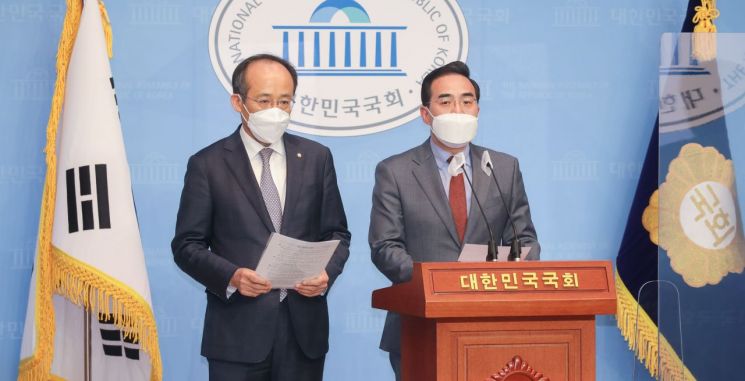
Park Hong-geun, the Democratic Party's Budget Committee secretary, explained at a press conference, "Considering the nation's difficult situation and the people's hardships, there was a shared recognition between the ruling and opposition parties to maximize budget cuts." Chu Kyung-ho, the People Power Party's secretary, added, "In the final stage, there was much deliberation on how much to cut, how much budget to allocate for overcoming the COVID crisis, and how to secure the funds. Given the severe livelihood situation and the urgent need for COVID crisis measures, we approached the final negotiations proactively."
Having agreed on the total budget amount, the ruling and opposition parties plan to make fine adjustments on the scale of increases and cuts by project and the amount of government bond issuance before the plenary session on the 2nd. Regarding whether the entire net increase of 2.2 trillion won will be covered by government bond issuance, Chu said, "The scale of government bond issuance will be determined after the final work is completed." On the Korean New Deal budget cuts, he added, "There will be some cuts, but the specifics will come out later."
Park explained the inclusion of the third disaster relief fund and COVID-19 vaccine budget in the main budget, saying, "If a separate supplementary budget had been prepared, it could have required issuing much more government bonds. There was also a proposal from the opposition party, and considering the efficiency of future execution, it seemed appropriate to include it in the main budget, so we reviewed it."
◆ Budget bill processed within the legal deadline for the first time in six years since 2014 = With the ruling and opposition parties reaching a dramatic agreement a day before the legal deadline, the budget bill is expected to be processed on time for the first time in six years. Except for 2014, the first year the National Assembly Advancement Act was introduced, the National Assembly has delayed budget bill processing for five consecutive years.
Park said, "Since 2014, the legal deadline set by the law has not been met, but this time, we expect an example where the National Assembly abides by the law made by the people. This is the result of the ruling and opposition parties uniting, considering the nation's difficulties and the people's hardships, fulfilling the public's expectation that the 21st National Assembly must change, at least for this year."
© The Asia Business Daily(www.asiae.co.kr). All rights reserved.

















