Jeonse and Sales Markets Stirring Up
Record Jeonse Prices for 84㎡ Outside Gangnam Area Continue
Seoul Apartment New Supply to Plummet Next Year
Common People Angry at Government Real Estate Measures
Government and Ruling Party's Repeated 'Gaffe' Also Under Fire
[Asia Economy Reporters Inho Yoo and Mune Won] Mr. A, who lived in a detached house in a redevelopment zone in Gwangmyeong-si, Gyeonggi-do, is pacing anxiously as the relocation of union members is in full swing, but he has yet to find a rental house. This is because not only nearby but also apartment rental prices in the Gaebong-dong area across the street in Seoul have skyrocketed, and available listings are hard to find. For example, the rent for an 84㎡ (exclusive area) unit in Gaebong-dong A Apartment, which has over 2,400 households, was around 400 million to 450 million KRW until August, but now it has soared to over 650 million KRW, with no listings available. Mr. A raised his voice, saying, "Is it reasonable for rent prices to increase by more than 200 million KRW in just a few months?" and "What has the government done in the past three years?"
The middle class is being pushed to the brink due to government real estate policies that are disconnected from the market. After the implementation of the 'Lease 2 Laws' such as the contract renewal request system and the rent ceiling system, rental prices have surged by hundreds of millions of KRW, and even the sales prices, which had briefly stabilized, are rising again, expanding market instability. The market is expressing not just frustration but anger toward the government's real estate policies.
Struggling with Rental Life under the Lease 3 Laws
The sudden enforcement of the Lease 2 Laws at the end of July poured fuel on the rising rental prices. Not only have prices increased significantly, but listings have also dried up, leaving tenants who could not benefit from the contract renewal request system in a desperate situation. Right after the implementation of the Lease 2 Laws in August, the rental price index in the metropolitan area recorded 100.4, surpassing the baseline set in November 2017.
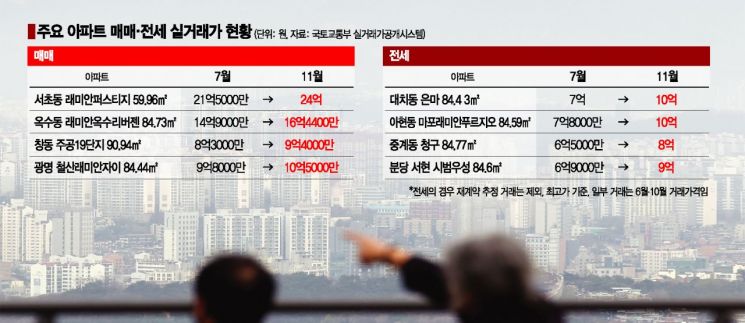
The rental crisis is spreading indiscriminately across regions. Even outside the Gangnam area, record-breaking rental transactions for 84㎡ units exceeding 1 billion KRW are steadily being renewed. For instance, 'Raemian Mapo Riverwell' in Yonggang-dong, Mapo-gu, which was built in 2015, saw an 84.97㎡ unit rented for 1.02 billion KRW in October, and in 'Mapo Raemian Prugio Complex 1,' an 84.6㎡ unit was rented for 1 billion KRW in the same month.
Although rental prices are soaring, owning a home is out of the question due to already high housing prices. For example, an 84.73㎡ unit in Raemian Oksu Riverzen, Oksu-dong, Seongdong-gu, Seoul, was sold for 1.644 billion KRW on the 3rd of last month, up 154 million KRW from the 1.49 billion KRW transaction in July. Mid- to low-priced units in the outskirts of Seoul and the metropolitan area are also showing clear upward trends. A 90.94㎡ unit in Jugong Complex 19, Chang-dong, Dobong-gu, was sold for 940 million KRW, setting a new record, and an 84.44㎡ unit in Cheolsan Raemian Xi, Cheolsan-dong, Gwangmyeong-si, was sold for 1.05 billion KRW on the 12th of last month, rising about 100 million KRW in the past three months.
The representative of A Real Estate Agency in Ahyeon-dong said, "Because there are almost no new rental listings, prices have no choice but to rise," adding, "Since the comprehensive real estate tax bills were issued, more landlords have been looking into monthly rent options."
The problem is that the shortage of supply is expected to worsen next year and the year after. According to Real Estate 114, the number of new apartment move-ins in Seoul next year is 25,520 households, about half of this year's 50,289 households. In 2022, it is feared that only 17,000 households will move in, the lowest in a decade. Professor Kwon Dae-jung of Myongji University said, "To stabilize the rental market, listings need to come out in the sales market so prices can naturally fall, but since it is tied up by regulations, there is no solution."
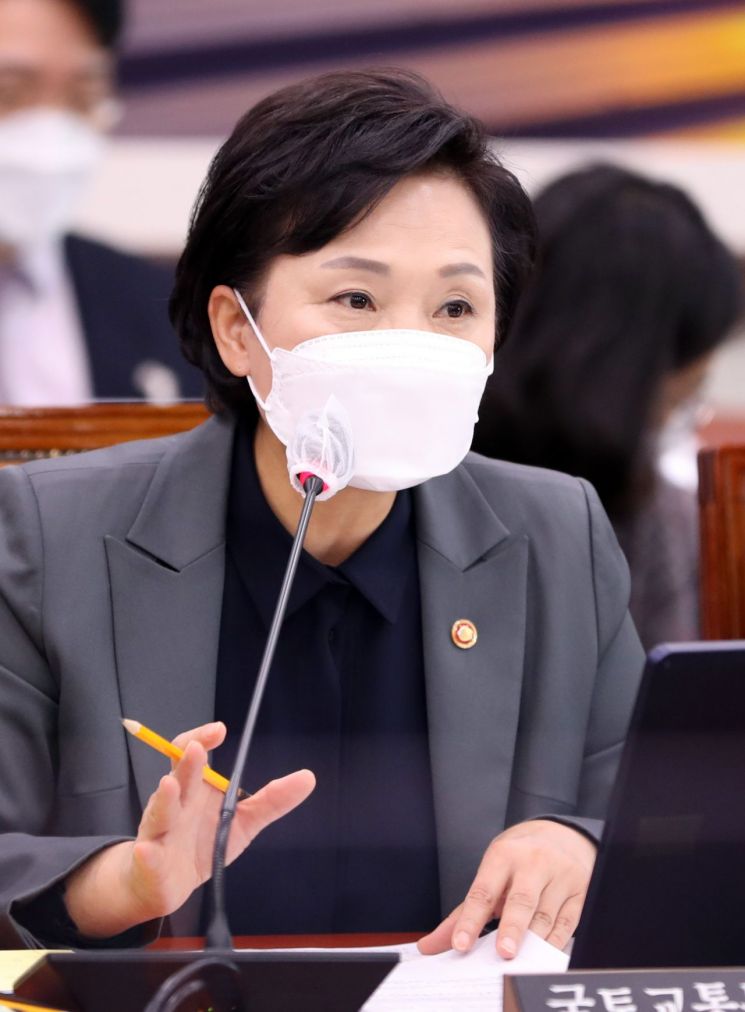 Minister of Land, Infrastructure and Transport Kim Hyun-mi is responding to questions from lawmakers at the Land, Infrastructure and Transport Committee plenary meeting held at the National Assembly in Yeouido, Seoul, on the morning of the 30th. (Photo by Yonhap News)
Citizens Angry at Real Estate Policies
Repeated failures in real estate policies are evident in the boiling public sentiment. Looking at the Blue House's public petition board, there have been about 120 real estate-related petitions over the past three months since August. Most of these petitions point out 'policy failures,' stating that "the patchwork measures announced to control housing prices and the related laws introduced for tenants have instead caused both sales and rental prices to rise."
Recently, as the scope of the comprehensive real estate tax has expanded not only to apartment owners in Gangnam, Seoul, but also to those in Gangbuk and single homeowners in the metropolitan area, complaints have surfaced on real estate communities and social networking services (SNS) such as "Arrest those who own houses," "Is owning one house a crime? It's a fine, not a tax," "Are retirees forced to sell their homes and move?" and "It's the same as paying monthly rent in my own home."
The government's and ruling party officials' successive 'real estate gaffes' are also cited as a cause of the heated public sentiment. When Minister of Land, Infrastructure and Transport Kim Hyun-mi said at the National Assembly Land, Infrastructure and Transport Committee's urgent inquiry on the 30th of last month, "If apartments were bread, I would stay up all night to make them," real estate communities responded with criticism such as "How is this different from Marie Antoinette telling people to eat cake if there is no bread?" "Why complain about supply now after not supplying for three years?" and "Let private companies handle the supply."
© The Asia Business Daily(www.asiae.co.kr). All rights reserved.


















